



Does Irlen Syndrome Contribute to Light Sensitivity (Photophobia)? 2025 Comparison Guide
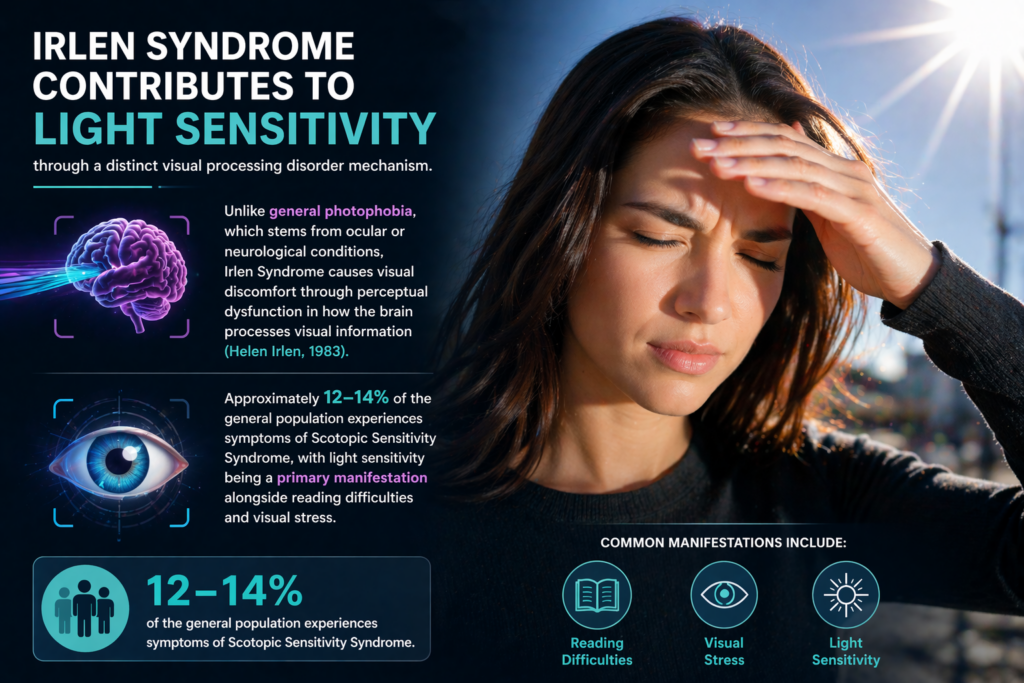
Irlen Syndrome contributes to light sensitivity through a distinct visual processing disorder mechanism. Unlike general photophobia, which stems from ocular or neurological conditions, Irlen Syndrome causes visual discomfort through perceptual dysfunction in how the brain processes visual information (Helen Irlen, 1983). Approximately 12-14% of the general population experiences symptoms of Scotopic Sensitivity Syndrome, with light sensitivity being a primary manifestation alongside reading difficulties and visual stress.
What Is Irlen Syndrome and How Does It Affect Visual Perception?
Irlen Syndrome image: Visual perception, light sensitivity, reading difficulties, colored overlays, solutions.
Irlen Syndrome, also known as Scotopic Sensitivity Syndrome, represents a visual processing disorder first identified by psychologist Helen Irlen in 1983. The condition affects how the visual cortex processes information from the retina, creating visual perception problems that extend beyond standard refractive errors measurable through optometry.
The magnocellular pathway, responsible for temporal processing and contrast sensitivity, shows dysfunction in individuals with Irlen Syndrome. This magnocellular deficit creates cortical hyperexcitability, meaning the brain’s visual processing centers become overwhelmed by certain wavelengths of light and visual patterns. Fluorescent lighting, LED lights, and bright environments trigger sensory overload because the visual system cannot adequately filter or process incoming visual stimuli.
Research indicates that individuals with Irlen Syndrome experience abnormal spectral sensitivity, particularly to short-wavelength blue light. Photoreceptors in the retina (rods and cones) transmit signals that the visual cortex struggles to organize, resulting in visual distortion, pattern glare, and glare sensitivity. These symptoms worsen under artificial lighting effects, especially fluorescent light headaches and computer screen sensitivity.
What Is General Photophobia and How Does It Differ?
Photophobia: Light sensitivity causing eye pain. General vs specific light triggers.
Photophobia describes brightness intolerance or light aversion resulting from various ocular, neurological, or systemic conditions. Unlike Irlen Syndrome, which involves perceptual processing disorder, standard photophobia typically stems from inflammation, anatomical abnormalities, or neurological hypersensitivity to luminance.
Common causes of ocular photophobia include corneal abrasions, uveitis, dry eye syndrome, and accommodation insufficiency. Neurological photophobia accompanies conditions like migraine, cluster headache light sensitivity, traumatic brain injury, and photosensitive epilepsy. According to neurology studies (American Academy of Neurology, 2020), approximately 80% of migraine sufferers report photophobia during attacks, representing a distinct mechanism from visual processing difficulties.
General light sensitivity disorder involves direct overstimulation of pain pathways through the trigeminal nerve or excessive pupillary response to luminance. The photophobia mechanism operates at the retinal or neural level rather than through perceptual dysfunction in cortical processing. This fundamental difference explains why traditional sunglasses or dimmed lighting may help general photophobia but often fail to address Irlen Syndrome visual stress.
Irlen Syndrome vs. Photophobia: Detailed Feature Comparison
| Feature | Irlen Syndrome Light Sensitivity | General Photophobia |
| Primary Mechanism | Visual processing disorder affecting magnocellular pathway and cortical processing | Ocular inflammation, neurological hypersensitivity, or trigeminal nerve activation |
| Light Type Triggers | Fluorescent lights, LED lights, blue light, pattern glare from screens and printed pages | All bright light sources equally (sunlight sensitivity, indoor lighting, outdoor brightness) |
| Associated Symptoms | Text blurring, word movement, depth perception problems, reading comprehension issues, slow reading speed | Eye pain, tearing, squinting, headaches without visual distortion or reading problems |
| Pattern Sensitivity | High sensitivity to stripes, grids, repetitive patterns causing pattern-induced seizures in severe cases | No specific pattern sensitivity; discomfort from overall luminance |
| Color Response | Symptoms improve with specific spectral filtering through colored overlays or tinted lenses | Neutral density filters (gray tints) or dimming sufficient; no color specificity required |
| Reading Impact | Significant reading difficulties, reduced reading fluency, letter reversal, visual scanning difficulties | Reading possible but uncomfortable; no perceptual distortion of text |
| Diagnostic Method | Irlen screening, assessment of visual stress with colored filters, reading rate improvement measurement | Ophthalmology examination, neurology evaluation, pupillometry, underlying condition diagnosis |
| Treatment Approach | Irlen Method with individually prescribed Irlen filters, chromatic intervention, environmental modifications | Treat underlying condition (anti-inflammatory medications, migraine prophylaxis), standard tinted glasses |
| Comorbid Conditions | Dyslexia (33%), ADHD, autism spectrum disorder, learning challenges, sensory processing disorder | Migraine, concussion, traumatic brain injury, uveitis, meningitis, medication side effects |
| Light Adaptation | Poor adaptation to lighting changes; light adaptation problems and dark adaptation issues | May show normal adaptation depending on underlying cause |
How Does Irlen Syndrome Cause Sensitivity to Bright Lights?
The mechanism of light sensitivity in Irlen Syndrome involves temporal contrast sensitivity deficits within the magnocellular pathway. Research published in Vision Research (Chase et al., 2003) demonstrated that individuals with scotopic vision difficulties show reduced contrast perception at specific temporal frequencies, particularly under photopic sensitivity conditions with bright ambient lighting.
Cortical hyperexcitability Irlen photophobia results from excessive neural firing in visual processing areas. When photoreceptors transmit signals about high-contrast patterns or specific light wavelengths (particularly short-wavelength blue light), the visual cortex cannot adequately inhibit or regulate these signals. This sensory integration disorder creates visual fatigue syndrome, asthenopia, and cognitive overload even with modest light exposure.
Chromatic aberration—the differential focusing of various light wavelengths by the eye’s optics—contributes significantly to Irlen Syndrome photophobia symptoms. Unlike individuals with typical vision who compensate neurologically, those with visual processing difficulties cannot suppress the aberrant signals created by chromatic dispersion. Colored filters for reading work by reducing specific wavelengths that trigger cortical hyperexcitability, thereby decreasing visual stress and improving spatial frequency sensitivity.
What Overlapping Symptoms Connect Irlen Syndrome and Photophobia?
Several shared characteristics create diagnostic challenges when differentiating Irlen Syndrome visual stress from general photoaversion. Light-induced headaches occur in both conditions, with approximately 60% of Irlen Syndrome patients reporting headache symptoms (Irlen Institute, 2019). These visual triggers migraine parallel the photophobia experienced during migraine attacks, though the underlying neurological basis differs.
Glare intolerance represents another convergence point. Individuals with either condition report glare from screens, discomfort from reflective surfaces, and preference for natural light over artificial lighting. However, Irlen Syndrome and computer screen sensitivity specifically involves temporal processing deficits that cause screen-related headaches through pattern glare, whereas standard photophobia responds primarily to luminance levels.
Environmental sensitivity affects both populations similarly. Workplace accommodations for Irlen light sensitivity often mirror photophobia relief strategies: reducing fluorescent light exposure, implementing classroom lighting adjustments, using screen filter applications for blue light blocking, and modifying workspace positioning relative to windows. The difference lies in effectiveness—Irlen Syndrome responds specifically to chromatic intervention while general photophobia requires overall luminance reduction.
Use-Case Scenarios: When to Suspect Irlen Syndrome vs. General Photophobia
Scenario 1: Student with Reading Problems and Light Sensitivity
A 12-year-old student exhibits slow reading speed, reading comprehension issues, and complaints about fluorescent light headaches in the classroom. Words appear to move on the page (word movement), and the student experiences academic difficulties despite normal visual acuity tested by optometry. This presentation suggests Irlen Syndrome because the visual perception issues combine with reading-specific symptoms. Standard photophobia would not cause perceptual distortion of text. Appropriate response: Irlen screening for light sensitivity followed by potential colored overlays for reading assessment.
Scenario 2: Post-Concussion Light Sensitivity
A 28-year-old athlete develops severe brightness intolerance following a sports-related concussion. All light sources cause discomfort equally, with no pattern sensitivity or reading-specific symptoms. The patient reports eye strain symptoms, vestibular symptoms including spatial disorientation, and motion sensitivity. This indicates traumatic brain injury-related photophobia rather than Irlen Syndrome. The neurological basis involves direct neural pathway disruption. Appropriate response: Neurology evaluation, vestibular rehabilitation, and general light sensitivity management with neutral tinted lenses.
Scenario 3: Adult with Migraine and Visual Triggers
A 35-year-old professional experiences migraine attacks preceded by aura symptoms and severe photophobia. Between attacks, the individual notices pattern glare from computer screens, difficulty reading under fluorescent lights, and improved comfort with specific blue light blocking filters. The temporal processing issues persist even without headache, suggesting overlapping Irlen Syndrome and migraine photophobia. Research indicates 30-40% of migraine sufferers show symptoms consistent with visual stress syndrome (Wilkins, 2016). Appropriate response: Comprehensive evaluation including Irlen Method assessment and neurology consultation for migraine management.
Scenario 4: Office Worker with Digital Eye Strain
A 42-year-old office worker reports computer vision syndrome symptoms including visual fatigue, accommodation insufficiency, and screen sensitivity worsening throughout the workday. Symptoms resolve with rest and worsen specifically with binocular vision tasks. Eye examination reveals convergence excess and fixation instability. This represents accommodative and binocular dysfunction rather than Irlen Syndrome or systemic photophobia. Appropriate response: Vision therapy, ergonomic workplace modifications, and optometric management of binocular coordination issues.
Diagnostic Approaches: Irlen Screening vs. Traditional Photophobia Assessment
Testing for Irlen Syndrome photophobia requires specialized Irlen screening protocols developed by the Irlen Institute. Certified Irlen Screeners evaluate reading rate improvement with colored overlays, assess pattern sensitivity using specially designed grids, and document visual discomfort reading under various lighting conditions. The assessment identifies optimal hue sensitivity for individual tinted glasses benefits, with colors ranging from blue-green to rose, purple, or amber depending on individual spectral sensitivity patterns.
Traditional photophobia diagnosis follows a medical model through ophthalmology and neurology channels. Comprehensive eye examinations rule out corneal disease, uveitis, and retinal pathology. Pupillometry measures pupil response to calibrated light stimuli, identifying abnormal light adaptation or excessive pupillary constriction. Neurological assessment investigates underlying conditions such as migraine, meningitis, or intracranial pathology through imaging and clinical evaluation.
The relationship between Irlen Syndrome and photophobia becomes clearest through differential diagnosis. Patients showing reading-specific symptoms, pattern glare sensitivity, improvement with chromatic intervention, and normal ophthalmologic examination likely have visual processing disorder. Those with equal discomfort across all lighting, absence of perceptual distortion, and underlying medical conditions have primary photophobia requiring medical rather than perceptual intervention.
Treatment Options: Irlen Filters vs. Photophobia Management Strategies
The Irlen Method provides evidence-based treatment for Irlen Syndrome causing headaches from lights and visual stress. Colored lenses for Irlen Syndrome photophobia use precise spectral filtering to reduce cortical hyperexcitability. According to research by Kruk et al. (2008), individualized Irlen filters produced statistically significant reading rate improvement (average 25% increase) and reduced visual fatigue in diagnosed individuals. The mechanism involves selective wavelength absorption that normalizes magnocellular pathway function.
Alternative treatments for Irlen light sensitivity include environmental modifications: replacing fluorescent lighting with incandescent or full-spectrum alternatives, implementing natural light preference in workspace design, using anti-glare screens, and adjusting contrast sensitivity on digital devices. Classroom modifications for Irlen photophobia may involve preferential seating away from windows, permission to wear tinted glasses during reading tasks, and provision of colored overlays for standardized testing.
Non-pharmacological treatment for general photophobia emphasizes trigger avoidance and symptomatic relief. Standard tinted glasses (typically gray or brown) reduce overall luminance without color-specific filtering. Photophobia relief strategies include wearing wide-brimmed hats outdoors, using dimmer switches for indoor lighting control, and implementing blue light blocking for circadian regulation and melatonin suppression prevention. Pharmacological approaches target underlying conditions: migraine prophylaxis, anti-inflammatory medications for uveitis, or artificial tears for dry eye-related photosensitivity.
Can Someone Have Both Irlen Syndrome and General Photophobia?
Comorbid Irlen Syndrome and photophobia occur frequently, particularly in populations with traumatic brain injury, autism spectrum disorder, or migraine. The conditions operate through distinct mechanisms but create additive visual discomfort. Individuals may require both chromatic intervention (Irlen filters addressing visual processing) and medical management (treating underlying neurological or ocular photophobia).
Research on seasonal light variations shows that individuals with Irlen Syndrome experience worsening symptoms during winter months when artificial lighting predominates and natural daylight decreases. This pattern differs from seasonal affective disorder but may involve overlapping mechanisms related to circadian disruption and melatonin regulation. Managing Irlen Syndrome in bright environments requires addressing both the perceptual processing component and potential medical photophobia triggers.
Decision Framework: Choosing the Right Evaluation and Treatment Path
Consider Irlen Syndrome evaluation if:
- Reading difficulties persist despite normal vision correction
- Text appears to blur, move, or shimmer on white backgrounds
- Fluorescent light sensitivity exceeds response to other light sources
- Pattern glare from screens or printed materials causes specific discomfort
- Symptoms improve when using colored paper, overlays, or specific tinted glasses
- Learning challenges or attention problems accompany light sensitivity
- Depth perception problems or spatial awareness issues present alongside photophobia
Consider traditional photophobia evaluation if:
- All bright light sources cause equal discomfort regardless of wavelength
- Eye pain, tearing, or squinting accompany light exposure
- Recent head injury, eye injury, or new medication preceded symptoms
- Headaches with photophobia follow migraine patterns with aura
- Visual discomfort occurs without reading-specific or pattern-related symptoms
- Symptoms appeared suddenly rather than being lifelong
- Standard neutral-tinted sunglasses provide adequate relief
Seek comprehensive evaluation for both if:
- Light sensitivity combines with reading problems and neurological symptoms
- Partial improvement occurs with either colored filters or standard photophobia treatment
- Traumatic brain injury or concussion history exists with pre-existing reading difficulties
- Migraine and visual processing disorder symptoms overlap significantly
Does Irlen Syndrome cause sensitivity to bright lights? Yes, through a visual processing mechanism distinct from but potentially overlapping with general photophobia. Understanding whether light sensitivity stems from perceptual dysfunction, medical pathology, or both determines optimal treatment. Scientific research on Irlen Syndrome photophobia continues evolving, with growing recognition that visual processing disorders represent a legitimate category of light sensitivity requiring specialized chromatic intervention rather than standard medical photophobia management.