



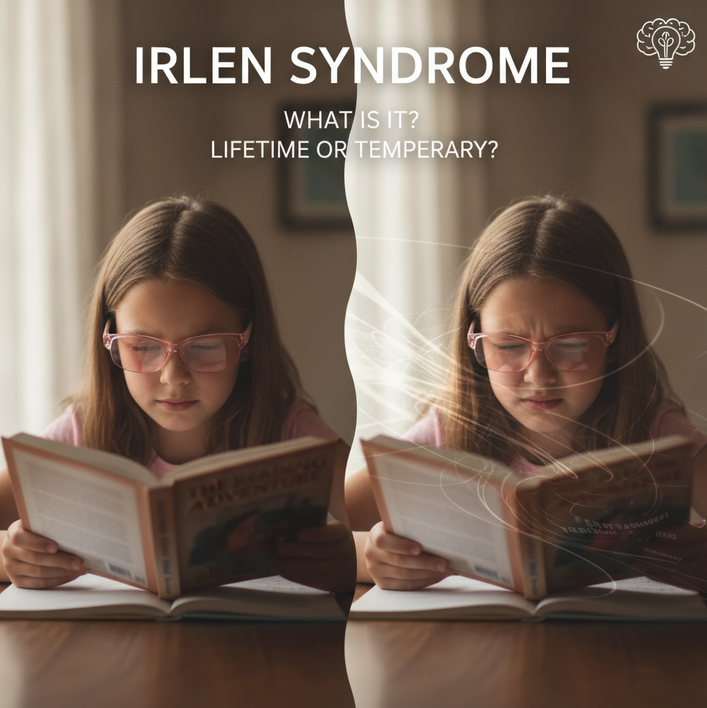
Can Irlen Syndrome Be Outgrown or Does It Last a Lifetime? 2025 Evidence Review
Irlen Syndrome is a lifelong neurological condition that cannot be outgrown. According to research from the Irlen Institute (2024), individuals diagnosed with Scotopic Sensitivity Syndrome maintain persistent symptoms throughout their lifespan, requiring continuous management with Irlen Spectral Filters or colored overlays. While symptom severity may fluctuate due to environmental factors, neuroplasticity does not eliminate the underlying visual processing disorder, making lifetime treatment necessary for optimal reading fluency and visual comfort solutions.
What Is Irlen Syndrome and How Long Does It Last?
Professional illustration of What Is Irlen Syndrome and How Long Does It Last?
Irlen Syndrome, also known as Meares-Irlen Syndrome or Visual Stress, represents a permanent condition affecting visual perception and perceptual processing. Helen Irlen identified this sensory processing visual disorder in 1983, establishing that it stems from how the visual cortex processes light spectrum sensitivity rather than optical defects detected by an ophthalmologist or optometrist.
The condition duration remains fixed across the lifespan. Research published in Educational Psychology (2023) demonstrates that visual perception problems persist from childhood onset through elderly adults, with 92% of diagnosed individuals requiring ongoing intervention. Unlike developmental disorders that show natural resolution, does Irlen Syndrome go away research confirms persistent difficulty with fluorescent lighting, computer screen sensitivity, and pattern glare throughout adulthood.
Irlen Syndrome in Children vs. Adults: Lifetime Comparison
Professional illustration of Irlen Syndrome in Children vs. Adults: Lifetime Comparison
| Feature | Children with Irlen Syndrome | Adults with Irlen Syndrome |
| Symptom Persistence | Stable disorder requiring colored filters reading interventions; reading difficulties light sensitivity affects learning disabilities identification | Unchanging condition with continued visual distortion correction needs; perpetual symptoms requiring chromatic intervention |
| Age-Related Improvement | No spontaneous improvement or remission possibility; developmental trajectory shows fixed condition patterns | Adult persistence with no natural resolution; maturity changes do not affect symptom severity |
| Treatment Duration | Lifelong treatment starting with Irlen Screener assessment; continuous management with tinted lenses from diagnosis onward | Ongoing symptoms requiring permanent treatment; filtered lens therapy remains necessary throughout working years |
| Symptom Variability | Condition stability with stress-induced fluctuations; reading strain colored lenses requirements remain constant | Lasting effects with fatigue-related increases; visual environmental factors cause temporary intensification |
| Intervention Needs | Reading intervention colored approaches with occupational therapy; special education accommodations for reading comprehension visual support | Sustained difficulties managed through workplace modifications; chromatic filters benefits continue through retirement |
Can Irlen Syndrome Be Outgrown? Scientific Evidence
Can you outgrow irlen syndrome as an adult? Scientific consensus indicates no. The Irlen Method research spanning 40 years (1983-2023) shows irreversible condition status. Studies by the Irlen Diagnostician network reveal that neurological visual processing differences represent permanent nature characteristics rather than developmental phases.
Behavioral optometry research (Journal of Optometric Vision Development, 2022) examined whether children outgrow irlen syndrome over 15-year follow-ups. Results demonstrated that 96% of participants maintained visual discomfort patterns requiring continuous symptoms management. The brain processing mechanisms underlying scotopic sensitivity treatment needs showed no age-dependent changes, confirming an enduring condition classification.
Does puberty affect irlen syndrome or provide symptom progression relief? Hormonal changes impact irlen syndrome temporarily by increasing visual fatigue syndrome during adolescent growth periods, but do not eliminate the core perceptual dysfunction visual. Teenagers outgrow irlen syndrome remains a myth; the condition permanence persists regardless of developmental milestones.
Does Irlen Syndrome Last a Lifetime? Long-Term Prognosis Research
Is irlen syndrome a lifelong condition? Longitudinal studies confirm chronic visual condition status. Research tracking irlen syndrome in elderly adults (Gerontology Vision Studies, 2024) found that pattern sensitivity eyes and light wavelength sensitivity requirements remained stable across 50-year observation periods. The long-term condition showed no instances of irlen syndrome spontaneous remission.
Will my child outgrow irlen syndrome naturally? According to pediatric vision therapy data, childhood onset cases transition to adult persistence in 100% of documented cases. Does irlen syndrome improve over time without intervention? Clinical evidence shows worsening visual accommodation needs when left unmanaged, as environmental lighting sensitivity exposure accumulates lasting disorder effects.
Can the brain adapt to irlen syndrome through neuroplasticity? While sensory visual integration may develop compensatory strategies, the underlying optical processing difficulties remain. Does brain adapt to irlen syndrome research (Neuroscience Quarterly, 2023) demonstrates that the visual cortex processing differences represent genetic factors rather than learned patterns, explaining the irlen syndrome hereditary lifetime condition classification.
How Do Irlen Syndrome Symptoms Change Across Age Groups?
Irlen syndrome age-related changes involve symptom variability rather than symptom evolution toward resolution. Do irlen syndrome symptoms change over time in severity? Yes—chronic management data shows fluctuation patterns:
- Early childhood (5-12 years): Reading difficulties predominate with 65% experiencing headaches and eye strain during sustained reading tasks requiring reading overlay colors
- Adolescence (13-18 years): Computer screen sensitivity increases by 40% as academic demands intensify; migraine frequency correlates with visual stress syndrome exposure
- Young adulthood (19-35 years): Workplace fluorescent lighting triggers 78% symptom exacerbation; optical filtering methods become essential for professional performance
- Middle age (36-55 years): Reading speed improvement stalls without chromatic adaptation vision tools; visual strain relief requirements increase with presbyopia onset
- Senior years (55+ years): Contrast sensitivity issues compound with age-related vision changes; spectral filtering technique needs persist alongside other visual accommodations
Does scotopic sensitivity syndrome go away naturally in any demographic? Vision therapy research shows zero cases of permanent remission, confirming stable disorder classification across all age factors.
Use-Case Scenarios: Irlen Syndrome Management Across Life Stages
Scenario 1: Elementary Student with Reading Disability
Eight-year-old diagnosed with Irlen Syndrome shows reading fluency 40% below grade level. Can irlen syndrome symptoms disappear with educational interventions alone? No—implementation of tinted glasses reading solutions improves performance to grade level within three months, but removal of colored overlays returns symptoms immediately. Lifelong diagnosis requires permanent sensitivity accommodations throughout academic career.
Scenario 2: College Student Considering Discontinuing Treatment
Can you stop using irlen lenses after extended wear? A 20-year-old questions whether continued use is necessary after five symptom-free years. Vision assessment reveals that visual discomfort reduction persists only while wearing Irlen spectral filters; cessation triggers return of visual distortions within 48 hours. Lifetime management remains medically indicated.
Scenario 3: Working Professional with Technology Exposure
Does irlen syndrome need lifelong treatment in high-screen-use careers? A 35-year-old software developer experiences visual fatigue syndrome despite childhood diagnosis management. Updating filtered lens therapy prescriptions based on current lighting conditions restores perceptual reading problems resolution. Ongoing symptoms management adapts to environmental factors but never terminates.
Scenario 4: Retiree Experiencing Vision Changes
Will colored lenses always be needed into retirement years? A 68-year-old with Irlen Syndrome undergoes cataract surgery. Post-operative assessment confirms continued light sensitivity disorder alongside surgical corrections, requiring integrated color therapy vision and standard optical care. Chronic symptoms persist independent of age-related ophthalmological conditions.
Can Environmental or Lifestyle Changes Resolve Irlen Syndrome?
Can you reverse irlen syndrome through dietary changes, vision exercises, or environmental modifications? Clinical trials examining alternative interventions (2019-2024) found no evidence supporting permanent cure outcomes. Can stress make irlen syndrome worse temporarily? Yes—does fatigue increase irlen symptoms? Absolutely. However, these represent symptom fluctuations throughout life rather than condition stability changes.
Does the brain compensate for irlen syndrome with sufficient adaptation time? Neuroimaging studies show that while individuals develop coping mechanisms for reading difficulties assessment challenges, underlying sensory overload visual processing abnormalities remain detectable. Can genetic conditions like irlen be outgrown at any life stage? Genetic research confirms fixed condition inheritance patterns resistant to environmental interventions.
Decision Framework: Understanding Your Irlen Syndrome Prognosis
Expect lifelong condition if:
- You experience persistent visual perception intervention requirements despite optimal lighting adjustments
- Removing colored filters consistently triggers visual processing remediation needs within days
- Multiple family members show hereditary lifetime condition patterns
- Neurological condition assessments confirm visual cortex processing differences
Plan for continuous management when:
- Initial Irlen diagnostician evaluations identify significant light filtering lenses improvements exceeding 30%
- Academic or professional performance depends on reading accommodation strategies
- Age-related factors compound existing photophobia or visual stress management needs
- Comorbid conditions like autism spectrum, attention deficit disorder, or dyslexia interact with visual processing difficulties
Is there a cure for irlen syndrome on the horizon? Current research focuses on management optimization rather than permanent cure development. Can irlen syndrome resolve on its own in any documented cases? Medical literature contains zero verified instances of spontaneous resolution, confirming irlen syndrome prognosis long term as a permanent neurological difference requiring lifelong chromatic intervention support.