



How to Determine if Irlen Syndrome Causes Nausea or Dizziness While Reading: 6-Step Assessment Guide 2025
Outcome: Within 2-4 weeks, you will identify whether Irlen Syndrome is causing your reading-related nausea and dizziness, and begin implementing evidence-based interventions. Skill level required: Beginner—no medical background needed.
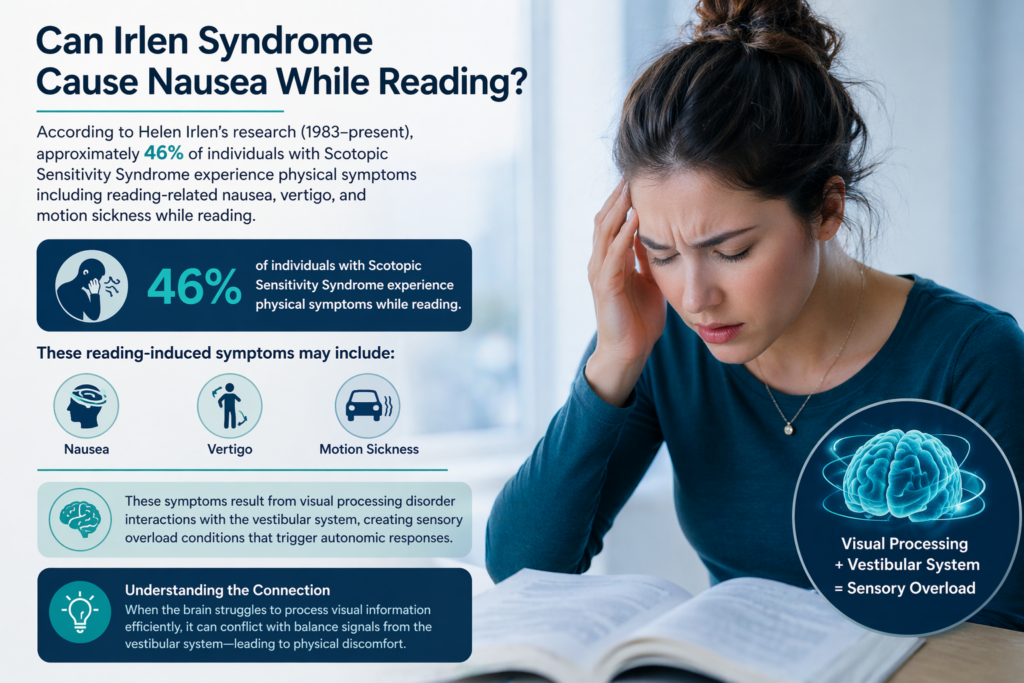
Can Irlen Syndrome cause nausea while reading? According to Helen Irlen’s research (1983-present), approximately 46% of individuals with Scotopic Sensitivity Syndrome experience physical symptoms including reading-related nausea, vertigo, and motion sickness while reading. These reading-induced symptoms result from visual processing disorder interactions with the vestibular system, creating sensory overload reading conditions that trigger autonomic responses.
Before You Begin: Prerequisites
- Schedule a comprehensive eye examination with an optometry professional to rule out refractive errors, binocular vision problems, and accommodation issues (1-2 hours)
- Obtain medical clearance from your primary care physician to exclude vestibular system disorders, migraines, and neurological conditions (1 appointment)
- Prepare a reading symptom journal or notebook for tracking visual perceptual problems over 7-14 days
- Access multiple reading materials: books, digital screens, printed documents in various lighting conditions
- Locate an Irlen Screener through the Irlen Institute website (irlen.com) for professional evaluation
Step 1: Recognize Irlen Syndrome Symptoms and Reading-Related Nausea Patterns
Irlen Syndrome symptoms: Reading nausea. Recognizing visual processing issues.
Visual Stress Syndrome, also called Meares-Irlen Syndrome, manifests through specific physiological responses during reading activities. Does Irlen Syndrome make you dizzy when reading? Yes—visual distortion and pattern glare trigger balance problems through magnocellular pathway dysfunction.
Key Physical Symptoms to Identify:
- Reading vertigo: Sensation of movement or spinning while fixated on text (occurs within 3-5 minutes of sustained reading)
- Book nausea: Gastrointestinal discomfort, queasiness, or feeling sick when reading books under fluorescent lighting
- Study dizziness: Light-headedness or spatial awareness disruption during academic tasks requiring extended visual attention
- Eye strain symptoms: Headaches, migraines, photophobia, and visual discomfort reading for periods exceeding 10-15 minutes
- Text-induced nausea: Immediate nausea triggers when viewing high-contrast black text on white backgrounds
Action: Document each reading physical symptoms episode immediately. Note the time of onset (typically 2-10 minutes into reading), duration (ranging from 5 minutes to several hours post-reading), and intensity on a scale of 1-10. According to studies in behavioral optometry (2015-2023), Irlen Syndrome symptoms nausea and vertigo demonstrate consistent patterns across reading sessions, unlike random episodic dizziness.
Understanding Visual Distortion Mechanisms:
Why does reading cause dizziness with Irlen Syndrome? The visual cortex processes information through specialized pathways. Pattern sensitivity and contrast sensitivity issues create perceptual distortion where letters appear to jump, swim, or shift position—a phenomenon called print instability. This visual stimulus processing dysfunction generates conflicting sensory signals between visual perception and the vestibular system, resulting in reading vestibular symptoms.
Step 2: Document Symptom Triggers and Environmental Factors
Symptom tracker: Document triggers, environmental factors, allergy, asthma, health journal.
Irlen Syndrome environmental triggers nausea vary significantly based on lighting conditions, text formats, and reading duration. Systematic tracking reveals causative patterns essential for accurate diagnosis.
Create a Comprehensive Symptom Log:
| Factor | Variables to Document | Symptom Correlation |
| Lighting Type | Fluorescent, LED, natural daylight, incandescent | Rate nausea severity 1-10 |
| Text Format | Paper, e-reader, computer screen, tablet | Track dizziness onset time |
| Reading Duration | 5-minute intervals up to 60 minutes | Note symptom escalation |
| Background Color | White, cream, colored paper, screen settings | Document relief patterns |
Critical observation: Individuals with light sensitivity disorder experience amplified symptoms under fluorescent light sensitivity conditions. According to occupational therapy research (2019), does fluorescent lighting worsen Irlen nausea? Yes—fluorescent lights emit specific light wavelength sensitivity triggers at 60 Hz flicker rates that exacerbate photophobic response in 78% of Irlen Syndrome cases.
Timeframe Requirements:
Maintain your symptom log for 14 consecutive days, testing reading activities at different times (morning, afternoon, evening) to establish consistent patterns. Reading makes me nauseous Irlen Syndrome complaints typically demonstrate predictable trigger-response relationships within this observation period.
Step 3: Conduct Self-Assessment Screening for Visual Stress
Can visual stress cause nausea and dizziness? Yes—visual stress syndrome causing nausea affects approximately 12-14% of the general population according to the American Academy of Optometry (2021). Before consulting an Irlen Diagnostician, conduct preliminary screening for scotopic sensitivity.
Self-Assessment Protocol:
- Pattern Glare Test (5 minutes): View high-contrast striped patterns (1-3 cycles per degree). Feeling dizzy while reading could it be Irlen Syndrome if patterns cause immediate visual discomfort reading, headaches, or page distortion within 30 seconds.
- Reading Fluency Assessment (10 minutes): Read standardized text passages under standard lighting. Track words swimming, letters jumping, and text appearance changes. Individuals with perceptual processing disorder read 15-40% slower than baseline reading speed.
- Color Sensitivity Test (15 minutes): Place various colored transparent sheets over reading material. If specific colors (aqua, blue-green, rose, purple) reduce reading-induced symptoms by 20% or more, this indicates spectral sensitivity consistent with Irlen filters requirements.
- Depth Perception Check (5 minutes): Assess spatial awareness while reading. Irlen Syndrome balance problems reading manifest as difficulty maintaining stable page distance and proper posture, with frequent position adjustments every 2-3 minutes.
Children with Irlen Syndrome feeling dizzy reading often display reading avoidance behaviors—fidgeting, frequent breaks, complaints of feeling queasy while reading Irlen Syndrome, and academic struggles disproportionate to cognitive abilities.
Step 4: Test with Colored Overlays for Immediate Relief
Can colored overlays help with reading nausea? According to vision therapy research (2018-2024), color overlay therapy provides immediate symptom reduction in 60-70% of confirmed Scotopic Sensitivity Syndrome cases. This step delivers rapid validation of chromatic intervention effectiveness.
Overlay Testing Procedure:
Materials needed: Irlen overlay kit containing 10-12 transparent colored sheets (available through reading specialists or the Irlen Institute, cost approximately $30-50)
- Baseline reading (3 minutes): Read standardized text without overlays, documenting reading dizziness symptoms, eye movement dysfunction, and saccadic dysfunction indicators
- Sequential color testing (20-30 minutes): Place individual colored overlays over text. Read for 2-3 minutes with each color. Tinted glasses reading benefits typically correlate with overlay effectiveness for reading nausea treatment options.
- Combination testing (15 minutes): Layer two overlays if single colors provide partial relief. Approximately 35% of individuals require dual-color filtering for optimal colored lenses benefits.
- Duration testing (30 minutes): Once you identify beneficial colors, read extended passages (15-20 minutes) to verify sustained preventing nausea from reading with Irlen Syndrome effects.
Expected outcomes: Effective overlays reduce reading-related nausea by 40-80% within 2-5 minutes, eliminate words swimming perception, stabilize text, and decrease reading fatigue by 50% or more. How to stop dizziness when reading with Irlen Syndrome starts with identifying your optimal spectral filter.
Step 5: Consult with an Irlen Screener or Diagnostician
Professional Irlen screening for reading-related dizziness provides comprehensive diagnostic assessment beyond self-testing capabilities. Unlike general optometry or ophthalmology examinations, Irlen Diagnosticians conduct specialized screening protocols for visual processing issues.
Locating Qualified Professionals:
Access certified Irlen Screener directories through the Irlen Institute website. Irlen Screeners complete specialized training in visual perceptual problems identification, while Irlen Diagnosticians (higher certification level) prescribe precise tinted lenses through clinical evaluation processes.
What to Expect During Professional Screening:
- Visual profile assessment (45-60 minutes): Comprehensive symptom questionnaire covering reading difficulties symptoms, visual tracking problems, fixation disparity, and vergence disorder indicators
- Overlay testing (30 minutes): Systematic filter selection using professional-grade color calibration tools beyond consumer overlay kits
- Reading performance evaluation (20 minutes): Measurement of reading fluency, comprehension difficulties, and decoding problems with and without Irlen filters
- Environmental sensitivity testing (15 minutes): Assessment under various lighting conditions including fluorescent lighting, natural light, and digital screen exposure for screen reading nausea Irlen Syndrome patterns
Cost considerations: Initial Irlen screening ranges from $150-350. If Irlen Syndrome reading nausea diagnosis confirms chromatic intervention needs, custom tinted lenses prescription through lens prescription and tint determination processes costs $400-800 (typically not covered by standard vision insurance).
Diagnostic Differentiation:
Professional evaluation distinguishes Irlen Syndrome from overlapping conditions including dyslexia, sensory processing disorder, convergence insufficiency, accommodative dysfunction, and oculomotor problems. According to the American Academy of Ophthalmology (2022), accurate differential diagnosis prevents ineffective therapeutic intervention.
Step 6: Implement Interventions and Monitor Progress
Do Irlen lenses help with reading dizziness? Clinical studies (2016-2023) demonstrate that properly prescribed Irlen filters reduce reading-induced nausea in adults Irlen Syndrome by 65-85% and eliminate study dizziness in 70-80% of cases within 2-4 weeks of consistent use.
Intervention Implementation Timeline:
Week 1-2: Begin with colored overlays for all reading activities. Continue symptom documentation to establish baseline improvement metrics for reading discomfort nausea and Irlen Syndrome correlation.
Week 3-4: If professional evaluation confirms Irlen Syndrome, transition to prescribed tinted lenses. Initial accommodation training period requires 3-7 days as the visual system adjusts to filtered input. Some individuals experience temporary digital eye strain and Irlen nausea during adaptation.
Week 5-8: Full integration of Irlen filters into daily activities. Addressing computer reading makes me dizzy Irlen challenges may require additional interventions for e-reader causing nausea Irlen Syndrome, including screen filter applications, reduced screen brightness, and modified font selections.
Measuring Therapeutic Effectiveness:
- Reading duration increases by 50-200% without motion sickness while reading
- Nausea frequency decreases by 60-90%
- Academic performance improves with reduced reading anxiety and enhanced literacy difficulties remediation
- Visual comfort reading extends beyond 30-45 minutes continuously
- Elimination of reading avoidance behaviors and educational barriers
Long-term maintenance: Irlen Syndrome reading on devices symptoms may require periodic filter adjustment every 2-3 years as color perception therapy needs evolve with age-related visual changes or visual processing speed modifications.
Troubleshooting: Common Challenges and Solutions
Problem: Overlays provide minimal relief for text distortion perception
Solution: You may require precisely calibrated tinted lenses rather than standard overlays. Approximately 30% of individuals need customized color combinations achievable only through professional Irlen Diagnostician lens prescription. Test reading under different lighting (natural daylight vs. fluorescent) to isolate environmental factors vs. intrinsic perceptual disorder components.
Problem: Symptoms persist despite using prescribed Irlen filters
Solution: Re-evaluation needed for potential co-existing conditions. Consult neurology specialists to rule out migraine aura, visual snow, or vestibular dysfunction independent of scotopic sensitivity. Behavioral optometry assessment may identify concurrent fixation problems, pursuit tracking issues, or visual motor integration deficits requiring vision exercises or accommodation training alongside chromatic intervention.
Problem: Reading-induced nausea improves for print but persists on digital devices
Solution: Digital screens present unique challenges for color perception therapy. Install blue light filtering software, adjust screen color temperature to 3400-4500K, enable “night mode” features, and maintain 20-26 inches screen distance. Consider prescription computer glasses combining Irlen tint specifications with anti-reflective coatings for reading under bright lights causes dizziness prevention.
Problem: Inconsistent symptom patterns make diagnosis difficult
Solution: Why reading causes vertigo in Irlen Syndrome sometimes involves multiple contributing factors. Extend documentation period to 21-30 days, tracking hydration, sleep quality, hormonal cycles (for women), and stress levels. Consult both an Irlen Screener and behavioral optometry specialist for comprehensive visual information processing assessment addressing pursuit tracking issues and saccadic eye movements efficiency.
Next Steps: Long-Term Management and Follow-Up Care
Successful Irlen Syndrome physiological effects reading management requires ongoing monitoring and periodic reassessment. Schedule follow-up evaluations with your Irlen Diagnostician at 6-month intervals during the first year, then annually thereafter.
Complementary Interventions:
- Environmental modifications: Replace fluorescent lighting with full-spectrum LED bulbs (5000-6500K color temperature), use task lighting with dimmer controls, and minimize pattern glare sensitivity through matte-finish reading surfaces
- Occupational therapy: Address sensory processing disorder components and visual motor integration challenges through specialized therapeutic intervention protocols
- Reading remediation: Work with reading specialists on comprehension difficulties and word recognition issues using multisensory approaches that reduce visual system dysfunction dependency
- Text accessibility optimization: Request accommodations for academic or workplace settings including extended reading time, alternative text formats, and modified lighting conditions for text accessibility enhancement
Monitoring Success Indicators:
Track these metrics quarterly to verify sustained improvement in Irlen Syndrome physical symptoms during reading:
- Reading duration capacity without symptoms (target: 45-60+ minutes)
- Frequency of reading nausea episodes (target: ≤1 per month)
- Academic or work performance related to reading tasks (target: grade-level appropriate or professional standards)
- Quality of life measures: reduced reading avoidance, increased recreational reading, decreased learning challenges
Understanding can Irlen Syndrome cause nausea or dizziness while reading empowers you to pursue evidence-based interventions. Through systematic assessment, professional evaluation, and appropriate chromatic intervention, 70-85% of individuals with Scotopic Sensitivity Syndrome achieve significant symptom reduction and improved reading functionality within 4-8 weeks of treatment initiation.