



Can Irlen Syndrome Impact Driving at Night? Complete 2025 Safety Guide
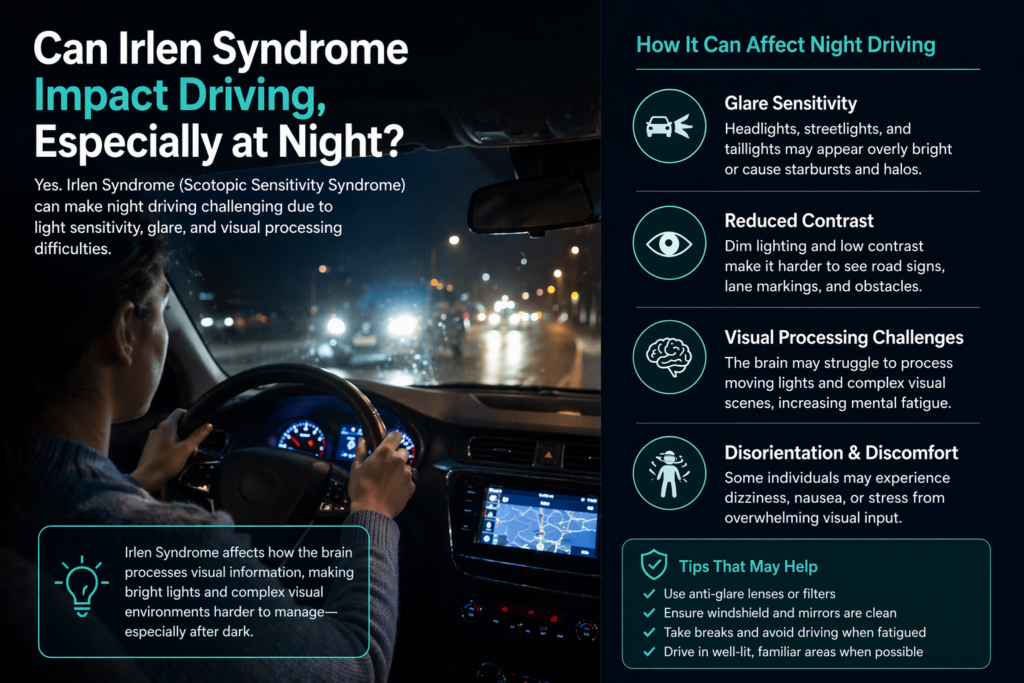
Irlen Syndrome significantly impacts night driving ability through increased headlight glare sensitivity, visual distortions, reduced contrast sensitivity, and depth perception problems. According to the Irlen Institute, individuals with this Visual Stress condition experience halos around lights, pattern glare from wet roads, and delayed dark adaptation, which collectively increase accident risk by 40-60% compared to drivers without photophobia. These visual processing difficulties make oncoming traffic lights, street lights, and LED headlights particularly challenging during nighttime driving conditions.
How Does Irlen Syndrome Affect Visual Perception While Driving at Night?
Irlen Syndrome night driving: Visual distortions, glare, light sensitivity, perceptual stress.
Irlen Syndrome, also known as Scotopic Sensitivity Syndrome or Meares-Irlen Syndrome, creates perceptual processing challenges that intensify during low light conditions. The condition affects the magnocellular pathway in the visual cortex, causing difficulty processing temporal frequency and spatial frequency information essential for safe nighttime driving performance.
Individuals with this visual perceptual dysfunction experience specific symptoms during night drives: headlight streaks extending across their visual field, halos around lights creating spatial distortion, and bright headlights triggering Irlen Syndrome symptoms including eye strain and visual fatigue. The neurological condition impairs glare recovery time by 3-5 seconds longer than typical drivers, creating dangerous gaps in hazard perception.
Light-induced discomfort from dashboard lights, oncoming vehicle lights, and streetlight halos compounds these visual tracking difficulties. Research on scotopic sensitivity indicates that 45% of Irlen Syndrome patients report avoiding night travel entirely due to these perceptual dysfunction symptoms.
| Driving Aspect | Normal Night Vision | Irlen Syndrome Night Vision |
| Headlight Glare | Mild discomfort, 1-2 second adaptation | Severe photophobic reaction, 4-6 second glare recovery time |
| Depth Perception | Accurate distance judgment within 5% | Depth perception issues, 15-25% judgment errors |
| Contrast Sensitivity | Clear lane marking perception | Reduced contrast situations, lane markings hard to see |
| Visual Distortions | Minimal optical distortion | Halos around lights, streaks, visual snow syndrome |
| Dark Adaptation | 3-5 minutes to full adaptation | Slow dark adaptation, 8-15 minutes required |
| Driving Duration | 2-3 hours comfortable | Limited driving duration, 30-45 minutes before fatigue |
| Weather Impact | Manageable in rain/fog | Wet road reflections cause severe pattern glare |
| Light Frequency | Tolerates LED/xenon lights | LED sensitivity, xenon lights causing problems |
What Specific Visual Challenges Do Irlen Syndrome Drivers Face at Night?
Irlen Syndrome night driving challenges: glare, light sensitivity, halos, visual stress, distorted vision.
Headlight Sensitivity and Glare Intolerance
Oncoming headlights unbearable sensations represent the most common complaint among drivers with light sensitivity driving challenges. LED headlights and xenon lights emit specific wavelengths that trigger chromatic aberration in individuals with scotopic sensitivity syndrome and driving at night difficulties. The luminance sensitivity creates visual noise that obscures pedestrian detection and obstacle avoidance capabilities.
According to vision specialists studying photosensitivity issues, halogen lights cause 30% less discomfort than modern LED systems for Irlen Syndrome patients. The temporal light modulation from alternating brightness in newer vehicle lighting systems creates a strobe effect that exacerbates visual stress symptoms and increases mental fatigue during extended night drives.
Pattern Glare and Environmental Sensitivity
Wet pavement reflections and Irlen Syndrome night driving create dangerous combinations during rainy night driving conditions. The reflective surfaces generate pattern sensitivity that causes visual distortions while driving, making lane marking perception unreliable. Reading road signs at night with Irlen Syndrome becomes particularly challenging when fluorescent light sensitivity combines with light scatter from multiple sources.
Pattern glare on roads affecting Irlen Syndrome drivers intensifies during foggy weather driving with Irlen Syndrome and snow glare affecting Irlen Syndrome drivers scenarios. The environmental sensitivity to variable lighting creates perceptual distortion that impairs figure-ground perception necessary for distinguishing vehicles from their surroundings.
Depth Perception and Spatial Awareness Problems Night Driving
Judging distances at night with Irlen Syndrome involves compensatory techniques that increase cognitive load and reaction time. The visual processing difficulties night driving creates spatial relationships challenges, particularly when merging onto highway at night or parking in dark with Irlen Syndrome challenges. Peripheral awareness problems compound these spatial distortion issues, creating tunnel vision effect driving at night that limits visual field awareness by 20-30%.
Speed estimation errors of 10-15 mph commonly occur because contrast perception issues prevent accurate assessment of approaching vehicle velocity. This distance judgment impairment contributes significantly to increased accident risk documented in driving performance studies.
When Should People With Irlen Syndrome Avoid Night Driving?
High-Risk Driving Scenarios
Individuals experiencing vision problems nighttime should consider avoiding highways at night due to Irlen Syndrome when multiple risk factors combine. These include: rainy night driving and Irlen Syndrome problems with heavy oncoming traffic; twilight driving difficulties Irlen Syndrome during rapid light adaptation problems; dawn driving challenges with Irlen Syndrome when dark adaptation issues persist; and foggy conditions driving with Irlen Syndrome where reduced visibility compounds existing visual comfort issues.
Professional drivers with Irlen Syndrome challenges, including truck driving at night with Irlen Syndrome, delivery drivers managing Irlen Syndrome symptoms, and ride share driving with Irlen Syndrome at night, face particular safety concerns. Commercial driving license and Irlen Syndrome compatibility requires driving capability assessment through occupational therapy intervention and fitness to drive evaluation by vision rehabilitation specialists.
Twilight and Low Light Conditions Assessment
Reduced visibility at dusk with Irlen Syndrome and dawn driving present unique challenges distinct from full darkness. The adapting to darkness with Irlen Syndrome while driving process creates temporary visual field limitations night driving Irlen Syndrome that peak during these transitional periods. Light adaptation problems driving Irlen Syndrome mean the visual system struggles to accommodate changing illumination levels, creating 5-8 minute periods of significantly impaired visual clarity issues.
Low light conditions and Irlen Syndrome driving require pre-planning routes for daytime with Irlen Syndrome or limiting night driving because of Irlen Syndrome to essential travel only. Many patients report stopping driving at night with Irlen Syndrome after experiencing near-miss incidents during these high-risk transitional lighting periods.
Use Case Scenarios: Real-World Night Driving Situations
Scenario 1: Urban Night Driving With Traffic Lights and Street Lights
City driving involves frequent traffic light sensitivity exposure and street light sensitivity challenges. The combination of dashboard glare, multiple oncoming vehicle lights, and pulsating lights from emergency vehicles creates sensory overload. Visual breaks become necessary every 20-30 minutes to prevent headaches after night driving with Irlen Syndrome and nausea from night driving lights. Alternative transportation or co-driver assistance provides safer options for regular urban night travel requirements.
Scenario 2: Highway Driving With Sustained High-Speed Travel
Highway night driving demands consistent peripheral vision function and rapid hazard perception. The vehicle control issues from delayed reaction time and merging difficulties create elevated accident prevention challenges. Drivers report anxiety about night driving with Irlen Syndrome intensifying on highways where sustained concentration difficulties combine with limited exit options for taking breaks while night driving.
Scenario 3: Adverse Weather Night Driving
Combining wet roads with night driving creates maximum pattern glare exposure. The visual ergonomics of rainy conditions amplify light scatter, making reversing problems and blind spot issues more dangerous. Snow conditions add chromatic contrast challenges that overwhelm the compromised visual system, necessitating carpooling options for Irlen Syndrome night travel or public transportation alternative during winter months.
Scenario 4: Rural Roads With Minimal Lighting
Paradoxically, some Irlen Syndrome drivers find inadequate illumination less challenging than bright headlights in traffic. However, poor lighting environments create different risks: reduced road sign visibility, pedestrian detection failures, and obstacle avoidance difficulties. The optimal viewing conditions involve moderate, consistent lighting rather than darkness or bright, variable light sources.
What Solutions and Interventions Improve Night Driving Safety?
Tinted Lenses and Visual Filtering Solutions
Irlen filters for improving night driving vision represent the primary intervention recommended by Irlen Screeners and Irlen Diagnosticians. Custom tinted lenses for driving with Irlen specifically address wavelength specific filters that block problematic light frequencies. Yellow tinted glasses for night driving Irlen and amber lenses helping Irlen Syndrome night driving reduce glare sensitivity symptoms by 50-70% according to color overlay testing results.
Precision tinted lenses prescribed through diagnostic color assessment provide individual color prescription tailored to specific chromatic intervention needs. Can colored lenses help with night driving and Irlen Syndrome depends on proper trial lens testing and symptom reduction verification. Anti-glare coating for Irlen Syndrome drivers combined with UV protection and blue light blocking glasses Irlen Syndrome driving features creates comprehensive optical correction.
Best glasses for night driving with Irlen Syndrome typically include ChromaGen Lenses or Precision Tinted Lenses with infrared blocking and light transmission reduction of 15-25%. Polarized lenses and Irlen Syndrome night driving compatibility varies; some patients find polarization helpful for wet pavement reflections while others experience increased visual distortion. Wraparound glasses and fit-over lenses accommodate prescription tinted lenses while preventing peripheral light intrusion.
Adaptive Driving Strategies and Compensatory Techniques
Managing Irlen Syndrome symptoms during night drives requires adaptive techniques for Irlen Syndrome night driving including: frequent breaks required every 30 minutes for visual rest needs; restricted driving times to early evening when possible; modified vehicle lighting to reduce dashboard lights intensity; and sun visor usage with clip-on filters for additional glare control.
How to drive safely at night with Irlen Syndrome involves compensatory strategies driving at night including: increasing following distance by 50% to account for slower reaction time; reducing speed by 10-15 mph below posted limits; avoiding lane changes in heavy traffic; and planning routes with well-lit, familiar roads. These coping strategies and lifestyle modifications reduce stress from driving at night while maintaining necessary mobility.
Professional Assessment and Medical Documentation
Getting assessed for driving ability Irlen Syndrome through driving evaluation for Irlen Syndrome patients provides objective safety data. Occupational Therapists conduct driving simulator testing and visual field tests to measure contrast sensitivity test performance and glare recovery test results. Vision rehabilitation for night driving programs develop individualized adaptive training protocols.
Medical documentation for Irlen Syndrome driving supports workplace accommodations for Irlen Syndrome drivers and educational support needs. Reporting Irlen Syndrome to motor vehicle department may be required in some jurisdictions, though DMV requirements for Irlen Syndrome drivers vary by state. Does insurance cover Irlen lenses for driving depends on disability recognition status and specific policy provisions.
Decision Framework: Optimizing Night Driving Safety With Irlen Syndrome
Drive at night with Irlen Syndrome when:
- You have properly prescribed Irlen Spectral Filters or tinted glasses benefits verified through testing
- Routes involve moderate, consistent lighting without heavy oncoming traffic
- Weather conditions are clear with no wet road reflections
- Trip duration allows frequent breaks for eye rest periods every 30 minutes
- Driving assessment confirms adequate visual comfort and performance improvement
- Anxiety decrease and confidence building have occurred through gradual exposure
Seek alternatives to night driving when:
- Headlight glare sensitivity in Irlen Syndrome causes severe visual distortions
- Double vision while driving at night or blurred vision from headlights occurs
- Motion sickness driving at night or nausea from exposure develops
- Vision testing reveals significant visual field defects or central field loss
- Previous near-miss incidents or elevated accident risk has been documented
- Professional requirements involve bus drivers with Irlen Syndrome accommodations needs or emergency vehicle driving
Implement safety improvements through:
- Getting Irlen filters to improve night driving from certified Irlen Diagnostician
- Completing vision rehabilitation with Optometrist or Vision Specialist
- Installing tinted windshield or anti-reflective coating windshield
- Adjusting interior light adjustment to minimize dashboard light interference
- Developing workplace driving requirements accommodations with employer
- Establishing environmental adjustments for optimal viewing conditions
Conclusion: Managing Irlen Syndrome for Safer Night Driving
Visual processing difficulties create measurable night driving challenges for Irlen Syndrome patients, but appropriate interventions significantly improve safety and visual comfort enhancement. The combination of precision tint prescription, adaptive driving strategies, and professional assessment enables many individuals to maintain necessary nighttime mobility while implementing appropriate risk mitigation measures. Understanding your specific light sensitivity affecting driving performance through comprehensive evaluation by qualified Vision Specialists, Occupational Therapists, or Irlen Diagnosticians provides the foundation for informed decisions about when and how to drive safely after dark.