



Can Irlen Syndrome Make Driving in Bright Sunlight or Tunnels Harder? 2025 Cost, Benefits & Verdict
Irlen Syndrome can make driving in bright sunlight or tunnels significantly harder due to light sensitivity, glare intolerance, and delayed visual adaptation. According to research on scotopic sensitivity syndrome, individuals with this visual processing disorder experience visual distortions, contrast sensitivity problems, and perceptual difficulties that directly impact driving safety and road visibility.
Understanding Irlen Syndrome and Visual Processing Issues
Professional illustration of Understanding Irlen Syndrome and Visual Processing Issues
Irlen Syndrome, also called Scotopic Sensitivity Syndrome, is a visual perception disorder identified by Helen Irlen in 1983. Unlike standard vision problems detected by optometrists, this neurological condition affects how the brain processes visual information through the magnocellular pathway from the retina to the visual cortex.
People with Irlen Syndrome experience visual stress when exposed to specific light wavelengths, fluorescent lighting, LED lights, and bright white surfaces. The condition causes chromatic aberration, where different wavelengths focus at different points, creating visual discomfort and perceptual dysfunction. Common symptoms include eye strain, headaches, nausea, dizziness, and visual fatigue that intensify during activities requiring sustained visual attention.
Light Sensitivity Driving Complications
Bright light intolerance creates multiple driving vision problems. The photophobia associated with Irlen Syndrome causes sensory overload when transitioning between different lighting environments. Driving at dawn with Irlen Syndrome or driving at dusk with Irlen syndrome becomes particularly challenging due to low-angle sun glare effects and high-contrast scenarios.
Specific Driving Challenges With Irlen Syndrome
Professional illustration of Specific Driving Challenges With Irlen Syndrome
Driving with Irlen syndrome challenges manifests in three critical scenarios requiring rapid visual adaptation and accurate depth perception.
Bright Sunlight Sensitivity and Glare Problems
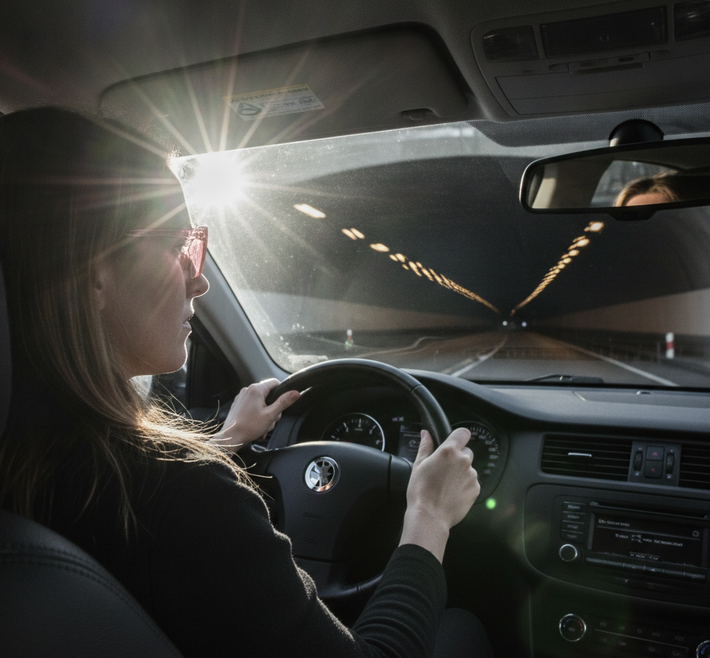
Summer driving with Irlen Syndrome exposes individuals to intense glare sensitivity disorder symptoms. The retinal hypersensitivity causes brightness perception issues where standard sun visors prove ineffective. Dashboard reflection, windshield glare, and road visibility issues compound when bright sunlight creates high contrast between shaded and illuminated areas.
Snow glare Irlen Syndrome driving and wet road glare present additional complications. Light reflecting off precipitation or snow creates pattern sensitivity reactions. Oncoming headlight glare during daylight hours, combined with chromatic filtering deficits, reduces visual efficiency and increases reaction time.
Tunnel Transition Difficulty and Adaptation Problems
Driving through tunnels with Irlen Syndrome creates dangerous light adaptation problems. The pupillary response delays when entering dark tunnels from bright sunlight, creating temporary tunnel vision problems. According to Irlen Method research, adaptation time for individuals with spectrum disorders can extend 3-7 seconds longer than neurotypical drivers—sufficient time to travel 132-308 feet at highway speeds.
The visual accommodation issues work bidirectionally. Exiting tunnels into bright sunlight triggers immediate photosensitivity, causing headache-inducing light exposure and potential migraine triggers. This contrast transition difficulty represents a significant driving safety concern, particularly on highways with frequent tunnel systems.
Additional Sensory Sensitivity Complications
Many individuals with Irlen Syndrome also have autism spectrum disorder, ADHD, traumatic brain injury, or concussion history. These co-occurring conditions amplify sensory sensitivity and environmental lighting responses. Research indicates that 12-14% of the general population experiences some degree of scotopic sensitivity, with higher prevalence among those with reading disorders, dyslexia, and migraine conditions.
Cost Breakdown: Investment Analysis for 2025
Addressing Irlen Syndrome and daytime driving requires multi-stage financial commitment with varying evidence support.
Screening and Diagnosis Costs
Initial Irlen screener evaluation: $150-$350 (2025 rates). This 60-90 minute assessment by certified Irlen screeners identifies light wavelength sensitivity and determines appropriate colored overlays. The screening provides baseline data on visual stress syndrome severity and perceptual processing difficulties.
Comprehensive diagnostic evaluation: $500-$750. Conducted by trained Irlen diagnosticians, this advanced assessment determines precise spectral modifications needed for tinted lens therapy. The evaluation tests multiple chromatic filters under various lighting conditions, including simulated automotive lighting sensitivity scenarios.
Treatment Investment
Colored overlays for reading intervention: $35-$65 per set. While helpful for stationary reading difficulties, these provide no driving assistance.
Irlen lenses (prescription tinted glasses): $800-$1,500. Custom-tinted eyewear incorporates precise color filtering glasses based on diagnostic results. Frames, prescription vision correction, and specialized tints contribute to total cost. Most insurance plans do not cover Irlen filters as they’re considered experimental by many ophthalmologists and optometrists.
Standard alternatives include prescription sunglasses ($200-$600), polarized lenses with UV protection ($150-$400), and photochromic transition lenses ($300-$500).
Expected Benefits and ROI Analysis
Anecdotal reports from individuals using Irlen lenses for driving describe reduced glare sensitivity, improved contrast problems, and decreased headaches from driving with Irlen Syndrome. Users report better visual comfort during light adaptation and reduced visual fatigue syndrome.
However, peer-reviewed research on Irlen Syndrome remains limited and controversial. A 2019 systematic review found insufficient evidence supporting Irlen Method efficacy for reading disorders. No controlled studies specifically examine driving performance outcomes with Irlen lenses versus standard glare reduction solutions.
The theoretical benefit involves blocking problematic wavelengths that cause temporal processing delays and magnocellular dysfunction. If effective, improved visual efficiency could enhance driving safety concerns and reduce eye discomfort during extended highway driving.
Who Should and Shouldn’t Invest
Strong Candidates for Irlen Evaluation
Consider Irlen assessment if you experience: persistent visual distortions while driving, migraine-related vision triggered by bright conditions, documented reading intervention history, diagnosed autism spectrum disorder or ADHD with visual complaints, or confirmed traumatic brain injury with ongoing light sensitivity driving problems. Individuals experiencing severe ocular discomfort during routine driving at dawn or seasonal driving challenges may benefit from specialized evaluation.
Poor Candidates for Investment
Skip Irlen screening if standard eye examinations reveal uncorrected vision problems (refractive errors, cataracts, retinal conditions). Address conventional vision correction first. Those with mild, occasional brightness adjustment difficulties often achieve equivalent results using quality polarized sunglasses with proper UV protection at significantly lower cost.
Consult ophthalmologists before pursuing Irlen evaluation if you have diagnosed retinal sensitivity conditions, unexplained vision changes, or neurological vision problems requiring medical intervention.
Alternatives to Consider
Multiple adaptive eyewear options provide glare reduction without Irlen-specific investment. High-quality polarized glasses (specific models block 99% of horizontal glare) cost $150-$300 and address many road visibility issues. Photochromic lenses automatically adjust to environmental lighting, assisting with tunnel lighting challenges.
Anti-glare solutions including dashboard modifications, windshield treatments, and strategic sun visor use may resolve some light filtering solutions needs. FL-41 tinted lenses, originally developed for migraine triggers, cost $200-$400 and provide alternative chromatic filtering for photosensitivity.
Behavioral accommodations include avoiding peak brightness hours, planning routes minimizing tunnel transitions, and taking frequent breaks during visual stress situations. Some Department of Motor Vehicles offices provide driving accommodations for Irlen Syndrome documentation, though requirements vary by jurisdiction.
Final Verdict: Limited Evidence, Individual Variability
Irlen Syndrome can indeed make driving in bright sunlight or tunnels harder for affected individuals, but the specialized assessment and treatment represent a high-cost investment with limited scientific validation. The $1,500-$2,600 total cost (screening, diagnosis, and lenses) may provide subjective improvement for some drivers, particularly those with severe photophobia and documented perceptual difficulties.
For most individuals experiencing light sensitivity driving challenges, starting with quality polarized sunglasses ($200-$400) and comprehensive eye examination ($100-$250) provides better value. This $300-$650 approach addresses common glare intolerance causes while ruling out conventional vision problems.
Pursue Irlen evaluation only after: comprehensive ophthalmologist examination confirms no medical vision issues, standard polarized lenses prove insufficient, symptoms significantly impair daily function, and financial resources permit exploratory treatment. The intervention remains experimental with inconsistent research support, making it a moderate-risk investment for most drivers concerned about automotive lighting sensitivity and driving safety.