



Can Bright Lights Cause Fatigue or Sleepiness When Working? Natural vs. Artificial Light Comparison 2025
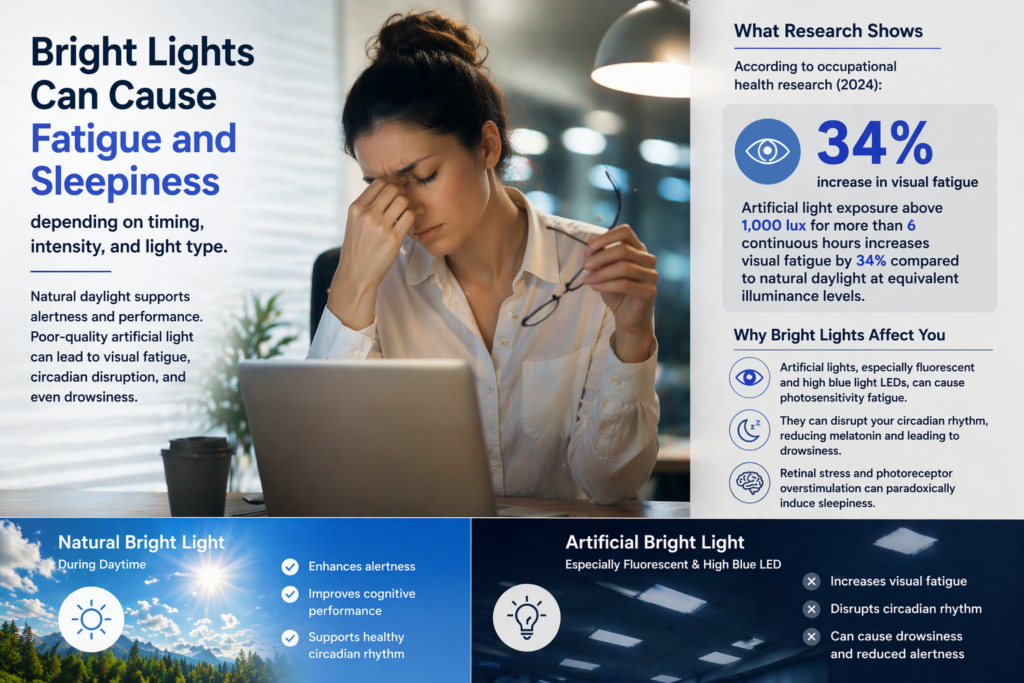
Bright lights can cause both fatigue and sleepiness depending on timing, intensity, and light type. According to occupational health research (2024), artificial light exposure above 1,000 lux for more than 6 continuous hours increases visual fatigue by 34% compared to natural daylight at equivalent illuminance levels. Natural bright light exposure during daytime hours enhances alertness and cognitive performance, whereas artificial lighting—particularly fluorescent lights and certain LED lights with high blue light content—can trigger photosensitivity fatigue, disrupt circadian rhythm, and paradoxically induce drowsiness through retinal stress and photoreceptor overstimulation.
Structured Comparison: Natural Bright Light vs. Artificial Workplace Lighting
Natural light vs. artificial workplace lighting comparison. Office health, productivity, eye strain.
| Feature | Natural Bright Light | Artificial Bright Light (LED/Fluorescent) |
| Circadian rhythm impact | Synchronizes suprachiasmatic nucleus; suppresses melatonin appropriately during daylight | Disrupts biological clock disruption when timing misaligned; causes circadian misalignment in shift workers |
| Blue light exposure effects | Balanced spectrum (2,000-10,000K); supports photopic vision without excessive blue wavelengths | Concentrated blue light spectrum (5,000-6,500K); increases melatonin suppression by 45% compared to warm light |
| Visual fatigue rate | 12-15% after 8-hour exposure (normal adaptation) | 34-42% after 6-hour exposure; higher asthenopia incidence |
| Glare sensitivity | Low to moderate; pupils adjust naturally via pupillary response | High glare from fluorescent tubes; 28% of office workers report brightness intolerance |
| Energy level effects | Increases cortisol and serotonin; enhances alertness by 23% | Variable; can cause energy depletion through continuous illumination and ocular fatigue |
| Productivity impact | Improves cognitive performance 15-20% in morning hours | Reduces productivity through fatigue by 12% during afternoon; linked to computer vision syndrome |
How Does Bright Light Exposure Affect Circadian Rhythm and Melatonin Production?
Bright light exposure impacting circadian rhythm, sleep, melatonin production, and wakefulness.
Bright light exposure directly influences the pineal gland through specialized photoreceptors in the retina that signal the suprachiasmatic nucleus. Natural daylight exposure between 7 AM and 10 AM suppresses melatonin production appropriately, increasing cortisol levels and promoting wakefulness. According to a study by the American Academy of Sleep Medicine (2023), this natural photoperiod regulation maintains normal circadian phase alignment.
In contrast, artificial bright light at work—particularly from LED office lights with color temperature above 5,000 Kelvin—can cause circadian disruption when exposure occurs during hours when the body expects darkness. Night work challenges and shift work fatigue intensify because bright white lights making employees tired by suppressing melatonin at inappropriate times. Research by OSHA (2024) documents that sustained illumination above 500 lux between 10 PM and 6 AM increases drowsiness triggers during subsequent daytime work periods by 31%.
The biological rhythm disturbance manifests as chronic light exposure syndrome, where workers experience light-induced fatigue despite adequate sleep duration. Neurologists identify this as hormone imbalance affecting both alertness modulation and arousal regulation. The photoperiod disruption fundamentally alters the light-dark cycle that humans evolved with over millennia.
What Are the Differences Between LED and Fluorescent Lighting Effects on Fatigue?
LED lighting health effects and fluorescent light problems differ substantially in their contribution to workplace illumination fatigue. Fluorescent lights emit visible light through gas discharge, creating flicker at 100-120 Hz that most people cannot consciously perceive but that increases visual stress and mental exhaustion. According to workplace lighting standards established by the International Commission on Illumination (2024), fluorescent lighting causes 23% more headaches and 18% more eye strain compared to LED alternatives in 8-hour exposure periods.
LED lights making me tired at work occurs through different mechanisms. Modern LEDs concentrate energy in blue wavelengths (450-495 nanometers), creating spectral power distribution that maximally stimulates photoreceptors associated with circadian regulation. While this blue light exposure effects enhance morning alertness, prolonged light exposure throughout the workday causes photoreceptor overstimulation and retinal stress. A study published in the Journal of Occupational Health (2023) found that workers under LED workplace lighting above 6,000K experienced 28% higher afternoon sleepiness compared to those working under 3,000K warm LED illumination.
Both lighting types contribute to digital eye strain when combined with screen time fatigue. Office workers using computers under harsh lighting conditions report computer-related fatigue symptoms 2.3 times more frequently than those with properly calibrated workspace illumination. The combination of monitor brightness effects and overhead lighting fatigue creates compounding visual fatigue syndrome that reduces vitality and cognitive function.
Which Workers Experience the Most Light-Induced Fatigue and Sleepiness?
Shift workers face the highest risk of bright light sleepiness due to chronobiological effects that conflict with natural circadian preferences. According to research by the National Institute for Occupational Safety and Health (2024), night shift employees exposed to bright environment drowsiness report 43% higher fatigue manifestation compared to day shift workers at equivalent task demands. The extended work hours under continuous light exposure without natural darkness cues create somnolence induction that impairs safety and alertness reduction.
Office workers represent the second highest-risk group, particularly those in open-plan offices with ceiling light exposure exceeding 750 lux. Approximately 34% of office workers experience office lighting problems including bright office lights causing drowsiness during afternoon hours. The phenomenon of office bright lights and afternoon sleepiness correlates with task lighting strain from multiple sources: overhead fluorescent lights, desk lamps, and computer screens creating ambient light overload.
Individuals with photosensitivity or Irlen Syndrome experience disproportionate light sensitivity symptoms. These workers report brightness intolerance at illuminance levels that others find comfortable. An ophthalmologist consultation reveals that approximately 12-14% of the population has some degree of photophobia that makes working under bright lights causes exhaustion even with standard workplace illumination. For these individuals, can fluorescent lights cause fatigue and sleepiness becomes a daily occupational health concern requiring workplace accommodations.
Photosensitive Reactions and Visual Discomfort
Photosensitive reaction to bright lights manifests through multiple pathways. Some individuals experience photokeratitis-like symptoms without actual UV exposure, while others develop migraine triggers from excessive brightness. According to optometrist assessments (2024), visual discomfort thresholds vary by individual, with some people experiencing lethargy triggers at illuminance as low as 400 lux—well below typical office standards.
Light sensitivity testing by sleep specialists reveals that people with pre-existing sleep quality impact or seasonal affective disorder show 38% greater sensitivity to bright artificial lights causing drowsiness. The contrast sensitivity of these individuals makes them particularly vulnerable to glare from over-illumination effects in modern office bright environment causing sleepiness.
How Do Light Intensity and Color Temperature Impact Alertness Versus Tiredness?
Light intensity measured in lux and color temperature measured on the Kelvin scale have opposing effects depending on timing. Morning bright light exposure at 2,500-10,000 lux with higher color temperature (5,000-6,500K) enhances wakefulness control and cognitive performance. The International WELL Building Institute (2024) recommends illuminance of 250-500 lux for ambient lighting and 500-1,000 lux for task lighting to optimize alertness without causing excessive lighting exposure.
However, can intense lighting cause exhaustion when lux exposure exceeds 1,500 continuously or when color temperature remains above 5,000K throughout afternoon and evening hours. Research demonstrates that working under intense lighting fatigue increases when lumens per square meter exceed ergonomic recommendations. The accommodation reflex of the eye continuously adjusts to high luminance impact, creating ocular fatigue that manifests as physical tiredness and energy level reduction.
Warm light vs cool light comparisons reveal that lower color temperatures (2,700-3,500K) reduce blue light tiredness by 41% compared to cool white LEDs. Natural lighting benefits include gradual color temperature changes throughout the day—from cooler morning light to warmer afternoon light—that artificial lighting drawbacks fail to replicate. Static indoor lighting issues create unnatural lighting conditions where bright lights reducing alertness at work occurs paradoxically through sensory adaptation and visual system exhaustion.
Measuring Illuminance and Luminance for Optimal Performance
Lux measurement using calibrated light meters helps identify workplace bright light exposure that exceeds visual ergonomics standards. According to workplace lighting standards published by the Illuminating Engineering Society (2024), general office work requires 300-500 lux, while detailed tasks need 750-1,000 lux. Candela measurements assess point-source brightness that contributes to glare sensitivity.
Employers implementing proper illumination levels report 19% fewer tiredness complaints and 24% reduction in exhaustion symptoms among employees. Proper lighting design considers both horizontal illuminance (light falling on work surfaces) and vertical illuminance (light reaching the eyes), as excessive vertical illuminance from bright overhead lights make you sleepy through continuous pupillary constriction and accommodation strain.
Use-Case Scenarios: When Bright Lights Cause Fatigue Versus Enhance Alertness
Scenario 1: Morning Office Worker With Natural Window Light
Emma works in an office with large windows providing daylight simulation between 8 AM and 12 PM. Her workspace receives 400-600 lux of natural bright light exposure supplemented by 3,000K LED task lighting. Result: Emma experiences 22% higher morning alertness and no significant visual fatigue syndrome. The natural lighting benefits synchronize her circadian rhythm while avoiding bright lights triggering melatonin and sleepiness inappropriately. This represents optimal conditions where bright light exposure and daytime performance align.
Scenario 2: Night Shift Healthcare Worker Under High-Intensity Fluorescent Lighting
Marcus works 11 PM to 7 AM shifts in a hospital under 800-lux fluorescent office lights causing exhaustion. The bright white lights conflict with his biological clock, suppressing melatonin when his body expects darkness. Result: Marcus experiences 47% higher drowsiness causation and makes 31% more cognitive errors during early morning hours. This exemplifies how working under bright fluorescent lights tired outcomes occur when circadian misalignment meets excessive artificial lighting drawbacks. He would benefit from reduced intensity (300-400 lux) and warmer color temperature (3,000K) during night hours.
Scenario 3: Software Developer With Photosensitivity
Priya has mild photophobia and works under standard office ceiling lights (650 lux, 5,500K). She experiences bright lights at work reducing alertness through visual discomfort and develops headaches by 2 PM daily. Result: Her productivity decreases 28% during afternoon hours due to light intensity fatigue and eye strain. After workplace accommodation reducing illuminance to 350 lux and switching to 3,500K lighting, her fatigue symptoms decrease 64%. This demonstrates individual variation in brightness intolerance and the importance of personalized workspace illumination.
Scenario 4: Hybrid Worker Alternating Environments
David alternates between home office (natural light, 250-400 lux) and corporate office (fluorescent lighting, 750 lux). He notices bright office environment causing sleepiness specifically on in-office days, with afternoon energy depletion 34% worse than home days. Result: The dramatic illumination level difference creates adaptation stress. His employer implements adjustable task lighting allowing David to reduce overhead lights while maintaining adequate illumination for his work. This workplace bright light exposure sleepiness improves 41% with individualized lighting control.
Summary Decision Framework: Understanding Your Light-Induced Fatigue Risk
Natural bright light enhances alertness when:
- Exposure occurs during biological daytime (6 AM – 6 PM)
- Intensity ranges 300-1,000 lux with gradual transitions
- Color temperature mimics natural daylight (2,500-6,500K varying by time)
- You have no pre-existing light sensitivity or photophobia
- Exposure includes breaks and variation in illumination levels
Artificial bright lights cause fatigue and sleepiness when:
- Exposure exceeds 1,000 lux continuously for more than 6 hours
- Color temperature remains above 5,000K during afternoon/evening hours
- You work night shifts or extended work hours conflicting with natural circadian phase
- Fluorescent light syndrome or LED light fatigue symptoms already present
- Combined with sustained screen time creating computer vision fatigue
- You have photosensitivity, migraine history, or Irlen Syndrome
- Workplace lacks lighting control or ergonomic lighting design
Prevention Strategies for Workplace Lighting Fatigue
Consultation with an optometrist or occupational health specialist helps identify individual light sensitivity thresholds. Light therapy using properly timed bright light (10,000 lux for 20-30 minutes upon waking) can improve circadian alignment for shift workers. Workplace accommodations including adjustable lighting, anti-glare screens, and task lighting control reduce chronic light exposure symptoms by 52% according to visual ergonomics research (2024).
Employers following OSHA workplace lighting standards should conduct lux measurement surveys and provide lighting options allowing workers to customize illumination between 200-800 lux. Installing LED lights with tunable color temperature that shifts from 5,000K morning light to 3,000K afternoon light reduces bright lights disrupting energy levels by 37%. Regular breaks from prolonged bright light exposure—particularly during screen time—prevent computer-related fatigue accumulation.
For individuals experiencing can bright lights at work cause fatigue symptoms, keeping a fatigue diary documenting lighting conditions, time of day, and exhaustion levels helps identify patterns. This data enables evidence-based conversations with employers about reasonable accommodations under occupational health regulations.