



What Is a Classroom Accommodation? Essential Student Support for Inclusive Education
Classroom accommodations are educational adjustments that change how students access learning materials or demonstrate knowledge without altering content standards or expectations. These student support services ensure that learners with disabilities, learning differences, or other challenges can participate fully in general education alongside their peers. According to the Individuals with Disabilities Education Act (IDEA) and Section 504 of the Americans with Disabilities Act (ADA), schools must provide reasonable accommodations to eligible students as of 2025.
Understanding Classroom Accommodations and Educational Equity
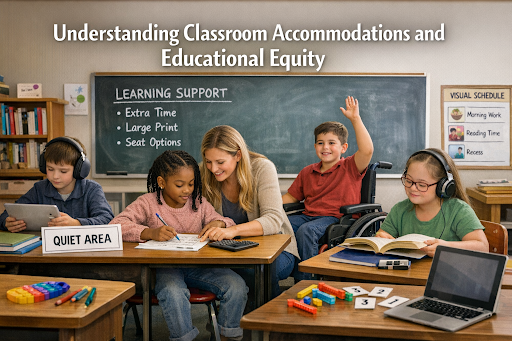
Classroom accommodations: Equity, accessibility, inclusion, learning support, diverse learners
Classroom accommodations represent a cornerstone of inclusive education and educational equity. The general education teacher, working with the special education teacher, school psychologist, and other support systems, implements these teaching accommodations to address learning barriers. Unlike modified curriculum approaches, accommodations maintain the same academic standards while removing obstacles that prevent students from demonstrating their true capabilities.
The legal framework supporting these accessibility measures includes the Individualized Education Program (IEP) for special education students and the 504 Plan for students with disabilities who do not require specialized instruction. These documents outline specific instructional support and classroom modifications tailored to individual student needs.
Key Characteristics of Effective Classroom Accommodations
Effective classroom accommodations: individualized, accessible, supportive, clear expectations, flexible.
Individualized Support Based on Student Assessment
Effective learning accommodations are never one-size-fits-all. The multi-tiered system of supports (MTSS) and response to intervention (RTI) frameworks help identify personalized learning needs. An occupational therapist, speech therapist, or educational aide may conduct assessments to determine which adaptive equipment or teaching strategies will benefit specific diverse learners.
Evidence-Based Teaching Strategies
Research-backed instructional accommodations include assistive technology such as text-to-speech software, speech-to-text software, and screen reader tools. For students with visual impairment, enlarged text and Braille materials provide accessibility solutions. Students with hearing impairment benefit from FM system devices that enhance auditory accommodations.
Legally Mandated and Documented
All academic accommodations must be formally documented in either an IEP or 504 Plan. The special education teacher coordinates with the paraprofessional team to ensure consistent implementation across all learning environments. As mandated by IDEA and ADA regulations, schools must provide these educational supports without cost to families.
Four Categories of Classroom Accommodations
Presentation Modifications: How Information Is Delivered
Presentation accommodations change instructional delivery methods. Students with dyslexia may receive audiobook versions of textbooks alongside traditional materials. Visual supports including graphic organizer tools help students with autism spectrum disorder process complex information. The general education teacher might use differentiated instruction techniques such as chunking—breaking content into smaller, manageable segments—to support students with working memory deficits.
- Text-to-speech software for reading assignments
- Visual aids and manipulatives for abstract concepts
- Enlarged text for students with visual impairment
- Sign language interpretation for hearing impairment
- Color-coded materials for organizational support
Response Modifications: How Students Demonstrate Learning
Response accommodations allow alternative assessment methods without changing expectations. A student with a physical disability might use a word processor instead of handwriting. Students with ADHD or learning disability diagnoses may demonstrate knowledge through oral testing rather than written exams. These classroom adaptations ensure that assessment accommodations measure student knowledge rather than disability impact.
- Speech-to-text software for writing assignments
- Use of calculator for students with math learning disabilities
- Oral responses instead of written tests
- Graphic organizers for essay planning
- Alternative assessment formats maintaining rigor
Setting Modifications: Where Learning Occurs
Environmental accommodations create optimal learning conditions. Preferential seating near the teacher helps students with attention difficulties or hearing impairment. A quiet testing environment reduces distractions for students with ADHD or autism spectrum disorder. Some struggling students require a separate testing location with a paraprofessional to minimize sensory accommodations conflicts in the main classroom.
- Preferential seating away from distractions
- Quiet testing environment for assessments
- Small group instruction settings
- Access to sensory break spaces
- Flexible seating accommodations using stability balls or standing desks
Timing and Scheduling Modifications
Timing modifications provide extended time accommodations without reducing content expectations. Students with processing speed challenges or emotional behavioral disorder may need frequent breaks during extended work periods. Extended time testing—typically time-and-a-half or double time—represents one of the most common testing accommodations for students with learning differences.
- Extended time testing (typically 1.5x to 2x standard time)
- Frequent breaks during instruction
- Scheduling modifications for medication management
- Additional time for transitions between activities
- Flexible deadlines with advance planning
How Classroom Accommodations Work in Practice
Step 1: Identification and Evaluation
The intervention strategies process begins when the general education teacher, parents, or school psychologist identify potential learning barriers. The RTI framework provides academic interventions before formal disability testing. If concerns persist, comprehensive evaluation by the special education team determines eligibility for an IEP or 504 Plan.
Step 2: IEP or 504 Plan Development
The IEP team—including the special education teacher, general education teacher, school psychologist, and parents—develops individualized support based on evaluation results. For students not requiring special education, a 504 Plan provides disability accommodations under ADA guidelines. Both documents specify which instructional accommodations, assistive devices, and support strategies the student requires.
Step 3: Implementation and Training
The general education teacher implements classroom supports with guidance from the special education teacher. Staff training covers assistive technology accommodations, behavioral supports, and differentiation methods. The paraprofessional or educational aide may provide direct support during specific activities requiring intensive intervention.
Step 4: Monitoring and Adjustment
Regular progress monitoring through the MTSS framework ensures accommodation effectiveness. The IEP team meets annually, though 504 Plans may be reviewed less frequently. Adjustments to academic supports occur based on student response and changing needs throughout the academic year.
Common Misconceptions About Classroom Accommodations
Myth: Accommodations Give Students an Unfair Advantage
Reality: Educational accommodations level the playing field rather than providing advantages. A student using text-to-speech software for dyslexia gains access to the same content as peers who can decode text fluently. The accommodation removes the disability-related barrier without lowering standards or expectations.
Myth: Accommodations and Modifications Are the Same
Reality: Accommodations change how students learn or demonstrate knowledge while maintaining grade-level standards. Modifications alter what students are expected to learn through modified curriculum or reduced workload. Most students with disabilities receive accommodations that preserve content rigor.
Myth: Only Students with Severe Disabilities Need Accommodations
Reality: Students across the disability spectrum benefit from instructional support. A student with ADHD requiring preferential seating and a student with visual impairment using screen reader technology both need accessibility measures despite different disability presentations.
Myth: Universal Accommodations Work for All Students
Reality: Effective classroom strategies require individualized assessment. While Universal Design for Learning (UDL) principles benefit all diverse learners, specific students need targeted educational adjustments based on unique learning differences documented in their IEP or 504 Plan.
Classroom Accommodations vs. Curriculum Modifications
| Aspect | Accommodations | Modifications |
| Content Standards | Maintains grade-level academic standards | Alters content expectations or complexity |
| Assessment Expectations | Same rigor with alternative methods | Reduced expectations or alternate standards |
| Legal Framework | Required under IDEA and ADA for access | Provided when accommodations insufficient |
| Examples | Extended time, assistive technology, preferential seating | Reduced workload, simplified assignments, alternate curriculum |
| Goal | Remove barriers to demonstrate knowledge | Adjust learning outcomes to student level |
Practical Applications: Accommodations by Disability Type
ADHD Accommodations
Students with ADHD benefit from behavioral accommodations and environmental modifications that support attention and executive function. Effective classroom management includes frequent breaks, chunking assignments into smaller tasks, and preferential seating away from distractions. Positive behavioral interventions combined with organizational accommodations—such as visual schedules and graphic organizer tools—address executive function difficulties that characterize ADHD.
Dyslexia Accommodations
Reading accommodations for dyslexia include audiobook access, text-to-speech software, and extended time testing for reading-heavy assessments. The speech therapist may provide specialized remediation techniques while the general education teacher implements presentation modifications. Students benefit from learning aids such as colored overlays (available through resources like Irlen screening services for visual processing support) and access to digital texts with adjustable formatting.
Autism Spectrum Disorder Accommodations
Students with autism spectrum disorder often require sensory accommodations and structured environmental modifications. Sensory supports might include noise-canceling headphones, flexible seating accommodations, or access to sensory break spaces. Visual supports such as schedules, social stories, and clearly defined expectations help students navigate the learning environment. The occupational therapist may recommend specific adaptive equipment for sensory processing issues.
Physical Disability Accommodations
Physical accommodations ensure accessibility measures for students with mobility impairments or physical disabilities. This includes wheelchair-accessible classroom layouts, adjustable furniture, and assistive tools like adapted keyboards or switches. The occupational therapist evaluates which assistive devices enable independent participation in classroom activities and educational resources.
Implementing Accommodations Through Universal Design for Learning
Universal Design for Learning (UDL) principles create inherently accessible learning environments that reduce the need for individual accommodations. UDL’s three principles—multiple means of representation, expression, and engagement—align with accommodation categories. When teachers incorporate UDL into instructional modifications, they proactively address diverse learners’ needs.
Scaffolding techniques embedded within UDL frameworks provide graduated support as students build skills. The differentiation techniques inherent to UDL benefit not only special needs students but also struggling students without formal diagnoses. This inclusive practices approach enhances academic success for all learners while meeting specific accessibility solutions for documented disabilities.
Building Effective Support Systems
Successful accommodation implementation requires collaboration among the general education teacher, special education teacher, paraprofessional staff, and related service providers. Regular communication ensures consistent application of educational technology and instructional support across settings. The school psychologist monitors student engagement and academic interventions effectiveness.
Professional development in differentiation methods, assistive technology accommodations, and inclusive practices strengthens the entire support system. Teachers skilled in multiple teaching accommodations can respond flexibly to individual student needs while maintaining high expectations for all diverse learners in their classrooms.