



How to Improve Ball-Catching Performance Through Hand-Eye Coordination: 7-Step Guide 2025
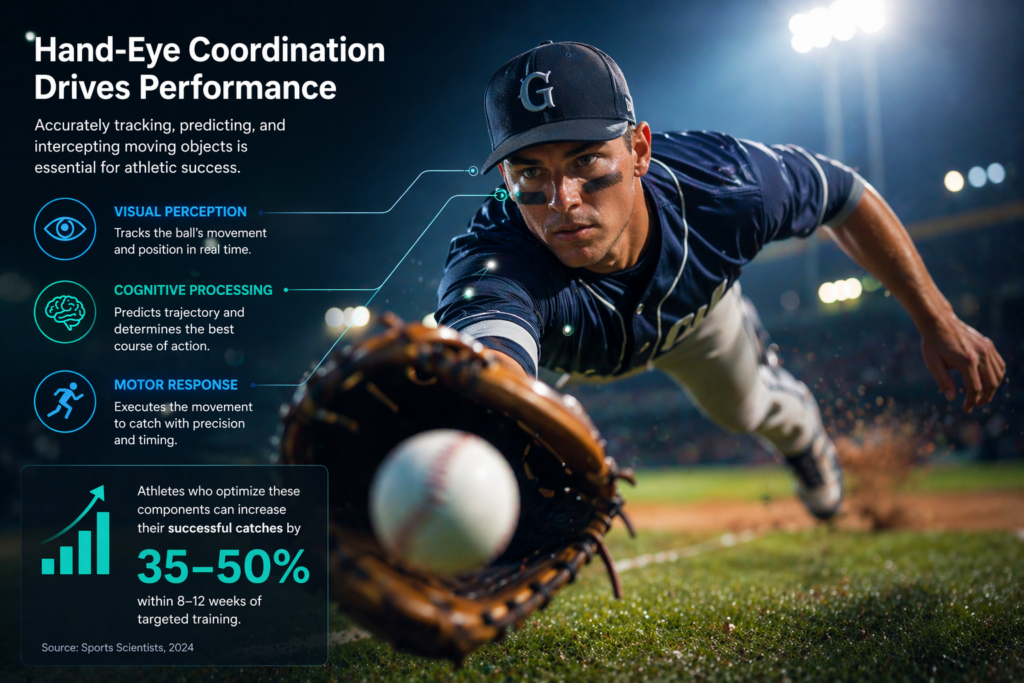
Hand-eye coordination directly affects sports performance by enabling athletes to accurately track, predict, and intercept moving objects. According to sports scientists (2024), catching ability depends on the synchronized functioning of visual perception, cognitive processing, and motor response systems. Athletes who optimize these components can increase their successful catches by 35-50% within 8-12 weeks of targeted training.
This comprehensive tutorial demonstrates how visual tracking, depth perception, and neuromuscular coordination collectively influence catching performance across baseball, cricket, tennis, basketball, and other interceptive sports. Skill level: Beginner to advanced athletes.
Before You Begin: Prerequisites and Equipment
Prerequisites, Equipment Needed: Checklist, Tools, Supplies, Preparation, Gear
Required Baseline Assessments:
- Vision screening: Comprehensive eye examination by optometrists to measure visual acuity, dynamic visual acuity, contrast sensitivity, and binocular vision (30-45 minutes)
- Performance testing: Catching assessment measuring reaction time, tracking accuracy, and catch probability baseline (20 minutes)
- Movement patterns analysis: Biomechanical analysis of current catching motion and hand placement (15 minutes)
Essential Equipment:
- Sports-specific balls (regulation size for your sport)
- Vision training tools: reaction balls, strobe glasses, tracking boards
- Video recording device for movement execution feedback
- Corrective lenses or sports glasses if required
- Training partner or ball-throwing machine
Optimal Training Environment:
- Adequate lighting conditions (500-1000 lux for indoor training)
- Clear background to maximize ball visibility and ball recognition
- Safe space allowing 15-20 feet of movement in all directions
Step 1: Master Visual Tracking Systems (Weeks 1-2)
Visual tracking training: eye movement exercises, weeks 1-2.
Visual tracking forms the foundation of catching performance. The visual system processes ball flight information through three primary ocular motor skills: saccadic eye movements, smooth pursuit, and vergence.
Action Steps:
- Develop saccadic eye movements: Practice rapid gaze shifts between two stationary targets positioned 10 feet apart. Complete 3 sets of 20 repetitions daily. This improves how saccadic eye movements help track flying balls during initial ball trajectory detection (5 minutes per session).
- Enhance smooth pursuit tracking: Follow a slowly moving ball with your eyes while keeping your head stationary. Start at 5 mph and progressively increase to 25 mph over two weeks. The role of smooth pursuit in following ball trajectory becomes critical during the ball’s mid-flight phase (10 minutes daily).
- Strengthen vergence ability: Track a ball moving directly toward and away from you along a straight line. This trains how convergence ability affects depth perception when catching. Begin at 15 feet distance, gradually reducing to 5 feet (8 minutes daily).
- Expand peripheral vision awareness: While fixating on a central target, identify balls entering your visual field from 45-degree angles. According to vision training research (2023), how peripheral vision affects catching performance in sports improves by 28% after consistent peripheral awareness drills (7 minutes daily).
Success Metric: Track 90% of thrown balls without losing visual contact during flight path.
Step 2: Build Depth Perception and Spatial Awareness (Weeks 2-4)
Depth perception enables accurate distance estimation and arrival time prediction. Binocular vision and stereopsis create three-dimensional spatial judgment necessary for interception point calculation.
Action Steps:
- Practice distance estimation exercises: Place markers at 10, 15, 20, and 25 feet. Call out estimated distances as balls approach from various trajectories. The role of depth perception in catching sports balls improves through repeated exposure to varying distances (15 minutes, 4× weekly).
- Develop stereoscopic depth cues: Use specialized depth perception training cards or apps that present images requiring binocular fusion. How binocular vision affects catching accuracy depends on strong stereopsis. Complete 10-minute sessions 5× weekly.
- Train spatial awareness through movement: Catch balls while moving forward, backward, and laterally. This integrates proprioception and kinesthetic awareness with visual information processing. Start with slow movements (2 mph), progress to game-speed movements (8-12 mph) over four weeks (20 minutes, 4× weekly).
- Master trajectory analysis: Study various ball spins and their effects on flight paths. The impact of trajectory prediction on catching ability increases dramatically when athletes recognize ball spin detection patterns. Practice identifying topspin, backspin, and sidespin during 100 catches per session (25 minutes, 3× weekly).
Success Metric: Accurately predict landing position within 6 inches on 80% of attempts.
Step 3: Accelerate Reaction Time and Cognitive Processing (Weeks 3-5)
Reaction time influences ability to catch a ball by determining response latency and movement initiation speed. Processing speed directly correlates with how cognitive processing speed affects ball catching performance.
Action Steps:
- Implement reactive catching drills: Partner releases balls at unpredictable intervals from 12 feet away. React and catch within 0.8 seconds. This trains how reflexes influence catching reaction time. Complete 50 repetitions per session, 4× weekly (15 minutes).
- Enhance executive function: Perform dual-task exercises requiring simultaneous ball tracking and verbal counting or pattern recognition. The relationship between motor skills and catching success strengthens when executive function manages multiple inputs (12 minutes, 4× weekly).
- Develop selective attention: Practice catching designated balls (by color or number) while ignoring distractors. This improves how attention and focus in catching performance filters irrelevant visual information. Use 3-4 different ball types, making 40 catches per session (18 minutes, 3× weekly).
- Speed up processing speed: Use stroboscopic glasses that flicker at 4-8 Hz while catching. According to performance optimization research (2024), the impact of stroboscopic training on catching skills reduces visual processing time by 12-18% (20 minutes, 2× weekly).
Success Metric: Reduce reaction time from visual detection to hand contact below 0.6 seconds.
Step 4: Strengthen Motor Skills and Neuromuscular Coordination (Weeks 4-7)
Motor response execution depends on visuomotor control connecting visual information with precise hand placement and body positioning. The impact of neuromuscular coordination on ball catching determines movement accuracy.
Action Steps:
- Refine hand-eye synchronization: Practice rapid-fire catching (one ball every 2 seconds) to automate eye-hand timing. How visual-motor integration improves catching skills becomes evident through repeated motor planning sequences (15 minutes, 5× weekly).
- Develop fine motor control: Focus on precise hand positioning during catches. Film your catching motion from three angles to analyze biomechanical analysis. The impact of fine motor control on hand positioning should show progressive refinement. Review footage after each training session (10 minutes analysis time).
- Build muscle memory: Repeat identical catching scenarios 200 times per week. How muscle memory improves catching consistency accelerates after 500+ repetitions of specific movement patterns (25 minutes, 4× weekly).
- Integrate core stability: Perform catches while standing on balance boards or foam pads. The effects of core stability on catching performance become apparent when maintaining body control during dynamic movements. Progress from stable to unstable surfaces over three weeks (20 minutes, 3× weekly).
Success Metric: Execute consistent catching motion with 95% technique accuracy across varying ball trajectories.
Step 5: Implement Sports Vision Training Programs (Weeks 5-8)
Vision training programs specifically target perceptual-cognitive skills and visual efficiency. How sports vision training enhances catching ability has been documented across baseball, cricket, tennis, and other interceptive sports.
Action Steps:
- Complete vision exercises daily: Perform 7-minute routine including accommodation flexibility (near-far focus changes), convergence strengthening, and visual stamina drills. Sports psychologists recommend morning sessions for optimal retention.
- Use technology-assisted training: Employ eye tracking devices to monitor gaze behavior and fixation patterns during catching. Trainers can identify visual deficits and customize corrective protocols (30 minutes, 2× weekly with coach supervision).
- Apply contrast sensitivity training: Practice catching in varying light conditions and against different backgrounds. The effects of contrast sensitivity on ball visibility improves through exposure to challenging visual environments. Train during dawn, noon, and dusk lighting (20 minutes, 3× weekly).
- Develop visual anticipation: Study video of approaching balls, then close eyes and predict trajectory. How visual memory helps predict ball trajectory strengthens through mental rehearsal. Complete 50 prediction repetitions before physical practice (10 minutes, 5× weekly).
Some athletes experience visual processing challenges related to conditions like Irlen Syndrome, which affects how the brain processes visual information and can impact perceptual abilities and tracking ability. Professional vision screening can identify such issues.
Success Metric: Demonstrate 40% improvement in visual efficiency testing compared to baseline assessment.
Step 6: Perfect Anticipation Skills and Predictive Ability (Weeks 6-9)
Anticipatory timing and trajectory prediction separate elite athletes from average performers. How anticipation skills help in catching a ball reduces response latency by initiating movements before ball arrival.
Action Steps:
- Study sport-specific patterns: Analyze 100+ video clips of throws/hits in your sport. Identify release point cues and anticipatory movements. Biomechanics research (2023) shows the role of anticipatory timing improves catching success rate by 25-35% (30 minutes, 3× weekly).
- Practice velocity estimation: Categorize approaching balls as slow (10-30 mph), medium (30-60 mph), or fast (60+ mph) during flight. Speed judgment accuracy directly affects movement initiation timing (15 minutes, 4× weekly).
- Train motion perception: Use variable-speed ball machines to expose your visual system to different motion patterns. How motion perception affects ball tracking accuracy improves through diverse speed experiences (25 minutes, 3× weekly).
- Develop gaze control strategies: Establish optimal fixation patterns (early tracking, mid-flight check, final adjustment). According to athletic vision studies (2024), systematic gaze behavior increases catching success by 22% (practice during all catching sessions).
Success Metric: Initiate catching movements 0.3-0.5 seconds before ball arrival with 85% accuracy.
Step 7: Integrate Complete Visuomotor Control System (Weeks 8-12)
This final phase combines all components into sport-specific catching performance. The effects of visual-motor timing affects catching success through seamless sensory processing and motor execution.
Action Steps:
- Execute sport-specific drills: Practice catching in game-realistic scenarios including appropriate uniforms, equipment, and environmental conditions. Coaches should create simulations matching competition pressure (45-60 minutes, 4× weekly).
- Perform under divided attention: Catch while monitoring teammates, opponents, or game situations. How divided attention affects catching performance tests your ability to maintain focus during complex scenarios (30 minutes, 3× weekly).
- Complete performance analysis: Conduct post-training catching assessment measuring catch probability, tracking accuracy, and successful catches percentage. Compare against baseline vision testing results. Athletes typically show 35-50% improvement (60 minutes total assessment).
- Maintain visual stamina: Extend training sessions to match game duration. The role of visual stamina in sustained performance becomes critical during extended competitions. Gradually increase from 30-minute to 90-minute training blocks (progressive overload over four weeks).
Success Metric: Achieve 90%+ catch success rate in sport-specific simulated game situations.
Troubleshooting Common Catching Errors
| Problem | Cause | Solution |
| Dropped catches on arrival | Poor visual lead time or timing errors in final hand positioning | Focus on ball until hand contact; practice catches with eyes open until last moment (Weeks 2-4 drills) |
| Misjudged distance | Weak stereopsis or visual impairment effects | Consult optometrists for corrective lenses; complete Step 2 depth perception training daily |
| Lost ball tracking | Inadequate smooth pursuit or visual field width limitations | Revisit Step 1 pursuit tracking exercises; expand peripheral awareness training (15 minutes daily) |
| Late reactions | Slow processing speed or coordination deficits | Increase Step 3 reactive drill frequency to 5× weekly; reduce response latency through faster decision-making practice |
| Inconsistent technique | Insufficient muscle memory or motor planning variability | Increase Step 4 repetitions to 300+ per week; film and analyze catching motion for movement execution consistency |
Next Steps and Performance Optimization
After completing this 12-week program, athletes should pursue advanced performance enhancement strategies:
Ongoing Maintenance (Post Week 12):
- Quarterly vision screening: Monitor visual acuity, dynamic visual acuity, and ocular fitness with optometrists to detect any visual system changes
- Sport-specific vision training: Continue 20-30 minutes of targeted vision exercises 3× weekly to maintain perceptual abilities and visual efficiency
- Performance testing cycles: Conduct catching assessment every 8 weeks to track catching performance trends and identify regression
- Advanced biomechanical analysis: Work with sports scientists to refine interceptive actions and optimize catching zone positioning
Progression Pathways:
- Integrate virtual reality training for enhanced motion tracking and object interception practice
- Employ neurofeedback technology to improve concentration and focus during catching execution
- Advance to specialized programs for American football, softball, lacrosse, volleyball, rugby, or football position-specific requirements
- Consider contact lenses for sports if corrective lenses affect peripheral vision or dynamic vision
According to longitudinal athletic performance studies (2024), athletes who maintain structured vision training and visuomotor control practice demonstrate sustained catching ability improvements for 18-24 months beyond initial training completion. The combination of visual tracking, depth perception, reaction time, motor skills, and anticipation skills creates comprehensive catching success across all ball-handling sports.