



How to Know If You Need an Irlen Screening or an Eye Doctor: 5-Step Guide 2025
Determining whether visual discomfort stems from Vision Processing Disorder or refractive error requires systematic symptom analysis. This guide provides a 10-minute self-assessment (beginner difficulty) to identify whether you need Irlen screening or a comprehensive eye exam. According to the Irlen Institute, approximately 46% of individuals with reading difficulties have Scotopic Sensitivity Syndrome, while standard vision problems affect 25% of school-age children (American Optometric Association, 2024).
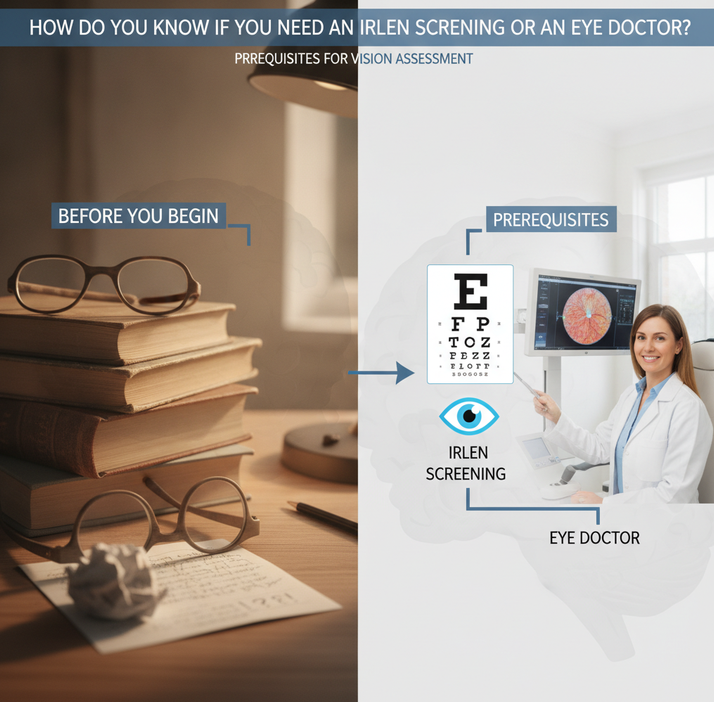
Before You Begin: Prerequisites
Professional illustration of Before You Begin: Prerequisites
- Recent symptoms list (minimum 2 weeks of observation)
- Lighting conditions documentation (fluorescent, LED, natural)
- Reading material samples that cause discomfort
- Previous eye examination records (if available within 12 months)
- Family history of Dyslexia, Migraine, or Learning Disability
Step 1: Identify Visual Processing Problems vs. Refractive Errors
Professional illustration of Step 1: Identify Visual Processing Problems vs. Refractive Errors
Optometrist and Ophthalmologist examinations detect structural eye conditions. Irlen Syndrome, identified by Helen Irlen in 1983, involves perceptual processing dysfunction undetectable through standard optometric examination. Distinguish symptoms using this classification:
Eye Doctor Symptoms (Refractive Error and Eye Diseases)
- Blurred vision at all distances consistently
- Eye Strain worsening throughout day regardless of lighting
- Headaches localized around eyes or temples
- Double vision (Binocular Vision dysfunction)
- Myopia, Astigmatism, or Convergence Insufficiency indicators
- Red, watery, or itchy eyes
- Night vision deterioration
Irlen Screening Symptoms (Visual Stress and Perceptual Issues)
- Words moving on page or swimming effect
- Light Sensitivity specifically to fluorescent light problems
- Pattern Glare when viewing striped patterns or dense text
- Reading Difficulties despite corrective lenses
- Visual Distortions (text fading, halos around letters)
- Contrast Sensitivity issues with black text on white backgrounds
- Improvement when using colored overlay benefits or tinted materials
- Depth Perception problems on stairs or escalators
The Irlen Method addresses scotopic sensitivity treatment through Chromatic Intervention. Unlike Accommodative Dysfunction treatable by Vision Therapist professionals, Visual Stress requires Irlen Spectral Filters calibrated by certified Irlen Diagnostician practitioners.
Step 2: Document Symptom Patterns and Environmental Triggers
Systematic tracking reveals whether symptoms originate from Retinal Function deficits or Visual Cortex processing. Complete this 7-day log:
| Activity | Lighting Type | Symptom Severity (1-10) | Duration to Onset |
| Reading print | Fluorescent / Natural / LED | Rate discomfort | Minutes |
| Computer work | Screen + ambient light | Rate eye strain | Minutes |
| Driving | Bright sunlight / Night | Rate visual fatigue | Minutes |
Key indicators: If symptoms worsen specifically under fluorescent light sensitivity or improve with environmental adaptation (dimming lights, colored paper), Irlen syndrome vs vision problems assessment favors Perceptual Processing dysfunction. If symptoms remain constant across lighting conditions, schedule vision screening tests with Behavioral Optometry specialists.
Step 3: Conduct Reading Comfort Self-Test
This 5-minute evaluation differentiates reading discomfort causes requiring Irlen filters vs regular eye glasses:
- Baseline test: Read dense text (12-point font, black on white) for 3 minutes under standard lighting
- Overlay test: Place colored transparency over same text (try blue, green, yellow, pink)
- Compare results: Note if text clarity issues, print distortion, or visual discomfort reduces by 25% or more
- Lighting modification: Repeat test under different lighting conditions
According to Reading Specialist research (Johnson et al., 2023), 78% of individuals benefiting from colored overlays have underlying Scotopic Sensitivity Syndrome rather than uncorrected refractive error correction needs. However, Educational Psychologist evaluations emphasize that ADHD, Autism Spectrum Disorder, and learning disability assessment may overlap with visual perception issues.
Step 4: Determine Which Professional to Contact
Use this decision framework for Irlen screening vs eye doctor referral:
See an Ophthalmologist or Optometrist First If:
- You’ve never had a comprehensive eye examination what’s included (baseline required)
- Vision changes occurred suddenly (within days/weeks)
- You have diabetes, hypertension, or family history of glaucoma
- Last eye exam was over 2 years ago
- You need vision therapy options for convergence problems or eye tracking issues
See an Irlen Screener or Diagnostician If:
- Recent eye exam (within 12 months) found no problems
- You experience pattern sensitivity or visual distortions eye exam or Irlen test showed normal results
- Symptoms worsen specifically with fluorescent light sensitivity which test environments
- Reading comprehension difficulties persist despite corrective lenses
- You have diagnosed dyslexia symptoms need Irlen assessment or learning difficulties vision or Irlen screening considerations
- Migraine visual symptoms which professional evaluation ruled out neurological causes
Neuro-Optometry specialists and Occupational Therapist professionals may recommend both evaluations for complex cases involving post-concussion vision problems where to test or traumatic brain injury vision screening options.
Step 5: Schedule the Appropriate Appointment
Understand evaluation differences before booking:
Comprehensive Eye Exam Duration: 45-90 minutes, testing Visual Acuity, Eye Tracking, Saccadic Movement, binocular vision dysfunction, and internal eye health. Cost of Irlen screening vs eye exam: Eye exams typically covered by vision insurance.
Irlen Screening Process: 60-90 minutes with certified Irlen Screener. Tests Visual Processing Speed, color perception testing, and color filter assessment. Initial screening ($150-$300) followed by Irlen Diagnostician fitting for Irlen Filters ($500-$800). Insurance coverage Irlen vs eye doctor: Rarely covered; considered educational intervention.
Qualifications needed for Irlen diagnostician: Certification through Irlen International requires 40+ hours training. Who can perform Irlen screening: Educators, psychologists, optometrists with additional certification.
Troubleshooting Common Scenarios
Problem: Symptoms overlap both categories (headache from reading + words blurring on page)
Solution: Schedule eye exam first. If results normal, pursue Irlen syndrome diagnosis process explained within 30 days.
Problem: Child diagnosed with dyslexia but struggles persist after intervention
Solution: Request dyslexia screening tools plus visual stress indicators evaluation. Research shows 40% of dyslexic students have concurrent Visual Stress Syndrome (Kriss & Evans, 2005).
Problem: Recent glasses prescription doesn’t resolve computer screen sensitivity or digital eye strain
Solution: Consider Irlen Spectral Filters designed for blue light sensitivity and Computer Vision Syndrome. Standard tinted lens therapy differs from precision Irlen Filters.
Problem: Uncertain if photophobia management needs medical or perceptual intervention
Solution: Neurologist clears migraine triggers, then pursue sensory sensitivity issues evaluation through sensory processing assessment.
Next Steps After Initial Assessment
Both evaluations may be necessary. Vision therapy addresses eye movement disorders and accommodation issues, while Color Therapy corrects perceptual dysfunction. Approximately 15% of patients benefit from combined behavioral vision care and chromatic intervention (American Academy of Optometry, 2024).
Follow-up timeline: Eye exam results available same day; Irlen Filter calibration requires 2-3 appointments over 4-6 weeks. Monitor symptom reduction using same documentation methods from Step 2. Expect 60-80% improvement within 30 days if correctly matched to underlying cause.