



Outcome Statement: This comprehensive guide explains what happens during an Irlen diagnostic session, a 2-3 hour clinical evaluation conducted by a certified Irlen Diagnostician to determine if colored filters can reduce visual stress and improve reading performance. Suitable for individuals of all ages experiencing reading difficulties, light sensitivity, or visual processing disorder symptoms.
What to Expect During an Irlen Diagnostic Session
An Irlen diagnostic session is a thorough perceptual processing assessment that goes beyond standard vision testing. According to the Irlen Institute (2024), this evaluation identifies scotopic sensitivity syndrome and determines the precise spectral filters needed to address visual distortions, pattern glare, and photophobia. Unlike a basic Irlen screening, the complete diagnostic evaluation session involves sophisticated color matching procedures and individualized color testing to prescribe customized Irlen filters.
The typical duration of Irlen diagnostic session ranges from 2 to 3 hours, depending on individual symptom complexity and the number of color adjustments required. This comprehensive vision assessment differs fundamentally from standard optometry examinations, as it focuses on perceptual processing rather than visual acuity measured through traditional eye charts.
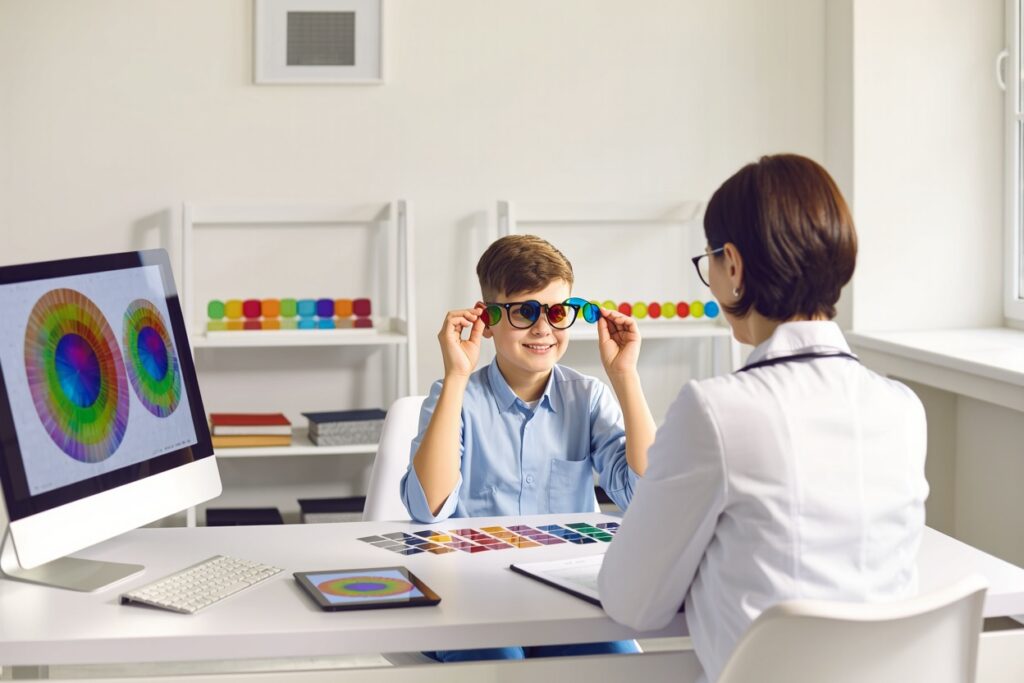
Before You Begin: Prerequisites for Irlen Diagnostic Testing
Preparation Checklist
- Complete Initial Screening: Most individuals must complete an Irlen screening with a certified Irlen Screener before scheduling the diagnostic appointment
- Recent Eye Examination: Obtain a comprehensive eye exam within the past year to rule out underlying vision problems
- Symptom Documentation: Prepare a visual symptom checklist noting specific reading difficulties, headaches, eye strain, and light sensitivity patterns
- Reading Materials: Bring samples of problematic text (work documents, textbooks, computer screen examples)
- Current Eyewear: Wear your regular prescription glasses or contact lenses if applicable
- Time Allowance: Schedule 2.5-3 hours without interruptions for the complete evaluation
- Rest: Avoid visual fatigue before the appointment; ensure adequate sleep the night before
Understanding what happens during an Irlen diagnostic session helps you prepare mentally and physically for this detailed chromatic intervention assessment, ensuring more accurate results and optimal color determination.
Step 1: Case History Intake and Visual Symptom Assessment
The diagnostic evaluation begins with a comprehensive case history intake conducted by your Irlen Diagnostician. This certified professional from the Irlen Clinic network reviews your medical history, academic performance, and specific complaints related to visual stress syndrome.
What Questions Are Asked During Irlen Evaluation:
- Detailed description of reading difficulties (comprehension problems, visual tracking issues, reading stamina limitations)
- Light sensitivity diagnosis factors (fluorescent lighting reactions, computer screen issues, headache triggers)
- Environmental factors assessed in Irlen diagnosis (workplace lighting, preferred reading conditions)
- Family history of dyslexia, ADHD, autism spectrum disorders, or learning disabilities
- Previous interventions tried (vision therapy, occupational therapy, educational psychology services)
- Current medications and health conditions affecting visual perception
Duration: 20-30 minutes
Outcome: Establishes baseline understanding of your perceptual processing disorder symptoms and guides the subsequent testing protocol.
Step 2: Reading Sample Analysis and Baseline Measurement
The Irlen diagnostician conducts a reading rate analysis using standardized reading materials to establish performance metrics before any intervention. This reading disorder evaluation measures multiple factors simultaneously.
Procedure:
- Read aloud from selected passages at your natural pace while the diagnostician times your performance
- Answer comprehension questions to assess text clarity and information retention
- Describe any visual distortions observed (words moving, rivers in text, print stability issues)
- Report physical symptoms (eye strain, headache onset, visual fatigue)
- Complete multiple reading samples under different lighting conditions
According to research on Meares-Irlen syndrome (Evans & Allen, 2016), baseline measurements are critical for before and after comparison, providing objective data on reading efficiency improvement. The diagnostician records your reading rate (words per minute), accuracy percentage, comprehension scores, and depth perception during near-vision tasks.
Duration: 30-40 minutes
Key Metric: Establishes measurable baseline for improvement tracking post-intervention.
Step 3: Colored Overlay Testing and Initial Color Assessment
This phase involves systematic color overlay testing to identify which wavelengths reduce visual stress and improve text clarity. The process of selecting Irlen filters during diagnosis follows a standardized protocol developed by Helen Irlen.
How Colored Overlays Are Tested During Irlen Session:
- Single Overlay Testing: Place individual colored overlays over reading material, testing 8-10 different colors systematically
- Symptom Assessment: Report changes in print distortion, contrast sensitivity, pattern sensitivity, and visual comfort zone
- Reading Performance Check: Re-read passages with promising overlays to measure reading rate improvement
- Dual Overlay Combination: Test combinations of two overlays to achieve optimal color determination (the Irlen Method uses up to 32 different overlay combinations)
- Environmental Testing: Evaluate overlay effectiveness under various lighting conditions (fluorescent light sensitivity testing, natural light, LED illumination)
The color selection procedure identifies your visual comfort zone by systematically eliminating wavelengths that cause visual processing assessment difficulties. According to Irlen Institute protocols (2024), approximately 46% of individuals with reading difficulties show measurable improvement with colored overlays alone.
Duration: 40-50 minutes
Outcome: Determines preliminary color preferences for subsequent precision filter testing.
Step 4: Pattern Glare and Contrast Sensitivity Testing
The diagnostician performs specialized pattern glare assessment and contrast sensitivity dysfunction evaluation to quantify your photosensitivity levels. These tests are what makes Irlen diagnostic different from eye exam procedures used in behavioral optometry.
Testing Protocol:
| Test Component | What Is Measured | Duration |
| Pattern Glare Test | Reaction to high-contrast striped patterns; measures perceptual distortion severity | 5-10 minutes |
| Contrast Sensitivity Test | Ability to distinguish objects from white backgrounds at varying contrast levels | 5-10 minutes |
| Fluorescent Lighting Assessment | Glare sensitivity and visual fatigue reduction under different light sources | 10-15 minutes |
These assessments help determine how scotopic sensitivity is diagnosed during Irlen session and whether environmental modification or wavelength filtering through Irlen lenses will provide symptom relief.
Step 5: Spectral Filter Selection and Precision Tinting Process
The most critical phase involves precise filter matching using specialized equipment available only at authorized Irlen Clinic locations. This customizing Irlen filters during diagnostic appointment process cannot be replicated through standard optometry services.
How Color Preferences Are Determined in Irlen Session:
- Spectrometer Assessment: The diagnostician uses specialized optical filters that isolate specific wavelengths (measured in nanometers)
- Sequential Filter Testing: Test individual spectral filters from the Irlen filter set, which contains over 100 possible color combinations
- Reading Sample Retesting: Read identical passages used in baseline testing with each promising filter combination
- Symptom Evaluation: Report changes in headache prevention, eye strain reduction, visual distortions, and reading stamina
- Fine-Tuning: Make micro-adjustments by combining filters or adjusting saturation levels
- Optimal Color Confirmation: Verify selected color through multiple reading tasks and lighting conditions
- Lens Customization Parameters: Record exact wavelength specifications for laboratory tinting (if Irlen lenses are prescribed)
According to the Irlen Method protocols, the precision tinting process during Irlen diagnosis achieves accuracy within 5-10 nanometers of the optimal wavelength. This level of filter calibration explains why generic colored glasses or blue-light blocking lenses cannot replicate the chromatic intervention effects.
Duration: 45-60 minutes
Critical Factor: The exact tint must address your specific wavelength sensitivity test results; even slight variations can reduce effectiveness.
Step 6: Before and After Comparison with Performance Metrics
The final step involves comprehensive before and after Irlen diagnostic session results documentation. The diagnostician repeats the initial reading analysis and performance metrics assessment while you wear the selected filters.
Measuring Reading Improvement During Irlen Testing:
- Reading Rate: Calculate percentage increase in words per minute (typical improvement ranges from 15-50% according to Irlen Institute data, 2024)
- Comprehension Testing: Reassess retention and understanding of complex text
- Visual Comfort Assessment: Document reduction in reported symptoms (0-10 scale for headaches, eye strain, visual fatigue)
- Endurance Testing: Measure sustained reading ability over extended periods
- Subjective Feedback: Record patient descriptions of visual optimization and text clarity improvements
The diagnostician provides a detailed written report documenting all improvement tracking data, which serves as your tinted lens prescription and academic support documentation for educational accommodations.
Duration: 20-30 minutes
Deliverable: Official diagnostic report with filter specifications and progress assessment metrics.
Troubleshooting Common Issues During Irlen Diagnostic Sessions
Issue: Visual fatigue makes it difficult to complete testing
Solution: Request breaks every 30-40 minutes. The diagnostician can schedule the evaluation across two shorter sessions if needed. Bring snacks and stay hydrated.
Issue: Uncertainty about whether a color helps
Solution: Be honest about subtle differences. The diagnostician can re-test questionable colors or use objective reading speed measurements rather than relying solely on subjective perception.
Issue: Multiple colors seem beneficial
Solution: This is normal. The diagnostician uses systematic elimination and combination testing to identify the single optimal wavelength or dual-filter combination for maximum visual stress evaluation accuracy.
Issue: Symptoms worsen during testing
Solution: Inform your diagnostician immediately. Certain test conditions (high contrast, pattern glare) intentionally provoke symptoms for diagnostic purposes, but testing should pause if discomfort becomes severe.
Issue: Concerns about cost of complete Irlen diagnostic assessment
Solution: Discuss pricing before scheduling. Diagnostic fees typically range from $350-$500 (2024 rates) depending on location. Some insurance plans cover portions under vision therapy or sensory processing treatment codes.
Next Steps: Follow-Up Evaluation and Filter Refinement
After your diagnostic session, the certified Irlen diagnostician provides specific recommendations for learning enhancement and remediation strategy implementation:
Immediate Actions (Week 1-2):
- Order prescription Irlen lenses from an authorized provider (processing time: 3-4 weeks)
- Use temporary colored overlays for reading tasks while awaiting tinted glasses fitting
- Implement lighting adjustment recommendations in work and study environments
- Begin documenting symptom changes in a daily journal for progress assessment
Short-Term Follow-Up (1-3 Months):
- Schedule initial re-testing protocol with your diagnostician to verify optimal performance
- Report any color adjustment needs (tint may require filter refinement in 10-15% of cases according to Irlen Institute data)
- Provide feedback on improvement in academic performance, standardized testing scores, or workplace productivity
Long-Term Monitoring:
- How often should Irlen diagnostic testing be repeated: Re-evaluation recommended every 2-3 years or if symptoms return
- Children may need prescription modification as their visual system develops
- Adults should reassess if experiencing major life changes (pregnancy, hormonal shifts, new medications affecting contrast sensitivity)
Understanding Expected Outcomes and Improvement Timeline
What improvement can be expected after Irlen diagnosis varies by individual, but research on scotopic sensitivity syndrome shows consistent patterns. According to peer-reviewed studies on the Irlen Method (Robinson & Conway, 2000), individuals typically experience:
- Immediate effects (within minutes): Reduced pattern glare, improved print stability, decreased visual distortions
- Within 2-4 weeks: Headache prevention, reduced eye strain, increased reading stamina
- Within 2-3 months: Measurable reading efficiency gains, improved comprehension, enhanced academic support outcomes
- Long-term (6+ months): Sustained reading performance, reduced sensory sensitivity, better visual accommodation to varied environments
The difference between Irlen screening and diagnostic session is significant: screening identifies potential candidates, while the comprehensive diagnostic evaluation provides precise spectral modification prescriptions and objective performance metrics that enable effective symptom identification and treatment.
Where to get Irlen diagnostic testing done: Visit certified Irlen Clinic locations listed through the Irlen Institute directory. Can optometrists perform Irlen diagnostic sessions? Only if they have completed certified Irlen diagnostician evaluation process training through the official program; standard optometry training does not include this specialized assessment.
By understanding the complete Irlen diagnostic session walkthrough, you can approach this evaluation confidently, knowing each step serves a specific purpose in determining whether chromatic intervention through Irlen filters can reduce your visual processing disorder symptoms and enhance reading performance.