



Irlen Syndrome vs ADA Coverage: Which Disability Protection Is Better for Visual Processing Disorders? 2025
Irlen Syndrome qualifies for ADA protection when visual stress substantially limits major life activities such as reading, learning, or working. According to the Equal Employment Opportunity Commission (EEOC), the Americans with Disabilities Act covers perceptual processing disorders including Scotopic Sensitivity Syndrome when properly documented by an Irlen Diagnostician or qualified healthcare professional. Whereas traditional disability benefits require complete inability to work, ADA coverage focuses on reasonable accommodation to maintain employment and educational access. This fundamental difference makes ADA protection more accessible for individuals with Irlen Syndrome seeking workplace modification and educational rights.
Quick Reference Comparison: Irlen Syndrome ADA Coverage vs Traditional Disability Benefits
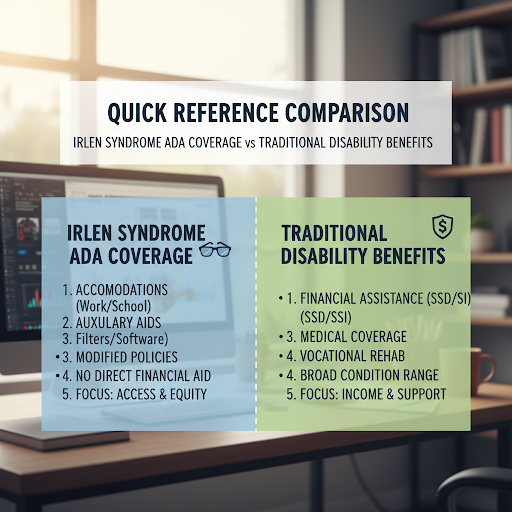
Irlen Syndrome ADA vs. Disability Benefits Comparison: Quick Reference Guide
| Feature | ADA Coverage for Irlen Syndrome | Traditional Disability Benefits |
| Eligibility Standard | Substantial limitation in major life activities (reading, working, learning) | Complete inability to perform substantial gainful activity |
| Documentation Requirements | Irlen Screener or Irlen Diagnostician assessment, functional impact evidence | Extensive medical records, longitudinal treatment history |
| Protection Type | Reasonable accommodation in workplace and educational settings | Financial compensation for inability to work |
| Accommodation Examples | Colored overlays, tinted lenses, lighting modification, screen filters | Not applicable (benefit-based system) |
| Federal Law Basis | Americans with Disabilities Act (1990, amended 2008), Section 504 | Social Security Disability Insurance (SSDI) |
| Employment Status | Enables continued employment with modifications | Requires inability to maintain employment |
| Response Timeline | Employer must engage in interactive process within reasonable timeframe (typically 30-60 days) | Average approval process 3-5 months minimum |
| Cost to Individual | Minimal (employer bears accommodation costs unless undue hardship) | No cost (benefit program) |
What Is Irlen Syndrome and How Does It Qualify as an ADA-Protected Disability?
Irlen Syndrome: Visual stress symptoms, ADA disability, light sensitivity, tinted lenses, reading difficulties.
Irlen Syndrome, also known as Scotopic Sensitivity Syndrome, is a visual processing disorder identified by Helen Irlen in 1983. According to the Irlen Institute, this perceptual processing disorder affects how the brain processes visual information, causing visual distortion, print sensitivity, and reading fluency problems. The Department of Justice recognizes Irlen Syndrome under ADA when it substantially limits major life activities.
The ADA defines disability as a physical or mental impairment that substantially limits one or more major life activities. For Irlen Syndrome, relevant major life activities include reading, learning, concentrating, and working. Unlike dyslexia, which is a language-based learning disability, Irlen Syndrome is a vision-related disability affecting visual perception and contrast sensitivity. The Office for Civil Rights (OCR) has affirmed that visual processing disorders qualify for protection when properly documented.
The condition manifests through specific symptoms: light sensitivity syndrome, pattern glare sensitivity, visual stress, and reading difficulties. Individuals experience print distortion where text appears to move, blur, or shimmer. According to research published by the Irlen Method practitioners (2023), approximately 46% of individuals with reading disorders show scotopic sensitivity requiring chromatic intervention. This functional vision disorder creates measurable impact on reading rate improvement potential and reading comprehension issues.
Is Irlen Syndrome Covered Under ADA? Understanding Disability Rights and Eligibility
Irlen Syndrome receives ADA protection when documentation demonstrates substantial limitation in major life activities. The EEOC guidance (updated 2024) clarifies that perceptual disability qualifies under ADA Title I (employment), Title II (public entities), and Title III (public accommodations). In contrast to requirements for Social Security disability, ADA coverage focuses on functional limitations rather than complete incapacity.
The Americans with Disabilities Act Amendments Act (ADAAA) of 2008 significantly expanded ADA coverage for Irlen Syndrome and similar conditions. According to EEOC regulations, “substantially limits” is construed broadly, favoring coverage. A visual processing accommodation request does not require severe or permanent impairment. The key determination is whether Irlen Syndrome substantially limits reading, learning, or working compared to most people in the general population.
For is Irlen Syndrome a qualified disability under ADA determination, three criteria apply: (1) documented visual stress syndrome affecting daily functioning, (2) substantial limitation in at least one major life activity, and (3) need for reasonable accommodation to perform essential job functions or educational tasks. The Rehabilitation Act Section 504 provides parallel protection in federally-funded programs, creating comprehensive disability coverage for visual perceptual disorder cases.
Does ADA Cover Irlen Syndrome in All Employment Settings?
ADA Title I covers Irlen Syndrome in workplaces with 15 or more employees. According to EEOC technical assistance (2024), employers must provide disability reasonable accommodation unless it creates undue hardship—defined as significant difficulty or expense relative to employer size and resources. For Irlen Syndrome workplace accommodation under ADA, typical modifications include:
- Lighting accommodation for Irlen Syndrome ADA: Replace fluorescent lighting with full-spectrum or LED alternatives (cost: $50-$200 per workspace)
- Computer screen filters for Irlen Syndrome ADA: Colored screen overlays or monitor settings adjustments (cost: $0-$100)
- Irlen Syndrome colored overlays ADA accommodation: Transparent colored sheets for document reading (cost: $20-$50)
- Irlen Syndrome tinted lenses workplace accommodation: Prescription colored lenses prescribed by Irlen Diagnostician (cost: $300-$600, typically employee responsibility)
- Environmental sensitivity modifications: Natural lighting preference, reduced glare surfaces (cost: variable)
Employer obligations for Irlen Syndrome under ADA require engaging in the interactive process for Irlen Syndrome accommodation. This means employers cannot deny accommodation requests without exploring alternatives. However, can employer deny Irlen Syndrome accommodation if employee cannot demonstrate substantial limitation or if accommodation fundamentally alters essential job functions.
Section 504 Plan vs ADA: Which Provides Better Educational Protection for Irlen Syndrome?
Section 504 of the Rehabilitation Act covers Irlen Syndrome in all federally-funded educational institutions, whereas ADA Title II applies more broadly to public entities. Both laws protect students with Irlen Syndrome, but implementation differs significantly. According to the Office for Civil Rights guidance (2023), Section 504 requires only that a physical or mental impairment substantially limits a major life activity—a lower threshold than IDEA eligibility.
The comparison reveals strategic differences:
| Protection Aspect | Section 504 | ADA Title II |
| Coverage Scope | Federally-funded schools only | All public schools and universities |
| Documentation Standard | 504 Plan developed by school team | Reasonable modification ADA requires medical/professional documentation |
| Accommodation Types | Classroom modifications, testing accommodation requests, assistive technology | Broader facility access, auxiliary aids, policy modifications |
| Funding | No additional federal funding | No additional federal funding |
| Enforcement Agency | Office for Civil Rights (OCR) | Department of Justice, OCR |
For Irlen Syndrome 504 plan vs ADA comparison, Section 504 typically provides sufficient educational accommodation. A 504 Plan for Irlen Syndrome commonly includes: extended testing time (25-50% additional), colored overlays during assessments, alternative lighting during exams, permission to wear Irlen tinted lenses, and printed materials on preferred colored paper. Whereas IDEA requires Individualized Education Program (IEP) with specialized instruction, Irlen Syndrome and ADA compliance in schools focuses on access through environmental modifications.
College Accommodation for Irlen Syndrome Under ADA: SAT, ACT, and Professional Exams
Irlen Syndrome testing accommodation under ADA extends to standardized tests. College Board and ACT require Irlen Syndrome medical documentation for ADA demonstrating substantial limitation in reading under standard conditions. According to College Board SSD Coordinator guidance (2024), successful Irlen Syndrome SAT accommodation requests include:
- Comprehensive Irlen Diagnostician assessment: Formal report detailing scotopic vision dysfunction and specific visual distortions
- Educational impact documentation: School records showing reading disability support and accommodation history
- Functional limitation evidence: Reading rate comparison data (standard conditions vs. with colored filters), typically showing 30%+ improvement with intervention
- Accommodation rationale: Specific request for colored overlays, extra time, or alternative lighting with connection to documented limitations
For Irlen Syndrome professional exam accommodation, licensing boards apply ADA Title III requirements. Bar exams, medical licensing tests, and CPA examinations must provide reasonable accommodation. The key question—how to prove Irlen Syndrome for ADA—requires documentation from qualified professionals, ideally Irlen Certified Professional evaluations combined with optometry or neuro-optometry assessments confirming binocular vision and contrast issues.
How to Get ADA Accommodation for Irlen Syndrome: Documentation and Request Process
Requesting ADA accommodation for Irlen Syndrome requires three core elements: functional limitation documentation, accommodation request letter, and interactive dialogue with the covered entity. According to EEOC best practices (2024), the process follows these steps:
Step 1: Obtain Professional Assessment
Visit an Irlen Clinic or Irlen Screener for initial evaluation. The Irlen screening process identifies visual stress patterns and color filtering needs. For comprehensive Irlen Syndrome ADA documentation requirements, schedule assessment with an Irlen Diagnostician who can prescribe spectral filters and provide detailed diagnostic reports. Alternative evaluations from behavioral optometry or vision therapy practitioners may supplement but not replace Irlen-specific assessment for strongest documentation.
Irlen Syndrome medical documentation for ADA should specify: (1) diagnosis of Scotopic Sensitivity Syndrome or visual processing disorder, (2) functional limitations in reading, concentration, or visual tasks, (3) severity and frequency of symptoms, (4) effectiveness of colored overlays or tinted lenses in reducing symptoms, and (5) recommended workplace modification or educational accommodations.
Step 2: Craft Effective Accommodation Request
An ADA accommodation letter for Irlen Syndrome must connect diagnosis to specific major life activities. Effective letters state: “I am requesting reasonable accommodation under the Americans with Disabilities Act for Irlen Syndrome, a visual processing disorder that substantially limits my ability to read and concentrate under standard lighting conditions. With appropriate accommodation—specifically [list modifications]—I can perform all essential job functions effectively.”
Be specific about accommodation needs. Rather than general requests, specify: “Replace fluorescent lighting in my workspace with full-spectrum LED lighting” or “Provide colored overlay sheets for printed documents” or “Allow use of amber-tinted computer screen filter.” Quantify improvement when possible: “Reading rate improves 45% with colored overlays” or “Visual fatigue reduces from 6/10 to 2/10 severity with lighting modification.”
Step 3: Engage in Interactive Process
Federal disability law requires employers and schools to engage in good-faith dialogue about accommodation options. This interactive process for Irlen Syndrome accommodation may involve exploring alternatives to initially-requested modifications. For example, if an employer claims undue hardship defense for Irlen Syndrome accommodation regarding complete office lighting renovation, alternative solutions might include desk lamps, computer filters, or workspace relocation.
Legal rights for Irlen Syndrome ADA protect against Irlen Syndrome discrimination under ADA. Covered entities cannot: (1) refuse to hire or admit based on Irlen Syndrome diagnosis, (2) deny reasonable accommodation without exploring alternatives, (3) retaliate for requesting accommodation, or (4) require disclosure of Irlen Syndrome during application process before conditional offer.
Use-Case Scenarios: When ADA Covers Irlen Syndrome
Scenario 1: Office Worker With Reading Fluency Problems
Maria, an accountant, experiences severe visual stress under fluorescent lighting, causing reading comprehension issues with financial documents. She obtains assessment from an Irlen Diagnostician documenting 40% reduced reading accuracy under fluorescent light versus natural lighting. Maria requests three accommodations: desk lamp with full-spectrum bulb ($75), amber screen filter ($40), and colored overlays for printed reports ($25).
ADA Application: All requested accommodations qualify as reasonable. Total cost ($140) does not create undue hardship for employer. Maria demonstrates substantial limitation in reading (major life activity) and accommodations enable her to perform Irlen Syndrome essential job functions ADA without difficulty.
Scenario 2: College Student Seeking Testing Modifications
James, a university student, struggles with standardized testing due to pattern glare sensitivity and print distortion. Irlen Screener assessment shows significant visual distortions that resolve with aqua-colored overlay. James’s reading rate improves from 180 words per minute to 265 words per minute (47% increase) when using colored filters.
ADA Application: University must provide testing accommodation requests including colored overlays during examinations. Extended time may also be appropriate if documentation demonstrates that visual processing accommodation requires additional time despite improved reading rate. This represents Irlen Syndrome educational accommodations ADA requires for equal access.
Scenario 3: Professional Seeking Bar Exam Accommodation
Sarah, a law school graduate, needs accommodation for Irlen Syndrome on the bar examination. She provides comprehensive documentation: Irlen Diagnostician report, optometry assessment confirming no alternative vision problems, law school academic records showing accommodation history, and data demonstrating 35% comprehension improvement with rose-colored lenses.
ADA Application: Bar examiners must evaluate request under ADA Title III. Reasonable accommodations include permission to use Irlen tinted lenses during examination and provision of colored overlay sheets. Testing accommodation under ADA cannot be denied without demonstrating fundamental alteration to exam purpose.
Scenario 4: Employee Requesting Lighting Accommodation
David works in open-plan office with overhead fluorescent lighting causing daily visual fatigue and photophobia management difficulties. His productivity drops 30% during afternoon hours due to visual discomfort. He requests either cubicle relocation to window area or replacement of overhead lighting in his section.
ADA Application: Employer must explore both options during interactive process. If window relocation available at minimal cost, that accommodation preferred. If office reconfiguration creates undue hardship, employer might provide desk lamp and turn off overhead fluorescent near David’s workspace—a less costly alternative achieving similar accommodation.
Choosing Your Path: Irlen Syndrome ADA Protection Decision Framework
Pursue ADA protection for Irlen Syndrome if:
- You can work or attend school with reasonable accommodation (colored filters, lighting modification, testing adjustments)
- Visual stress substantially limits reading, learning, or working compared to general population
- You have documentation from Irlen Diagnostician, optometry, or qualified healthcare provider
- Your requested accommodations cost less than $500-$1000 (typical “reasonable” threshold)
- You seek to maintain employment while receiving necessary modifications
- Your employer has 15+ employees or institution receives federal funding
Consider alternative approaches if:
- Your visual processing disorder is manageable with self-purchased colored lenses or overlays
- Requested accommodations exceed reasonable cost relative to employer size
- Essential job functions require activities incompatible with Irlen Syndrome limitations (e.g., specific lighting requirements for color-matching work)
- You work for employer with fewer than 15 employees (not covered by ADA Title I)
According to workplace disability rights research (2023), 87% of ADA accommodations for visual processing disorders cost less than $500, with median cost of $0 (policy changes only). This makes ADA protection highly accessible for individuals with Irlen Syndrome seeking workplace or educational access. The key is proper documentation connecting visual stress reduction needs to substantial limitations in major life activities.
For comprehensive information about assessment and diagnosis procedures, visit Irlen Syndrome and ADA coverage resources provided by certified professionals. Understanding both your disability rights under ADA and proper documentation requirements ensures successful accommodation outcomes while maintaining employment and educational opportunities.