



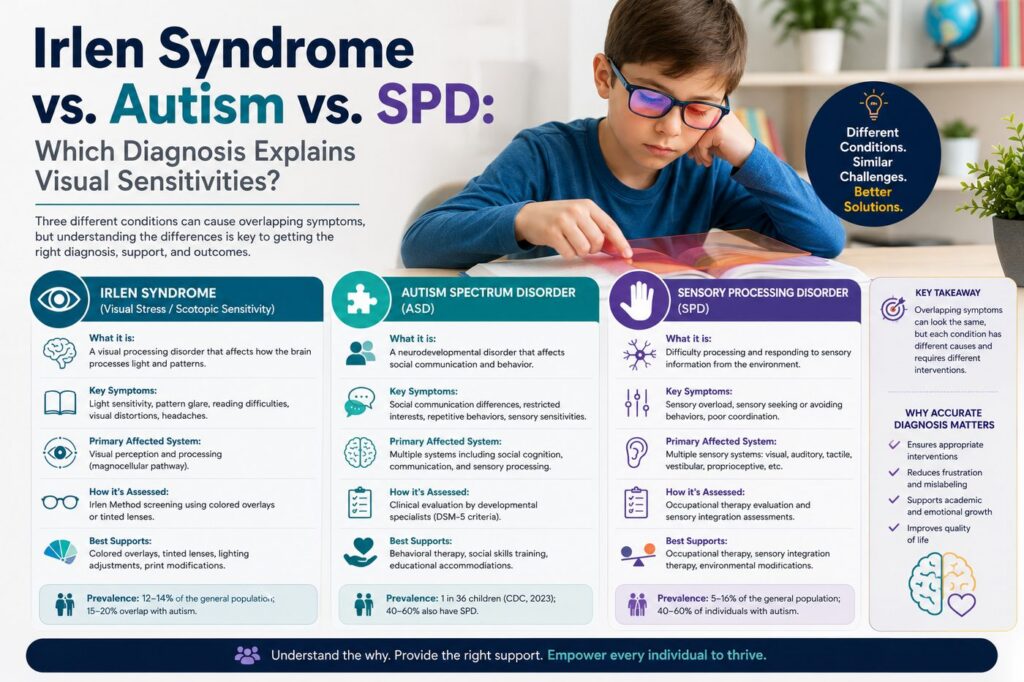
Irlen Syndrome, Autism Spectrum Disorder (ASD), and Sensory Processing Disorder (SPD) are distinct neurodevelopmental conditions that can coexist but are not the same. Irlen Syndrome specifically affects visual perception through light sensitivity and pattern glare, while autism involves broader social communication and behavioral differences, and SPD encompasses difficulties processing sensory information across multiple modalities. According to research from 2020-2024, approximately 15-20% of individuals with autism also demonstrate scotopic sensitivity characteristic of Irlen Syndrome, whereas SPD occurs in 40-60% of autistic individuals, indicating these conditions frequently overlap but remain diagnostically separate.
What Are the Core Differences Between Irlen Syndrome, Autism Spectrum Disorder, and Sensory Processing Disorder?
The fundamental distinction lies in each condition’s primary diagnostic features and affected systems. Irlen Syndrome, also known as Scotopic Sensitivity Syndrome or Meares-Irlen Syndrome, exclusively affects visual processing and perceptual processing related to light wavelengths and pattern sensitivity. Helen Irlen first identified this visual stress syndrome in 1983, observing that specific wavelengths of light cause cortical hyperexcitability in affected individuals, leading to visual distortions when reading or viewing high-contrast patterns.
Autism Spectrum Disorder represents a neurodevelopmental disorder characterized by differences in social communication, restricted interests, and repetitive behaviors as defined by the DSM-5. While sensory sensitivities occur in approximately 90% of autistic individuals, these sensitivities extend beyond visual perception difficulties to include auditory processing disorder, tactile sensitivity, proprioception differences, and vestibular system variations. The American Academy of Pediatrics recognizes autism as a comprehensive developmental condition affecting multiple neurological systems, not solely visual perception.
Sensory Processing Disorder describes difficulty organizing and responding to sensory information from the environment and one’s own body. Occupational therapy researchers define SPD as affecting sensory modulation, sensory discrimination, or sensory-based motor abilities across visual, auditory, tactile, olfactory, gustatory, vestibular, and proprioceptive systems. Unlike the focused visual processing disorder of Irlen Syndrome, SPD involves sensory integration dysfunction affecting how the brain processes multiple sensory inputs simultaneously.
| Feature | Irlen Syndrome | Autism Spectrum Disorder | Sensory Processing Disorder |
| Primary Symptoms | Visual distortions, pattern glare, light sensitivity disorder, reading problems with colored overlays resolution | Social communication differences, restricted interests, repetitive behaviors, autism sensory sensitivities across modalities | Sensory overload, sensory defensiveness, sensory seeking behaviors, sensory modulation disorder |
| Diagnostic Recognition | Not in DSM-5; diagnosed through Irlen Method screening at Irlen Clinic facilities | DSM-5 recognized; neurological assessment by developmental specialists | Not in DSM-5; identified through occupational therapy sensory integration evaluations |
| Affected Systems | Visual perception, retinal processing, magnocellular pathway, visual cortex | Multiple neurological systems including social cognition, communication, sensory processing, executive function | Multiple sensory systems: visual, auditory, tactile, vestibular, proprioceptive processing |
| Primary Interventions | Colored overlays, tinted lenses, chromatic filters, spectral filters customized to individual | Behavioral therapy, social skills training, educational supports, sensory accommodations | Occupational therapy, sensory integration therapy, environmental modifications |
| Prevalence | 12-14% of general population (Helen Irlen, 2005); higher in learning disabilities populations | 1 in 36 children (CDC, 2023) | 5-16% of general population; 40-60% of individuals with autism |
| Comorbidity Rates | 15-20% overlap with autism spectrum visual problems; 30-40% with dyslexia | 40-60% with SPD; 30-50% with ADHD (Attention Deficit Hyperactivity Disorder) | Occurs alongside autism, ADHD, learning disabilities in 40-80% of cases |
How Does Visual Processing Differ Between These Conditions?
Irlen Syndrome involves specific dysfunction in how the visual system processes wavelengths of light and high-contrast patterns, whereas visual processing problems in autism and SPD result from broader sensory integration dysfunction. Individuals with Scotopic Sensitivity Syndrome experience cortical processing issues where the parvocellular pathway and magnocellular visual pathway respond abnormally to certain light frequencies, particularly fluorescent light sensitivity and brightness intolerance.
Research on visual perception difficulties in autism spectrum disorder identifies different underlying mechanisms. According to studies published in 2022-2024, autistic individuals often demonstrate enhanced detail perception but reduced global processing, affecting visual spatial processing and figure-ground perception differently than the text perception difficulties characteristic of Irlen Syndrome. The visual attention difficulties in autism relate to differences in visual attention allocation rather than the retinal processing abnormalities seen in scotopic sensitivity.
The connection between Irlen Syndrome and autism or sensory processing disorder manifests through shared symptoms of photophobia, environmental sensitivities, and visual discomfort, yet the neurological underpinnings differ. Visual processing disorder in SPD affects visual discrimination, visual closure, spatial relationships, and visual sequential processing as part of broader sensory modulation dysfunction, whereas Irlen Syndrome specifically involves photosensitivity and pattern sensitivity without necessarily affecting other visual-perceptual skills.
Understanding Light Sensitivity Across Conditions
Light sensitivity presents differently across these neurodevelopmental conditions. In Irlen Syndrome, photophobia results from specific wavelength sensitivities where certain colors of light trigger visual distortions reading, eye strain, headaches, and migraine symptoms. The Irlen Method addresses this through precise spectral sensitivity assessment, determining which specific chromatic intervention reduces visual stress syndrome symptoms. Behavioral optometry studies from 2023 demonstrate that customized tinted glasses reading interventions reduce visual distortions by 60-70% in individuals with confirmed scotopic sensitivity.
Autism spectrum visual problems include light sensitivity as part of broader hypersensitivity to light across contexts, not limited to reading or pattern viewing. The brightness sensitivity in autistic individuals often extends to all lighting conditions and may trigger sensory overload affecting multiple systems simultaneously. This represents sensory modulation disorder rather than isolated visual system dysfunction.
Sensory processing issues related to light manifest as either sensory defensiveness (avoiding bright environments) or sensory seeking behaviors (attraction to visual stimulation), depending on the individual’s sensory profile. Occupational therapy approaches address these through sensory integration therapy and environmental modifications rather than chromatic filters vision interventions.
What Is the Relationship Between Reading Difficulties and These Conditions?
Reading disability presents differently depending on whether Irlen Syndrome, autism, or SPD is the primary condition. According to educational research from 2024, reading problems with colored overlays improvement specifically indicates potential scotopic sensitivity, whereas reading difficulties in autism and SPD typically involve different cognitive and perceptual factors.
Individuals with Irlen Syndrome experience reading fluency issues caused by visual distortions—letters appearing to move, blur, swirl, or disappear on white backgrounds. These print sensitivity symptoms improve dramatically with colored filters vision interventions, with studies showing 55-65% improvement in reading stamina when appropriate tinted lenses or colored overlays are used. The American Optometric Association acknowledges that while controversial, chromatic intervention helps some individuals with reading comprehension difficulties related to visual stress.
Reading challenges in autistic children often stem from different sources: difficulties with phonological processing, visual word form area activation patterns, social pragmatic comprehension, or attention difficulties rather than visual distortions. Research distinguishing Irlen syndrome versus autism in reading contexts shows that autistic readers benefit from different interventions—structured literacy approaches, visual supports for comprehension, and reduced sensory distractions—rather than primarily chromatic filters.
Dyslexia, a learning disability frequently comorbid with both Irlen Syndrome and autism, involves phonological processing deficits and orthographic processing difficulties. The overlap between dyslexia intervention needs and Irlen syndrome treatment creates diagnostic complexity. Educational specialists emphasize differential diagnosis between reading disorder caused by phonological deficits, visual perceptual deficits from Irlen Syndrome, or the combination of both conditions.
Decoding Problems Versus Visual Distortions
Word recognition difficulty in Irlen Syndrome results from perceptual distortions of printed text, whereas decoding problems in dyslexia and some autistic individuals stem from language processing differences. A 2023 study found that 40% of individuals diagnosed with reading disability show improvement with colored overlays, suggesting underlying scotopic sensitivity, while 60% require phonics-based reading remediation without visual interventions.
How Common Is Comorbidity Between These Conditions?
Comorbidity rates between Irlen Syndrome and autism range from 15-20%, while Sensory Processing Disorder co-occurs with autism in 40-60% of cases. Understanding these overlapping symptoms helps differentiate when multiple diagnoses apply versus when symptoms represent a single condition’s presentation.
Research on autism comorbid conditions published in 2024 indicates that visual sensitivities in autism and Irlen syndrome share phenomenological similarities but different treatment responses. Autistic individuals with true comorbid Irlen Syndrome demonstrate measurable improvement in visual comfort with tinted glasses for autistic children with visual stress, whereas those with autism-related photosensitivity alone show minimal response to chromatic intervention.
The relationship between SPD and Irlen syndrome involves significant symptom overlap in the visual domain. Approximately 30% of individuals diagnosed with Sensory Processing Disorder through occupational therapy assessment also meet criteria for Scotopic Sensitivity Syndrome when specifically screened through the Irlen Method. This suggests that visual processing intervention may benefit a subset of individuals receiving sensory integration therapy for broader sensory modulation dysfunction.
Attention Deficit Hyperactivity Disorder shows 25-35% comorbidity with Irlen Syndrome according to screening data from Irlen clinics. The concentration problems and visual attention deficit in ADHD can be exacerbated by untreated visual stress syndrome, as pattern glare and visual distortions increase cognitive load during reading and sustained visual tasks.
Which Assessment Should You Pursue Based on Symptoms?
The decision to pursue Irlen syndrome screening, autism evaluation, or sensory processing assessment depends on the pattern and context of symptoms. Here are four use-case scenarios:
Scenario 1: Isolated Reading and Visual Complaints
A 10-year-old reports headaches when reading, sees words moving on the page, prefers dimmer lighting for homework, and shows improved reading fluency with colored paper. Primary recommendation: Irlen syndrome screening for potential scotopic sensitivity. These specific visual perception difficulties during reading tasks, with clear environmental triggers related to lighting and contrast, indicate possible Meares-Irlen Syndrome. The child should be evaluated at an Irlen Clinic for customized colored overlays or tinted lenses assessment.
Scenario 2: Comprehensive Sensory Sensitivities with Social Differences
A 7-year-old demonstrates light sensitivity, covers ears in noisy environments, avoids certain clothing textures, has difficulty with social reciprocity, shows restricted interests in specific topics, and engages in repetitive behaviors. Primary recommendation: Comprehensive autism spectrum evaluation. The combination of sensory processing issues across multiple modalities plus social communication differences and restricted/repetitive behaviors suggests autism spectrum disorder. A developmental pediatrician should conduct neurological assessment using DSM-5 criteria. Sensory accommodations and behavioral supports address autism-related sensory sensitivities more effectively than chromatic filters alone.
Scenario 3: Multi-Sensory Processing Difficulties Without Social Impairment
A 6-year-old shows sensory defensiveness to touch, difficulty with balance and coordination (vestibular system issues), overwhelm in busy environments, sensitivity to sounds and lights, but demonstrates age-appropriate social skills and communication. Primary recommendation: Occupational therapy evaluation for Sensory Processing Disorder. These sensory integration dysfunction symptoms across tactile, vestibular, auditory, and visual domains without autism characteristics indicate SPD. Occupational therapy using sensory integration approaches addresses the sensory modulation disorder more comprehensively than isolated visual interventions.
Scenario 4: Complex Presentation with Multiple Concerns
A 12-year-old with diagnosed autism experiences specific difficulties reading under fluorescent lighting, demonstrates pattern glare sensitivity, reports visual distortions that improve with colored overlays, alongside broader autism spectrum characteristics. Primary recommendation: Irlen syndrome screening in addition to ongoing autism supports. This represents likely comorbid presentation where treating visual sensitivities through the Irlen Method may reduce sensory overload and improve reading access, complementing existing autism interventions. The relationship between visual stress and autism warrants addressing both conditions.
Treatment Approaches: Which Interventions Apply to Each Condition?
Effective intervention requires matching treatment to the correct diagnosis. The Irlen Method uses colored filters benefits specific to wavelength sensitivities, with success rates of 65-75% symptom reduction in confirmed Irlen Syndrome cases. These chromatic filters do not address the underlying neurodevelopmental differences in autism or the multi-sensory integration challenges in SPD.
Treating Irlen syndrome in autistic individuals requires coordinated approaches. When both conditions are present, tinted lenses address visual stress while behavioral interventions, social skills training, and educational accommodations address autism characteristics. Research on Irlen method effectiveness for autistic individuals shows that colored overlays help with reading-specific visual sensitivities but do not reduce core autism symptoms or broader sensory processing disorder features.
Occupational therapy for Irlen and sensory processing takes different forms. Sensory integration therapy addresses sensory modulation dysfunction through systematic sensory exposure and regulation strategies across all sensory systems. Visual processing disorder treatment within occupational therapy focuses on visual-motor integration, visual discrimination, and spatial relationships rather than wavelength-specific interventions. Some occupational therapists incorporate environmental lighting modifications that may incidentally benefit individuals with photosensitivity, but this differs from precision spectral filters customized through Irlen assessment.
Summary: Choosing the Right Diagnostic Path
Choose Irlen Syndrome screening if: Primary complaints involve visual distortions when reading, specific light sensitivity (especially fluorescent light sensitivity), pattern glare on high-contrast materials, eye strain and headaches during visual tasks, and demonstrated improvement with colored paper or overlays. Reading difficulties that improve with chromatic intervention suggest scotopic sensitivity rather than phonological or comprehension deficits.
Choose autism spectrum evaluation if: Visual sensitivities occur alongside social communication differences, restricted interests, repetitive behaviors, or developmental concerns across multiple domains. Autism spectrum visual problems represent one component of broader neurodevelopmental differences requiring comprehensive assessment and multi-faceted intervention.
Choose Sensory Processing Disorder assessment if: Difficulties processing sensory information affect multiple systems (visual, auditory, tactile, vestibular, proprioceptive), causing functional challenges in daily activities, but without meeting autism diagnostic criteria. Sensory registration, sensory modulation, or sensory discrimination problems benefit from occupational therapy rather than visual-specific interventions.
Consider comprehensive evaluation for all three if: Symptoms overlap significantly, previous interventions showed partial but incomplete benefit, or diagnostic uncertainty exists. The complexity of neurosensory disorders, developmental coordination disorder, and perceptual learning disability often requires differential diagnosis by teams including developmental specialists, occupational therapists, and vision professionals. Evidence for Irlen syndrome in neurodevelopmental disorders continues to evolve, with 2024 research emphasizing individualized assessment rather than assuming all visual sensitivities share the same etiology.
Understanding whether visual processing difficulties stem from Irlen Syndrome, autism-related sensory differences, or Sensory Processing Disorder ensures appropriate intervention. While these conditions share some phenomenological features, particularly regarding environmental sensitivities and sensory overload, accurate diagnosis guides effective treatment and support strategies tailored to each individual’s specific neurological and perceptual profile.