



Parents and educators frequently encounter children struggling with concentration difficulties, reading challenges, and behavioral issues that complicate academic performance. When these symptoms emerge, professionals often focus immediately on Attention Deficit Hyperactivity Disorder as the primary explanation. However, the link between Irlen Syndrome and ADHD presents a more complex diagnostic picture that requires careful consideration and comprehensive evaluation. Both conditions share remarkably similar behavioral manifestations, creating potential for diagnostic confusion and misidentification.
Understanding the relationship between these neurodevelopmental conditions proves essential for appropriate intervention strategies and educational accommodations. Scotopic Sensitivity Syndrome, also known as Visual Stress, affects how the brain processes visual information, while ADHD impacts executive function and attention regulation. The overlapping symptoms between these distinct conditions often lead families down lengthy diagnostic pathways, sometimes receiving partial explanations for their child’s academic struggles and sensory processing issues.
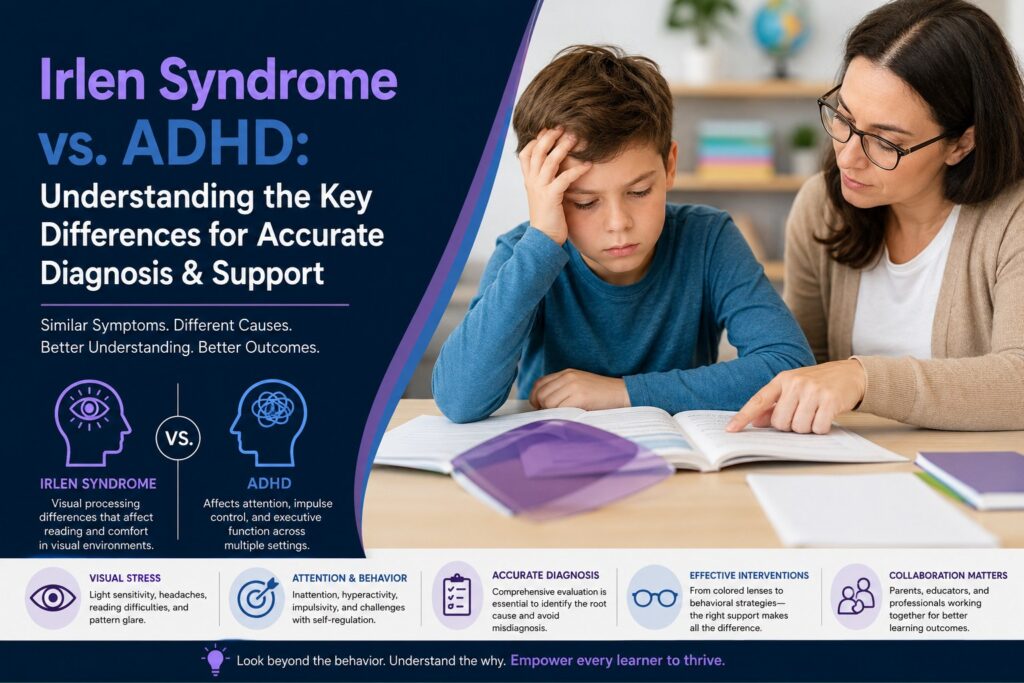
Irlen Syndrome Creates Visual Processing Challenges in Learning Environments
Helen Irlen first identified this perceptual processing disorder in the 1980s, discovering that certain individuals experience significant visual distortions when viewing printed text and patterns. The condition affects the Magnocellular Pathway, a neural system responsible for processing motion, depth perception, and visual timing. Individuals with this disorder experience pattern glare, light sensitivity, and visual discomfort that substantially impact reading performance and concentration.
The Irlen Method utilizes colored overlays and tinted lenses to filter specific wavelengths of light, reducing visual stress syndrome and improving reading comprehension. Those affected may experience headaches, eye strain, and visual fatigue from fluorescent lighting and high-contrast environments. These environmental sensitivities create behavioral responses that closely mimic attention problems, as individuals naturally avoid uncomfortable reading tasks and struggle to maintain focus during visually demanding activities.
What Are the Primary Symptoms of Visual Stress?
Visual perception issues manifest through numerous observable behaviors that educational professionals and parents commonly attribute to learning disabilities or attention disorders. Children experiencing visual disturbances may squint, rub their eyes frequently, use their finger as a reading guide, lose their place while reading, or skip words and lines. These compensatory behaviors emerge from underlying perceptual difficulties rather than cognitive deficits or willful inattention to academic tasks.
The sensory overload created by standard classroom lighting and printed materials produces restlessness, avoidance behaviors, and apparent distractibility. Students may demonstrate excellent listening comprehension while struggling significantly with written work, creating an inconsistent performance profile. This discrepancy often confuses educators who expect uniform academic abilities across different modalities, leading to questions about motivation rather than recognition of genuine visual processing deficits affecting reading accuracy and endurance.
Attention Deficit Hyperactivity Disorder Affects Executive Function and Behavioral Regulation
ADHD represents a neurodevelopmental disorder characterized in the DSM-5 by persistent patterns of inattention, hyperactivity, and impulsivity that interfere with functioning across multiple settings. The condition affects approximately 5-10% of children globally, impacting executive function, working memory, and self-regulation abilities. Stimulant medication, such as methylphenidate, remains the most common treatment approach, alongside behavioral interventions and educational accommodations through IEP or 504 Plan modifications.
The American Academy of Pediatrics provides comprehensive diagnostic guidelines requiring symptom presentation across home, school, and social environments. Children with this attention disorder demonstrate difficulty sustaining focus during tasks, appear not to listen when directly addressed, struggle with organization, and exhibit excessive physical activity. These behavioral issues stem from neurological differences in brain function affecting the prefrontal cortex and dopamine regulation systems, creating genuine challenges with attention control and impulse management.
How Does ADHD Impact Academic Performance?
Academic struggles in students with Attention Deficit Hyperactivity Disorder extend beyond simple concentration problems to encompass complex cognitive processing challenges. Difficulty with attention regulation affects reading comprehension, mathematical problem-solving, written expression, and test-taking performance. Students frequently start assignments but fail to complete them, make careless errors despite understanding content, and struggle with time management and planning skills essential for academic success.
The executive function deficit creates challenges with task initiation, sustained mental effort, and transitioning between activities. These students often require significant redirection, demonstrate inconsistent performance, and struggle particularly with tasks requiring prolonged mental focus. However, they may hyperfocus on preferred activities, demonstrating sustained concentration when intrinsically motivated, which differentiates the condition from generalized cognitive limitations and suggests neurological differences in motivation and reward processing systems.
Overlapping Symptoms Create Diagnostic Confusion Between Conditions
The similarity in behavioral manifestations between Visual Stress and attention problems presents significant challenges for accurate identification and appropriate intervention selection. Both conditions produce difficulty sustaining attention during reading tasks, avoidance of written work, restlessness during desk work, and inconsistent academic performance. This symptom overlap leads to situations where Irlen Syndrome gets misdiagnosed as ADHD, or students receive partial diagnoses that address only one aspect of their complex learning challenges.
Professionals untrained in recognizing sensory sensitivity and visual processing disorder may interpret visual discomfort behaviors exclusively through an attention deficit lens. When students demonstrate improved concentration during hands-on activities versus reading tasks, evaluators may attribute this pattern to learning style preferences rather than investigating underlying perceptual difficulties. The comorbidity of these conditions further complicates the diagnostic picture, as research suggests individuals can genuinely have both Irlen Syndrome and ADHD simultaneously, requiring comprehensive treatment approaches addressing each distinct challenge.
Can Visual Processing Issues Cause ADHD-Like Symptoms?
Perceptual disorder symptoms frequently produce secondary behavioral responses that appear identical to primary attention disorders. When visual input processing creates discomfort, headaches, or visual distortions, children naturally exhibit avoidance behaviors, fidgeting, and apparent inattention. These responses represent adaptive strategies to reduce sensory overload rather than underlying executive function deficits, yet they manifest identically to hyperkinetic disorder symptoms in classroom observations.
The focusing problems caused by visual accommodation difficulties and contrast problems differ neurologically from attention regulation challenges, yet produce comparable observable behaviors. Students experiencing pattern sensitivity may lose concentration not from executive dysfunction but from genuine visual fatigue and eye strain. This distinction carries profound implications for intervention selection, as treating visual stress causing ADHD-like symptoms with stimulant medication alone fails to address the underlying perceptual processing difficulties contributing significantly to academic struggles and behavioral concerns.
| Feature | Irlen Syndrome | ADHD |
| Primary Deficit | Visual processing and light sensitivity | Executive function and attention regulation |
| Reading Difficulties | Due to visual distortions and pattern glare | Due to sustained attention challenges |
| Environmental Triggers | Fluorescent lighting, high contrast, patterns | Distracting stimuli, understimulating environments |
| Listening Comprehension | Typically strong when visual component removed | May struggle with auditory attention as well |
| Primary Intervention | Colored overlays, tinted lenses, lighting modifications | Medication, behavioral therapy, executive function training |
| Response to Color Filtering | Significant improvement in visual comfort and reading | Minimal to no impact on core attention symptoms |
Comprehensive Evaluation Differentiates Visual and Attention Processing Disorders
Accurate identification requires assessment by multiple specialists, including professionals in neuropsychology, behavioral optometry, and educational psychology. An Irlen Screener conducts initial evaluations using colored overlays to identify light filtering benefits, while a certified diagnostician performs comprehensive testing to determine precise tinted lenses specifications. Meanwhile, ADHD diagnosis requires extensive behavioral observation, rating scales across settings, developmental history, and cognitive assessment to establish executive function profiles and rule out alternative explanations.
The American Optometric Association recognizes vision therapy and specialized vision correction as distinct from standard ophthalmology examinations. Comprehensive vision assessments evaluate visual tracking, binocular vision disorder, convergence problems, and depth perception problems that standard eye charts miss entirely. When combined with neuropsychological testing examining working memory, processing speed, and attention control, professionals develop complete diagnostic pictures distinguishing primary attention disorders from vision problems that mimic ADHD or identifying comorbid conditions requiring integrated treatment approaches.
Why Is Proper Screening for Both Conditions Important?
Incomplete evaluation leads to intervention strategies that address only partial aspects of a child’s learning challenges, leaving significant difficulties unresolved and families frustrated. Students receiving ADHD medication without visual stress identification may show improved general attention but continue struggling specifically with reading tasks and screen sensitivity. This incomplete response pattern should prompt investigation of additional contributing factors rather than simply increasing medication dosage or concluding treatment has failed.
Conversely, addressing visual processing deficit without recognizing co-occurring executive function deficit leaves attention regulation challenges, impulsive behavior, and working memory problems unaddressed. Comprehensive screening enables development of individualized educational programs incorporating appropriate accommodations for both conditions. Special education teams can implement lighting modifications, provide colored filters, extend time for reading assignments, incorporate movement breaks, and structure tasks appropriately when they understand the complete profile of learning challenges affecting student performance and behavior.
Treatment Approaches Address Visual Stress and ADHD Through Complementary Interventions
Managing these conditions requires distinct yet potentially complementary strategies targeting their unique neurological foundations. The Irlen Method provides precisely tinted lenses or colored overlays after comprehensive screening determines optimal color combinations reducing visual discomfort and improving reading speed. Environmental modifications include adjusting lighting, reducing glare, using cream-colored paper, and formatting documents with increased spacing to minimize pattern glare sensitivity and visual fatigue during academic tasks.
ADHD treatment typically combines stimulant medication or non-stimulant alternatives with behavioral interventions, executive function training, and environmental accommodations. Occupational therapy addresses sensory processing disorder components, while educational accommodations through 504 plans or IEPs provide preferential seating, extended time, movement breaks, and organizational support. When conditions co-occur, integrated treatment plans address both the perceptual difficulties and attention regulation challenges, maximizing academic success and reducing behavioral issues through comprehensive, individualized approaches.
Do Colored Lenses Help Students With ADHD?
Research examining colored lenses improving ADHD symptoms shows limited direct benefit for core executive function deficits when visual processing disorder does not co-exist. Students with pure attention disorders without underlying visual stress typically demonstrate no significant response to chromatic filtering or overlay therapy. This lack of response actually provides diagnostic information, suggesting attention difficulties stem primarily from executive dysfunction rather than visual perception issues contributing to concentration problems.
However, for individuals with comorbid conditions experiencing both attention deficit disorder and scotopic sensitivity, Irlen lenses address the visual component while stimulant medication or behavioral interventions target attention regulation. This complementary treatment approach recognizes the neurological connection between different processing systems while acknowledging that visual interventions for ADHD symptoms prove effective only when genuine visual system dysfunction contributes to observable behavioral manifestations and academic performance issues.
Educational Accommodations Support Students With Visual Processing and Attention Challenges
Classroom strategies for students with these conditions require understanding their distinct needs while recognizing practical implementation considerations. Visual accommodations include providing colored overlays for reading materials, adjusting classroom lighting, using non-glossy paper, allowing tinted glasses, positioning students away from windows, and providing digital materials with customizable backgrounds. These environmental modifications reduce sensory processing issues and visual discomfort affecting reading endurance and concentration during visually demanding tasks.
ADHD accommodations address attention span, organization, and behavioral regulation through preferential seating near instruction, minimizing distractions, providing fidget tools, incorporating movement breaks, using visual schedules, breaking tasks into smaller components, and allowing extended time. When students present with both conditions, educational teams develop comprehensive accommodation packages addressing visual stress syndrome and executive function challenges simultaneously, creating optimal learning environments supporting diverse neurological processing differences and maximizing academic achievement potential.
What Should Parents Request in IEP Modifications for These Conditions?
Parents advocating for comprehensive educational support should request assessment by certified Irlen screeners when visual stress symptoms appear alongside formal psychoeducational evaluation examining attention and executive function. Documentation from behavioral optometry specialists and neuropsychologists strengthens requests for specific accommodations addressing identified deficits. IEP modifications should explicitly state environmental accommodations, assistive technology provisions, testing modifications, and instructional strategies targeting both visual processing and attention regulation challenges.
Specific provisions might include access to colored overlays or tinted lenses during all reading activities, modified lighting in testing environments, digital texts with adjustable formatting, extended time accounting for both visual fatigue and processing speed, preferential seating considerations, and scheduled movement breaks. Progress monitoring should track both reading accuracy and speed alongside attention regulation and task completion, ensuring interventions effectively address the complete profile of learning challenges rather than focusing exclusively on single diagnostic categories.
- Request comprehensive vision assessment by behavioral optometry specialists beyond standard eye examinations
- Seek Irlen screening from certified diagnosticians when light sensitivity and reading difficulties persist
- Obtain neuropsychological evaluation examining executive function, attention, and processing speed
- Document response to colored overlays, lighting modifications, and other environmental adjustments
- Track academic performance across different modalities to identify discrepancy patterns
- Monitor behavioral responses to various classroom environments and task demands
Frequently Asked Questions
Can Irlen Syndrome be mistaken for ADHD?
Yes, Irlen Syndrome frequently gets misdiagnosed as ADHD because both conditions produce similar observable behaviors including difficulty concentrating during reading tasks, restlessness, avoidance of written work, and inconsistent academic performance. The visual discomfort and sensory overload caused by visual processing difficulties create secondary behavioral responses that appear identical to attention deficit symptoms. Comprehensive evaluation by specialists trained in both conditions helps distinguish between these neurologically distinct disorders and identify when both co-exist.
How common is it to have both Irlen Syndrome and ADHD?
Research on the precise comorbidity rates between Irlen Syndrome and ADHD remains limited, though clinical observations suggest these conditions can co-occur in some individuals. Both represent neurodevelopmental conditions affecting different processing systems — visual perception versus executive function — and having one does not preclude having the other. Comprehensive assessment becomes particularly important when students show partial response to ADHD interventions, as unidentified visual processing challenges may continue contributing to academic struggles despite appropriate attention disorder treatment.
Will treating Irlen Syndrome help ADHD symptoms?
Treating Irlen Syndrome through colored lenses and environmental modifications helps only those ADHD-like symptoms directly caused by visual stress and perceptual difficulties. When inattention, restlessness, and task avoidance stem from visual discomfort rather than true executive function deficits, addressing the visual processing issues may substantially improve concentration and behavior. However, core ADHD symptoms related to neurological differences in attention regulation, impulse control, and executive function require separate interventions including medication, behavioral therapy, and appropriate accommodations rather than visual interventions alone.
When should children with ADHD be tested for Irlen Syndrome?
Children with ADHD should undergo Irlen screening when they demonstrate specific visual stress indicators including light sensitivity, headaches during reading, reports of text movement or blurring, significantly better listening comprehension than reading comprehension, or inadequate response to standard ADHD interventions for reading difficulties. Additional indicators include preference for dim lighting, avoidance of high-contrast materials, eye rubbing, and excessive blinking during visual tasks. Irlen evaluation becomes particularly valuable when discrepancies exist between different academic performance areas, suggesting multiple contributing factors beyond attention regulation challenges.
Understanding the relationship between visual processing challenges and attention regulation difficulties enables parents, educators, and healthcare providers to develop comprehensive intervention strategies addressing the full spectrum of learning challenges students face. While the link between Irlen Syndrome and ADHD involves complex diagnostic considerations, proper identification and targeted treatment of each condition creates pathways toward academic success and reduced frustration for struggling learners.
Have you encountered situations where visual stress symptoms were initially attributed to attention problems, or where comprehensive evaluation revealed multiple contributing factors to learning difficulties? Share your experiences and questions in the comments below, and consider consulting certified diagnosticians and neuropsychology specialists for thorough assessment when overlapping symptoms create diagnostic uncertainty. Understanding these nuanced differences transforms intervention effectiveness and educational outcomes for children navigating complex neurodevelopmental challenges.