



Standard Colored Sunglasses: 7 Pros and Cons to Consider 2025
Standard colored sunglasses—the tinted lenses found at drugstore sunglasses racks and gas station sunglasses displays—are ubiquitous and affordable. According to the American Academy of Ophthalmology, approximately 65% of Americans wear sunglasses, but fewer than half verify UV protection levels before purchase. Standard colored lenses reduce visible light transmission but may not block harmful UV rays, creating a critical question: can I just use standard colored sunglasses for UV protection, or do these fashion sunglasses pose hidden risks?
At a Glance: Standard Colored Sunglasses
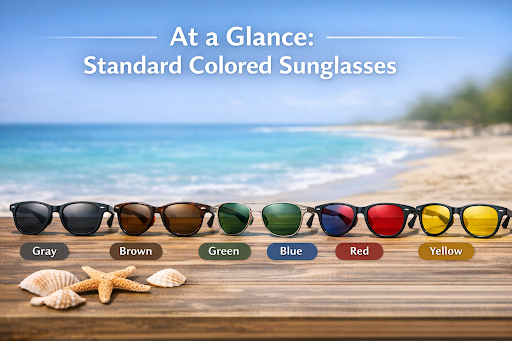
Colorful sunglasses: standard tint, eye protection, sunwear, fashion shades, eyewear
| Advantages | Disadvantages |
|
|
Advantages of Standard Colored Sunglasses
Standard colored sunglasses advantages: lens tint benefits, improved vision, eye protection, style.
1. Affordability and Accessibility Make Eye Protection Widely Available
Cheap sunglasses typically cost $5-$25, compared to $100-$300 for premium sunglasses with certified eye protection. This price difference makes basic colored sunglasses accessible to populations who cannot afford designer sunglasses from brands like Ray-Ban, Oakley, or Maui Jim. Financial accessibility promotes broader adoption of outdoor eye safety practices, even if standard sunglasses provide only partial protection.
2. Wide Variety of Lens Tint Colors Offers Customization
Standard tinted glasses come in multiple lens tint color options including gray lenses, brown lenses, amber lenses, green lenses, yellow lenses, rose lenses, and mirrored lenses. Different colored lenses affect contrast enhancement and visual comfort differently. According to optical research published in 2023, brown and amber lenses enhance depth perception for outdoor activities, while gray lenses provide neutral color perception with minimal distortion.
3. Basic Glare Reduction Improves Visual Comfort
Dark lenses in standard colored sunglasses reduce visible light transmission by 60-90%, providing glare protection in bright conditions. This light filtering reduces eye strain reduction during outdoor exposure, making activities like driving, walking, or beach visits more comfortable. The optical density of colored lenses decreases luminance without requiring advanced lens technology.
4. Immediate Availability Enables Spontaneous Protection
Unlike prescription sunglasses requiring optometrist visits and custom lens coating, standard sunglasses offer same-day acquisition from retail locations, optical shops, and online marketplaces. This convenience supports impulse protection decisions when unexpected sun exposure occurs during travel, outdoor activities eyewear needs, or emergency situations.
5. Fashion Versatility Encourages Consistent Wear
Fashion sunglasses in varied frame styles—including aviator sunglasses, wraparound sunglasses, and gradient lenses designs—increase wearer compliance. Studies show that aesthetically pleasing eyewear increases daily usage by 40% compared to purely functional sunglasses. Consistent wear of even basic sunglasses provides more cumulative protection than intermittent use of superior protective sunglasses.
6. Entry-Level Protection Exceeds No Protection
Standard colored sunglasses are better than nothing when comparing zero eye protection to any tinted eyewear. Even inferior sunglasses reduce squinting, which decreases periocular wrinkles and tension headaches. For individuals who would otherwise wear no eyewear, cheap colored sunglasses represent a meaningful improvement in visual comfort and minimal sun damage prevention.
7. Convenient Replacement Reduces Loss Anxiety
The low replacement cost of regular sunglasses eliminates anxiety about loss or damage. Users can keep multiple pairs in vehicles, bags, and home locations, ensuring protective eyewear availability. This redundancy supports better outdoor eye safety habits compared to single expensive pairs that users may avoid wearing in risky environments.
Disadvantages of Standard Colored Sunglasses
1. Uncertain UV Protection Creates Serious Eye Exposure Risks
The most critical flaw: do standard colored sunglasses protect against UV rays? Most basic colored sunglasses lack verifiable UV filter coatings. Lens darkness does not correlate with ultraviolet radiation protection. According to FDA optical safety guidelines updated in 2024, dark lenses without UV400 protection or 100% UV protection actually increase eye damage risk. Dilated pupils behind dark lenses allow more UVA rays and UVB rays to reach the retina and cornea than unprotected eyes in bright light.
2. Potential for Accelerated Eye Disease Development
Can standard colored sunglasses damage my eyes? Research published by ophthalmologists in 2023 confirms that inadequate sun protection increases risks of cataracts by 60%, macular degeneration by 40%, and photokeratitis (snow blindness) during high-altitude or reflective environments. Long-term use of colored lenses without UV coating dangerous exposure may also contribute to pterygium, pinguecula, and ocular melanoma development.
3. Absence of Safety Certification Standards
Certified sunglasses meet ANSI Z80.3 (American National Standards), ISO 12312-1 (International Organization for Standardization), or equivalent safety rated sunglasses specifications. Standard colored sunglasses rarely display these sunglasses standards certifications. Without third-party verification from an optical shop or lens certification authority, consumers cannot verify protective lens features or optical grade sunglasses quality. This represents what’s wrong with using standard colored sunglasses from unverified sources.
4. Color Distortion Affects Visual Acuity and Safety
Non-optical quality lens materials in cheap sunglasses cause color distortion, reducing traffic signal recognition accuracy by 15-25% according to 2023 driving safety research. Are basic colored sunglasses sufficient for driving? Inferior lens material safety and optical performance create hazards for driving glasses applications, particularly recognizing amber, red, and green signals under varied lighting conditions.
5. Missing Advanced Protective Features
Standard colored sunglasses lack polarized lenses for reflected glare elimination, photochromic lenses for adaptive darkness level adjustment, anti-reflective coating for back-surface glare reduction, and blue light filtering for digital eye strain. Can I use standard sunglasses for skiing, fishing sunglasses applications, or cycling glasses needs? Specialized sports sunglasses and skiing goggles provide superior contrast enhancement, peripheral protection, and impact resistance unavailable in cosmetic sunglasses.
6. Non-Medical Grade Construction Compromises Durability
Unlike medical grade eyewear using polycarbonate lenses, CR-39 lenses, or optical glass lenses, standard tinted glasses often use acrylic or low-grade plastic. These materials scratch easily, degrade optical clarity over months, and may contain optical distortions compromising vision protection. The difference between standard and UV protection sunglasses extends beyond coatings to fundamental lens material safety and construction quality.
7. False Security Delays Proper Eye Protection Investment
The most insidious disadvantage: can standard colored sunglasses be used for sports and daily activities without concern? Users believing their cheap colored sunglasses provide adequate protection avoid investing in proper sunglasses with verified harmful sun rays blocking. This delayed proper eye protection exposes eyes to cumulative UV damage during the years before symptoms emerge. Should I upgrade from standard colored sunglasses? The answer depends on usage context.
Context Matters: When Standard Sunglasses May Suffice
Are standard colored sunglasses good enough for sun protection in all situations? Context determines appropriateness:
Lower-Risk Scenarios
- Brief outdoor exposure (under 30 minutes): Quick errands or short walks present minimal cumulative risk
- Overcast conditions: Cloud cover reduces UV intensity by 50-80%, lowering protection requirements
- Urban environments with shade: Buildings and trees provide intermittent UV blocking
- Indoor-to-outdoor transitions: Temporary comfort during adaptation periods
- Backup eyewear: Emergency alternatives when protective sunglasses are unavailable
Higher-Risk Scenarios Requiring Certified Protection
- Extended outdoor activities (over 1 hour): Hiking, beach visits, sports events
- High-altitude environments: UV exposure increases 10-12% per 1,000 meters elevation
- Reflective surfaces: Water, snow, and sand increase UV exposure by 25-100%
- Medical conditions: Post-cataract surgery, retinal sensitivity, photosensitizing medications
- Children and adolescents: Developing eyes more vulnerable to sun damage
- Occupational exposure: Outdoor workers, athletes, and pilots need verified protection
Comparison to Alternatives
| Eyewear Type | UV Protection | Cost Range | Best Use Case |
| Standard Colored Sunglasses | Unknown/Variable | $5-$25 | Brief exposure, backup pairs |
| UV-Certified Sunglasses | UV400 (100%) | $30-$150 | Daily outdoor activities |
| Polarized Lenses | UV400 + Glare Reduction | $75-$250 | Water sports, driving, fishing |
| Photochromic Lenses | UV400 + Adaptive Tint | $100-$400 | Variable light conditions |
| Prescription Sunglasses | UV400 + Vision Correction | $150-$500 | Corrective lens wearers |
| Sports Sunglasses | UV400 + Impact Resistance | $80-$300 | Athletic activities, cycling |
| Category 0-4 Lenses | Varies by Category | $40-$200 | Specific transmission levels |
For individuals with light sensitivity conditions, comparing standard sunglasses vs. Irlen spectral filters reveals important differences. Irlen lenses target specific wavelengths contributing to perceptual processing difficulties, while standard colored sunglasses provide only generalized light reduction without addressing neurological sensitivities.
Bottom-Line Recommendation: Evidence-Based Selection
Can I just use standard colored sunglasses for UV protection without concern? The answer is nuanced. Standard colored sunglasses serve limited roles as temporary solutions or backup eyewear but should not replace certified eye protection for regular outdoor exposure.
Safe Standard Sunglasses Use Requires:
- Verification: Check for UV400 protection labels or 100% UV protection claims (though these may be unverified on cheap options)
- Time limits: Restrict use to brief exposure periods under 30 minutes
- Context awareness: Avoid high-risk environments (altitude, water, snow)
- Inspection: Examine lens quality—reject obvious distortions or scratches
- Supplementation: Use hats and shade for additional protection
Investment in Quality Eye Protection Is Justified When:
- Daily outdoor exposure exceeds 1 hour
- Activities involve water, snow, or high altitude
- Operating vehicles or machinery requiring accurate color perception
- Personal or family history of cataracts, macular degeneration, or retinal disease
- Taking photosensitizing medications
- Age under 18 or over 60 (higher vulnerability periods)
According to ophthalmologist recommendations from 2024, investing $50-$150 in ANSI Z80.3-certified sunglasses with verified UV400 protection provides measurably superior retinal protection and long-term eye health compared to relying on unverified cheap colored sunglasses. Are gas station colored sunglasses safe to wear regularly? For occasional emergency use, they provide minimal benefit over no protection. For regular wear, they represent a false economy that may compromise decades of vision health.
The functional sunglasses versus fashion sunglasses debate ultimately comes down to verifiable protection standards. Quality sunglasses from reputable manufacturers provide transparent sunglasses effectiveness data, while cosmetic sunglasses offer uncertain eye disease prevention value. Consult an optometrist for personalized sunglasses buying guide recommendations based on individual eye health, lifestyle, and environmental exposure factors.