



What Is the Difference Between Irlen Syndrome and Visual Stress? A Comprehensive Comparison
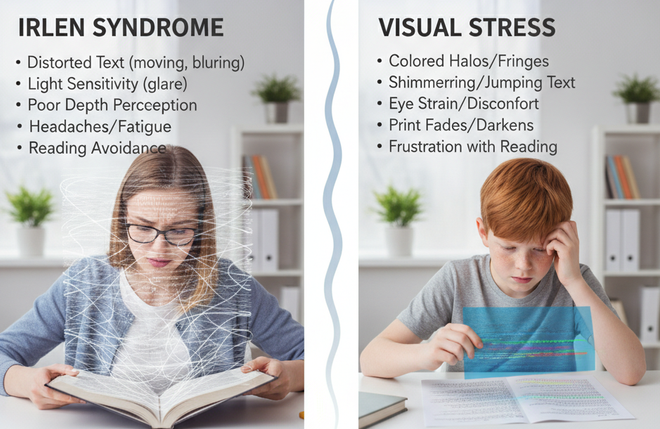
Irlen Syndrome and visual stress represent two overlapping yet distinct approaches to describing pattern-related visual perception difficulties that affect reading and visual processing. Irlen Syndrome, formally termed Scotopic Sensitivity Syndrome by Helen Irlen in 1983, refers to a neurological condition involving visual cortical hyperexcitability. Visual stress, independently described by Arnold Wilkins and colleagues in the United Kingdom during the 1980s, focuses on pattern glare and visual discomfort triggered by striped patterns and text.
Understanding Irlen Syndrome and Visual Stress: Core Definitions
Professional illustration of Understanding Irlen Syndrome and Visual Stress: Core Definitions
The distinction between these conditions lies primarily in terminology, theoretical frameworks, and diagnostic approaches rather than symptom profiles. According to research published by the College of Optometrists (2020), both conditions describe similar visual perception difficulties including text distortion, words moving on page, blurred text, eye strain, and light sensitivity. The fundamental difference centers on conceptual origin and assessment methodology rather than clinical presentation.
Irlen Syndrome emphasizes scotopic sensitivity and perceptual processing disorder originating in the visual cortex. The Irlen Method involves proprietary screening protocols administered by certified Irlen screeners using specific colored overlays and Irlen filters. Visual stress, alternatively termed Meares-Irlen Syndrome in some contexts, focuses on cortical hyperexcitability measured through pattern glare tests and the Wilkins Rate of Reading Test, typically conducted within optometry and behavioral optometry settings.
Key Characteristics: Symptoms and Manifestations
Professional illustration of Key Characteristics: Symptoms and Manifestations
Both conditions share remarkably similar symptom profiles affecting visual perception and reading efficiency:
Visual Perception Difficulties
- Print Sensitivity: Text appears to move, shimmer, blur, or develop rivers in text between words
- Perceptual Distortions: Letters change shape, words fade in and out, or background brightness fluctuates
- Pattern Sensitivity: Striped patterns, high-contrast text, and repetitive designs trigger visual disturbance reading
- Contrast Sensitivity Issues: Difficulty processing black text on white backgrounds due to glare sensitivity
Physical Symptoms of Visual Discomfort
- Reading headaches and migraine triggers associated with fluorescent lighting
- Visual fatigue and eyestrain while reading for extended periods
- Photophobia or light sensitivity, particularly to fluorescent light and glare
- Reading discomfort requiring frequent breaks or position changes
Functional Impact on Reading
- Reduced reading speed despite adequate decoding skills
- Reading comprehension difficulties unrelated to cognitive function
- Visual tracking problems and eye movement difficulties affecting text flow
- Visual attention deficit manifesting during sustained reading tasks
Diagnostic Differences: Irlen Syndrome Versus Visual Stress Assessment
The most significant practical difference between Irlen Syndrome vs visual stress lies in diagnostic methodology and professional credentials of assessors.
Irlen Syndrome Diagnosis
Testing for Irlen syndrome requires consultation with a certified Irlen screener trained in the proprietary Irlen Method. The screening process involves:
- Initial questionnaire assessing light sensitivity symptoms and reading difficulties
- Reading performance evaluation using standardized texts
- Sequential testing with colored overlays to identify optimal chromatic intervention
- Referral to Irlen diagnosticians for precision Irlen lenses calibration if overlays provide benefit
The Irlen screening typically costs between $150-$300, with Irlen filters adding $500-$1,500 (as of 2025). Insurance coverage remains limited, as many providers classify this as experimental treatment.
Visual Stress Assessment
Visual stress assessment occurs within optometric practice settings, conducted by optometrists or ophthalmologists trained in behavioral vision therapy and functional vision evaluation. The process includes:
- Comprehensive vision examination ruling out refractive errors, binocular vision dysfunction, and convergence insufficiency
- Pattern glare test measuring susceptibility to striped pattern sensitivity
- Wilkins Rate of Reading Test comparing reading speed with and without colored filters
- Intuitive colorimeter testing determining precise wavelength for precision tinted lenses
According to the British Psychological Society (2009), optometric visual stress assessment provides standardized, evidence-based measurement of visual discomfort syndrome integrated with conventional vision care.
Treatment Approaches: Colored Filters and Chromatic Intervention
Both frameworks employ color therapy vision using chromatic filters to reduce visual information processing difficulties. Treatment effectiveness depends on proper color selection rather than theoretical model.
Colored Overlays for Reading
Colored overlays benefit approximately 20% of individuals experiencing reading discomfort, according to research by Bruce Evans (2001). These transparent colored sheets placed over text reduce contrast sensitivity issues and pattern-related visual stress. Overlays cost $5-$20 per sheet and provide immediate, measurable reading speed improvement in responsive individuals.
Tinted Lenses and Spectacles
Tinted spectacles offer whole-field color filtering for individuals benefiting from overlays. Precision tinted lenses prescribed through intuitive colorimeter testing achieve wavelength accuracy within 1-2 nanometers. Irlen lenses utilize proprietary filter combinations based on Irlen diagnostic protocols. Both approaches cost $300-$1,500 for spectacles (as of 2025).
Research published in Ophthalmic and Physiological Optics (2015) found no significant outcome difference between Irlen filters and precision tinted lenses when color choice was appropriately matched to individual needs.
Scientific Evidence and Professional Acceptance
The scientific evidence for Irlen syndrome versus visual stress remains controversial within mainstream optometry and ophthalmology. The American Academy of Optometry maintains that while colored filters help some individuals with reading difficulties, the neurological mechanisms remain poorly understood.
Arnold Wilkins’s research (1995-2020) provided neurophysiological evidence linking visual stress to cortical processing disorder and temporal visual processing deficits in the magnocellular pathway. Studies using functional MRI demonstrated reduced visual cortical hyperexcitability when participants viewed text through appropriately colored filters.
The College of Optometrists issued guidance (2020) acknowledging that colored overlays and tinted lenses reduce visual discomfort for some individuals but questioned the diagnostic specificity of Irlen Syndrome as a distinct condition separate from visual stress.
Common Misconceptions: Myths Versus Reality
Myth: Irlen Syndrome and visual stress cure dyslexia or learning disabilities.
Reality: These conditions address visual perception difficulties, not phonological processing deficits underlying dyslexia. Colored filters may improve reading comfort but do not remediate core dyslexia.
Myth: Everyone benefits from colored overlays.
Reality: Only 15-20% of the population experiences measurable reading efficiency gains from chromatic intervention, according to educational psychology research.
Myth: Irlen Syndrome differs fundamentally from visual stress.
Reality: Both describe similar sensory processing vision issues with different assessment frameworks and terminology preferences.
Myth: Standard vision examinations detect Irlen Syndrome or visual stress.
Reality: Conventional optometry tests visual acuity and eye health but do not assess perceptual dysfunction or pattern sensitivity.
Relationship to Other Developmental Disorders
Visual perception disorder frequently co-occurs with ADHD, autism spectrum disorder, and learning disabilities, though causation remains unclear. Research indicates 30-40% of individuals with dyslexia experience visual stress symptoms, while 12-14% of those with autism spectrum disorder demonstrate light sensitivity and pattern glare susceptibility.
Distinguishing visual processing problems from attention deficit requires comprehensive evaluation by educational psychology professionals. Accommodative dysfunction, convergence insufficiency, and tracking problems reading represent distinct binocular vision issues requiring vision therapy rather than colored filters.
Practical Applications: Classroom Accommodations and Reading Support
Schools increasingly recognize visual stress impact on reading comprehension and provide assistive technology for visual stress reading:
- Student access to colored overlays for reading without formal diagnosis
- Modified lighting reducing fluorescent light sensitivity and glare
- Digital text with adjustable background colors and contrast ratios
- Extended time for reading-intensive tasks acknowledging reading fatigue
- Educational support for Irlen syndrome through 504 plans or IEPs
Effectiveness of Irlen lenses for visual stress in educational settings shows mixed results, with placebo-controlled studies (2019) suggesting expectation effects contribute significantly to perceived benefits.
Conclusion: Choosing Between Assessment Approaches
The choice between Irlen screening and optometric visual stress assessment depends on professional availability, cost considerations, and insurance coverage. Both pathways lead to similar chromatic intervention strategies when genuinely indicated. Individuals experiencing visual perception difficulties should begin with comprehensive optometric examination excluding refractive, accommodative, or binocular vision problems before pursuing colored filter interventions.