



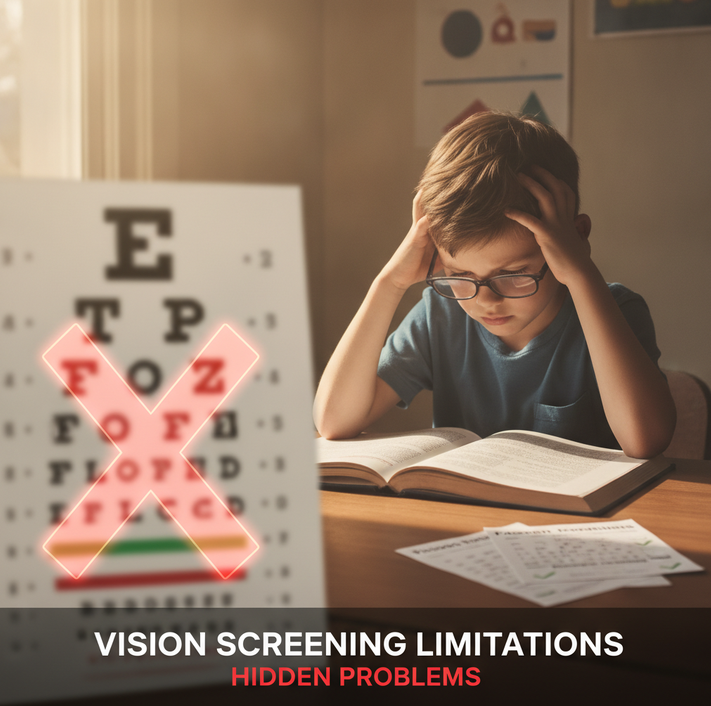
What Is the Reason Children Pass Vision Tests but Still Struggle to Read?
Children who pass vision tests but still struggle to read often have undiagnosed functional vision problems that standard screenings fail to detect. According to the American Optometric Association (2024), approximately 80% of school vision screenings test only distance visual acuity—the ability to see letters clearly on a Snellen chart from 20 feet away. These basic eye chart tests measure 20/20 vision but completely miss critical visual processing skills, eye coordination problems, and binocular vision dysfunction that directly impact reading ability.
Why Vision Screening Limitations Create Hidden Problems
Professional illustration of Why Vision Screening Limitations Create Hidden Problems
Vision screenings conducted by school nurses or pediatricians typically focus on central vision clarity. A child can achieve perfect vision test results while struggling with eye tracking ability, focusing difficulties, and eye teaming problems. The College of Optometrists in Vision Development (2024) reports that reading-related vision skills involve at least 17 separate visual functions working together simultaneously. Standard screenings evaluate only one or two of these functions.
Visual acuity testing measures static sight—the ability to identify stationary letters at a distance. Reading, however, requires dynamic visual efficiency skills including saccadic eye movements (jumping from word to word), smooth pursuits (following lines of text), convergence ability (turning eyes inward for near work), and accommodation flexibility (rapidly adjusting focus). When children have reading problems despite good vision on standard tests, parents often receive confusing messages that their child’s “eyes are fine.”
Key Visual Skills Required for Successful Reading
Professional illustration of Key Visual Skills Required for Successful Reading
The International Dyslexia Association (2023) identifies visual system development as distinct from literacy skills like phonological awareness and decoding skills. Children need integrated visual motor coordination to succeed academically:
Eye Tracking and Movement Control
Saccadic dysfunction affects a child’s ability to jump accurately from word to word. Fixation stability determines whether letters remain steady or appear to move. According to developmental optometrists, tracking skills deficits cause children to skip words, lose their place frequently when reading, or require a finger to track while reading. These visual tracking deficits often present as reading comprehension issues rather than vision problems in children.
Binocular Vision and Eye Teaming Skills
Convergence insufficiency occurs when eyes cannot maintain proper alignment during near work. The American Optometric Association estimates 5-13% of children experience this eye coordination problem. Symptoms include double vision, blurred vision when reading, headaches while reading, and visual fatigue after 15-20 minutes of homework. Children may tilt their head while reading to compensate for vergence abilities difficulties. Eye teaming problems force the brain to work harder to fuse two separate images, depleting cognitive energy needed for reading comprehension despite decoding.
Accommodation and Focusing Ability
Accommodation disorder prevents children from maintaining clear focus at reading distance or switching focus smoothly between near and far objects. Accommodative facility—the eye’s focusing stamina—deteriorates during sustained reading. Children with these focusing difficulties that interfere with reading often complain that words moving on page or experience near vision stress. They may sit very close to book when reading or avoid reading and close work entirely.
Vision Problems Not Detected by School Screening
Functional vision testing evaluates real-world visual performance. A comprehensive eye exam conducted by an optometrist or ophthalmologist assesses:
- Visual perception skills including visual discrimination ability, visual sequential memory, and pattern recognition
- Depth perception and spatial relationships necessary for letter recognition and word recognition
- Visual motor integration connecting what eyes see with hand movements for writing
- Peripheral vision awareness and visual field assessment
- Contrast sensitivity affecting ability to distinguish black print on white paper
- Visual memory and visual attention span for sight word recognition
Educational psychologists note that visual processing disorder affects how the brain interprets visual information, even when eyes function normally. Irlen syndrome, also called scotopic sensitivity, causes print sensitivity and visual discomfort from certain lighting conditions or color contrasts. These conditions require specialized vision therapy or environmental modifications.
Vision Screening vs. Comprehensive Eye Exam
| School Vision Screening | Comprehensive Vision Evaluation |
| Tests distance visual acuity only | Evaluates 17+ visual functions |
| Takes 2-5 minutes | Requires 60-90 minutes |
| Identifies 5% of vision problems | Detects functional vision issues affecting learning |
| Performed by school nurse | Conducted by developmental optometrist or vision therapist |
| No evaluation of eye coordination | Tests binocular coordination, convergence, and vergence facility |
| Does not assess reading readiness | Includes developmental vision assessment for visual skills for reading |
Common Misconceptions: Myth vs. Reality
Myth: If a child has 20/20 vision, their eyes are working properly for reading.
Reality: Normal eye chart test results only confirm distance clarity. Children need efficient saccadic movements, fusion problems resolution, and accommodative function for sustained reading performance.
Myth: Vision problems always cause obvious symptoms like squinting.
Reality: Hidden vision problems affecting reading often manifest as behavioral issues, reading avoidance, or unexplained academic struggles. Children may not recognize their visual symptoms as abnormal.
Myth: If a child passed vision screening but has reading problems, the issue must be dyslexia or a learning disability.
Reality: The vision and learning connection requires evaluation before assuming neurological causes. According to reading specialists and occupational therapists, vision-related learning disabilities account for 20-30% of reading difficulties causes.
When to See a Developmental Optometrist
Parents should seek a functional vision assessment if their child demonstrates these signs of hidden vision problems:
- Child sees clearly but struggles with reading despite adequate phonics instruction
- Complaints of headaches, eye strain, or rubs eyes frequently when doing homework
- Reading fluency problems with slow reading pace or reversals in reading
- Letter confusion problems or confuses similar looking letters like b/d or p/q
- Directional confusion affecting spatial awareness during symbol identification
- Poor reading posture problems or consistently tilts head while reading
- Skips lines or words when reading requiring constant re-reading
- Reading endurance issues—child reads well initially but deteriorates after 15 minutes
Practical Applications for Parents and Teachers
Special education teachers and reading intervention specialists recommend these action steps when a passed eye exam still can’t read situation occurs:
- Request a comprehensive eye care evaluation from an optometrist specializing in pediatric vision issues, not just a standard vision screening
- Document specific visual symptoms that affect reading including when symptoms worsen and any compensatory strategies the child uses
- Consider a visual skills evaluation by a vision therapist if the child demonstrates eye movement disorders or visual efficiency skills deficits
- Explore optometric vision therapy for reading problems if functional vision testing reveals treatable conditions like convergence insufficiency and reading problems or accommodation disorder impact on reading
- Collaborate with educational psychologists to distinguish between visual processing abilities deficits and primary reading disabilities
Visual development continues through age 12. Early identification of functional vision issues through comprehensive eye examination for children prevents years of unnecessary academic struggles and improves school performance problems. Understanding that good eyesight but poor reading ability often stems from undiagnosed vision problems not detected by school screening empowers parents to seek appropriate developmental vision assessment and intervention.