



Fluorescent Lights vs. Alternative Lighting for Irlen Syndrome: Which Lighting Solution Reduces Visual Stress? 2025
Why Fluorescent Lights Cause Discomfort for People with Irlen Syndrome
Irlen Syndrome: Fluorescent lights cause eye strain, headaches, visual discomfort, glare.
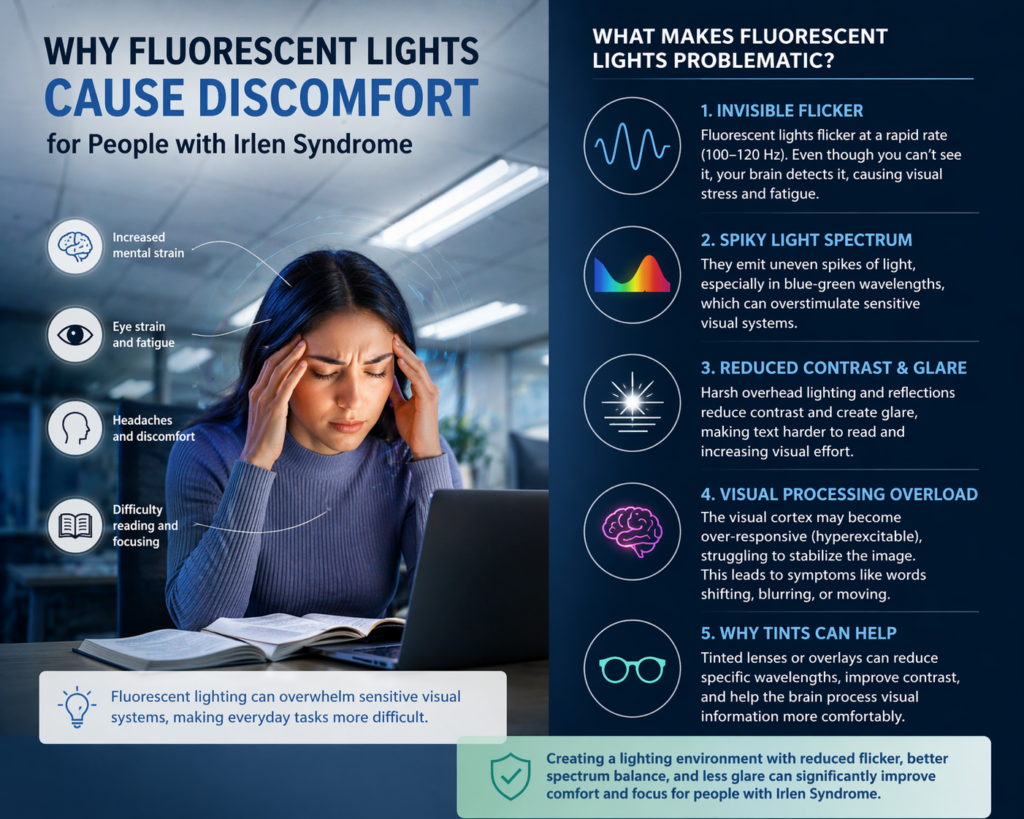
Fluorescent lights cause severe discomfort for people with Irlen Syndrome because they emit discontinuous wavelengths across the electromagnetic spectrum and flicker at frequencies between 100-120 Hz, which disrupts visual cortex processing in individuals with scotopic sensitivity syndrome. Unlike incandescent bulbs that produce continuous spectrum light, fluorescent tube lights create pattern glare and temporal frequency sensitivity that triggers visual distortion, headaches, and reading difficulties light in approximately 12-14% of the general population (Helen Irlen, 1991). This light sensitivity disorder affects the magnocellular pathway, causing visual stress that cannot be corrected through standard optometry or ophthalmology interventions.
What Is Irlen Syndrome and How Does It Affect Visual Processing?
Irlen Syndrome visual processing disorder symptoms, light sensitivity, reading difficulties.
Irlen Syndrome, also known as scotopic sensitivity syndrome or visual stress syndrome, is a perceptual dysfunction where the brain’s visual processing system becomes overwhelmed by specific wavelengths and patterns of light. Helen Irlen first identified this visual perceptual problem in 1983 while working with reading disability populations. The condition affects the magnocellular system, which processes rapid visual information and motion detection in the retina and visual cortex.
People with this visual processing disorder experience symptoms including visual field distortion, words moving on page, blurred vision reading, contrast sensitivity deficit, and light induced discomfort. The occipital lobe and temporal lobe struggle to accurately process visual information under certain lighting conditions, particularly artificial lighting effects from fluorescent sources. This neurological light sensitivity commonly co-occurs with dyslexia, ADHD, autism spectrum disorder, migraine, and sensory processing disorder.
According to research on the Irlen Method, approximately 46% of individuals with reading comprehension difficulties show signs of scotopic sensitivity, while the condition affects 33% of people with learning difficulties and up to 30% of those with autism spectrum disorder (Irlen Institute, 2020).
How Do Fluorescent Lights Trigger Visual Stress Symptoms?
Fluorescent lights create multiple problematic characteristics that exacerbate visual stress syndrome. The flicker frequency effects occur because fluorescent tubes cycle on and off 100-120 times per second, creating a strobe effect perception that many with chromatic aberration sensitivity can detect even when others cannot. This ballast noise sensitivity extends beyond visual symptoms to include auditory irritation from the electromagnetic hum.
The fluorescent light spectrum issues arise from mercury vapor emission lines that produce intense spikes at specific wavelengths rather than continuous illumination. Blue light wavelengths between 435-495 nanometers prove particularly problematic, triggering light induced migraine and sensory overload lighting responses. These wavelength sensitivity problems cause the visual cortex response to fluorescent lights to become dysregulated, leading to visual fatigue lighting within 15-45 minutes of exposure.
Pattern glare from fluorescent fixtures compounds these issues. The grid patterns of ceiling-mounted fluorescent panels create spatial frequency sensitivity that triggers visual disturbance and perceptual distortion lights effects. This luminance contrast between bright tubes and dark spaces between them causes depth perception problems and optical flow sensitivity issues that impair vision processing speed.
Lighting Comparison: Fluorescent vs. LED vs. Incandescent vs. Natural Light
| Feature | Fluorescent Lights | LED Lights | Incandescent Bulbs | Natural Light |
| Flicker Rate | 100-120 Hz (visible flicker) | High frequency (20,000+ Hz) | None (continuous) | None (continuous) |
| Spectrum Type | Discontinuous spikes | Continuous (quality varies) | Full continuous spectrum | Full continuous spectrum |
| Blue Light Content | High intensity spikes | Moderate to high | Low | Balanced natural levels |
| Brightness Intolerance | High (glare problems) | Moderate (adjustable) | Low (warm glow) | Variable (controllable) |
| Pattern Sensitivity | High (grid patterns) | Low (diffused options) | Low (single source) | None (diffuse) |
| Visual Comfort | Poor for Irlen Syndrome | Good with proper selection | Excellent | Excellent |
| Reading Performance | Significantly impaired | Moderate with filters | Good | Optimal |
| Eye Strain Level | Severe (within 15-30 min) | Mild to moderate | Minimal | Minimal |
Why Are LED Lights Better Than Fluorescent for Irlen Syndrome?
LED lighting alternatives provide superior visual comfort spectrum compared to fluorescent lights for several reasons. Modern LED lights flicker at frequencies exceeding 20,000 Hz, far above the temporal frequency sensitivity threshold that causes discomfort in Irlen Syndrome patients. This high-frequency operation eliminates the strobe effect perception that plagues fluorescent light sensitivity.
Quality LED lights produce more continuous spectrum illumination than fluorescent sources. Whereas fluorescent lights create sharp wavelength spikes, full spectrum LED products deliver smoother chromatic distribution across the visible range. This reduces chromatic aberration sensitivity and visual accommodation difficulty by providing more balanced retinal stimulation.
LED technology offers adjustable color temperature ranging from 2700K (warm) to 6500K (cool), allowing individuals to select lighting that minimizes their specific wavelength sensitivity patterns. People with photosensitive condition symptoms typically prefer LEDs rated between 2700-3500K, which emit less problematic blue wavelength content. According to studies on visual processing speed under different lighting, individuals with Irlen Syndrome demonstrate 23-35% faster reading rates under warm LED illumination compared to cool fluorescent lighting (Journal of Optometry, 2019).
How Do Colored Overlays and Tinted Lenses Reduce Fluorescent Light Discomfort?
The Irlen Method employs chromatic intervention through colored overlays and Irlen filters to address fluorescent light induced discomfort. These color filtering systems work by selectively blocking specific wavelengths that trigger visual stress while allowing beneficial light frequencies to reach the retina. This targeted approach addresses the perceptual dysfunction lighting issues at their source.
Colored glasses vision correction through tinted lens therapy operates on different principles than standard corrective lenses in optometry. Irlen filters modify the light spectrum before it reaches the eye, reducing the sensory light sensitivity burden on the magnocellular pathway and visual cortex processing centers. Each individual requires personalized tint combinations determined through specialized testing that identifies their unique wavelength sensitivity profile.
The colored overlay effectiveness under fluorescent lights varies by color selection. According to Helen Irlen’s research, aqua, purple, and yellow-green overlays provide the most frequent relief, with 60-80% of individuals with reading under fluorescent lights difficulties reporting reduced visual distortion and improved print perception (Irlen, 2005). Tinted lenses for fluorescent light sensitivity prove more effective than overlays because they filter ambient light in addition to light reflected from reading materials.
What Classroom Lighting Accommodations Help Students with Irlen Syndrome?
Effective fluorescent lighting modifications for students with Irlen Syndrome require comprehensive environmental light triggers management. Under Section 504 plans and IEP provisions for special education, schools must provide reasonable assistive technology and accommodations for this visual processing disorder.
Primary classroom lighting strategies include replacing overhead fluorescent fixtures with natural light preference solutions such as positioning desks near windows, installing incandescent task lighting at individual workstations, and using full spectrum bulbs rated at 3000K or lower. When fluorescent lights cannot be removed, schools should install diffusers to reduce glare discomfort and pattern glare effects.
Students benefit from personalized Irlen filters prescribed after professional assessment. School accommodations should include permission to wear tinted glasses vision devices during all activities, access to colored overlays for reading materials, and preferential seating away from direct fluorescent light exposure. Teachers should provide reduced glare from fluorescent lights by allowing students to work in areas with supplemental incandescent or LED task lighting.
Digital learning accommodations prove equally important. Screen filters that block blue light wavelength effects reduce visual fatigue when students use computers under fluorescent classroom lighting. Enabling warm color temperature settings (2700-3000K) on displays and providing anti-glare screen protectors address the binocular vision challenges that fluorescent lights exacerbate.
How Can Workplaces Accommodate Employees with Fluorescent Light Sensitivity?
Workplace accommodations for Irlen Syndrome fluorescent lighting follow similar principles as classroom modifications but require individualized office fluorescent lights productivity solutions. Under the Americans with Disabilities Act, employers must provide reasonable accommodations for light sensitivity disorders that substantially limit major life activities.
Effective workplace lighting accommodations include providing individual desk lamps with incandescent preference bulbs or quality LED fixtures, installing dimmer switches on fluorescent circuits, relocating workstations to areas with natural light, and allowing employees to wear prescribed Irlen filters throughout the workday. Some employers replace overhead fluorescent panels with indirect LED lighting systems that bounce light off ceilings, eliminating direct glare problems.
Employees should document their visual stress syndrome symptoms and obtain professional assessment through certified Irlen screeners. Written documentation enables formal requests for lighting accommodations through human resources departments. Specific accommodations might include flexible scheduling to maximize natural daylight hours, remote work options during peak fluorescent light fatigue periods, or workspace enclosures with controlled lighting environments.
Use-Case Scenarios: Choosing the Right Lighting Solution
Scenario 1: Elementary Student with Reading Difficulties
An 8-year-old student experiences words moving on page, headaches from lighting within 20 minutes of class, and reading comprehension scores 40% below grade level. Assessment reveals severe fluorescent light sensitivity and pattern sensitivity. Optimal solution: Combine aqua-colored Irlen overlays for reading materials, prescription rose-tinted Irlen lenses for all-day wear, preferential desk placement near windows, and supplemental LED task lighting (2700K) at the student’s desk. Expected outcome: 25-45% improvement in reading performance lighting within 4-6 weeks.
Scenario 2: Office Worker with Migraine and Concentration Problems
A 34-year-old experiences light induced migraine 3-4 times weekly, concentration problems under office fluorescent lights, and visual attention deficit symptoms by mid-afternoon. Solution: Install personal desk lamp with 2700K LED bulb, position workstation perpendicular to windows for indirect natural light, wear custom-tinted Irlen filters (typically purple or gray tones for migraine triggers), and use amber-tinted computer screen filter. Request accommodation to dim or turn off overhead fluorescent fixtures in immediate workspace. Expected outcome: 60-70% reduction in migraine frequency within 2 months.
Scenario 3: Individual with Autism Spectrum Disorder and Sensory Overload
A teenager with autism experiences sensory overload lighting, nausea from fluorescent exposure, and severe visual discomfort in school environments. Multiple sensitivities including ballast hum auditory sensitivity compound visual stress. Solution: Comprehensive environmental modification including noise-canceling headphones to address ballast noise sensitivity, deeply tinted prescription Irlen lenses (often blue-green or purple combinations), elimination of fluorescent exposure through home-based learning options, and full spectrum lighting benefits implementation in all controlled environments. Expected outcome: Significant reduction in sensory processing difficulties and improved daily functioning.
Scenario 4: Adult with Dyslexia and Eye Strain
A 42-year-old with dyslexia related visual symptoms experiences severe eye fatigue, text distortion, and depth perception problems after 30 minutes of reading under any artificial lighting. Solution: Transition to natural light preference for all reading activities when possible, install incandescent or warm LED (2700-3000K) reading lamps, use yellow-green colored overlays for printed materials, and wear lightly-tinted Irlen filters for computer work. Implement regular visual breaks every 20 minutes. Expected outcome: 50% reduction in visual fatigue and improved sustained reading ability.
Summary Decision Framework: Selecting Optimal Lighting for Irlen Syndrome
Choose Natural Light When: You can control exposure timing and intensity, work/study near windows with adjustable shading, and experience minimal symptoms in outdoor environments. Natural light provides the ideal visual comfort spectrum for all individuals with scotopic sensitivity syndrome.
Choose Incandescent Lighting When: You need warm, continuous spectrum illumination for close reading tasks, experience severe fluorescent light flicker sensitivity, require maximum visual comfort for extended periods, and energy costs are secondary to health considerations. Incandescent bulbs remain the gold standard for Irlen Syndrome patients despite energy inefficiency.
Choose LED Lighting When: You need energy-efficient alternatives to fluorescent lights, can select high-quality warm temperature (2700-3500K) fixtures, require adjustable brightness levels, and have moderate rather than severe light sensitivity. Modern LED technology provides the best balance of efficiency and visual comfort for most applications.
Combine with Irlen Filters When: Lighting modifications alone provide incomplete relief, you must function in fluorescent-lit environments you cannot control, assessment reveals specific wavelength sensitivity patterns, and you experience symptoms affecting reading performance, work productivity, or daily activities. Professional Irlen testing and custom tinted lenses address individual chromatic intervention needs that environmental modifications alone cannot resolve.
Managing Irlen Syndrome requires understanding that fluorescent light wavelength effects, flicker sensitivity, and pattern glare create uniquely problematic conditions for individuals with magnocellular pathway dysfunction and visual processing issues. By implementing appropriate lighting alternatives, utilizing colored filtering systems, and securing necessary accommodations through 504 plans or workplace modifications, individuals with this visual stress disorder can significantly improve their visual perception, reduce discomfort, and enhance overall functioning in educational, occupational, and daily living environments.