



Many individuals with perfect visual acuity experience unexplained reading difficulties, light sensitivity, and visual discomfort despite passing comprehensive eye exams. This paradox occurs because standard vision testing focuses exclusively on eye health and refractive vision testing, while Irlen Syndrome—also known as Scotopic Sensitivity Syndrome or Meares-Irlen Syndrome—is a perceptual processing deficit that standard optometry tests cannot measure. Understanding why regular eye doctors miss Irlen Syndrome requires examining the fundamental differences between eye structure examination and functional vision assessment.
Helen Irlen first identified this visual processing problem in the 1980s, revealing that traditional eye testing methodology overlooks brain-based vision issues affecting how the Visual Cortex processes visual information. This neurological vision condition involves wavelength-specific sensitivity and pattern sensitivity that ophthalmologists and optometrists are not trained to detect through conventional vision tests. The distinction between what eye exams test for specifically versus what Irlen Syndrome affects creates a diagnostic gap that leaves millions undiagnosed.
What Standard Eye Exams Actually Measure: Visual Acuity vs. Visual Processing
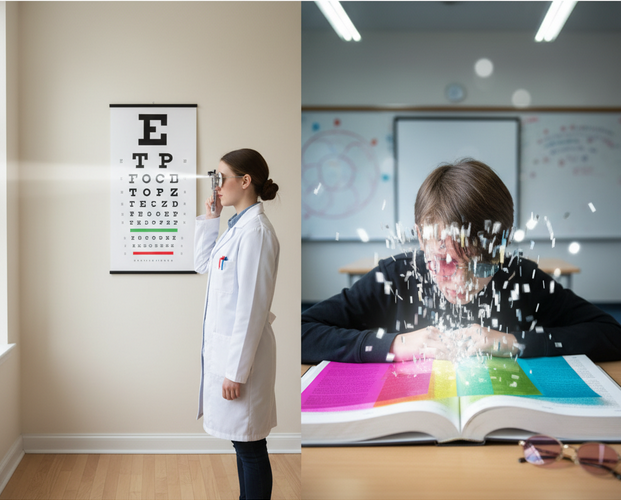
Eye exam measures: Visual acuity, processing, Irlen Syndrome, Helen Irlen.
Comprehensive eye exams conducted by an Ophthalmologist or Optometrist focus on measuring visual acuity measurement through the Snellen Chart, conducting Refraction Tests to identify refractive errors, performing Retinal Examination, Slit Lamp Examination, and Tonometry to assess intraocular pressure. These refractive testing only procedures evaluate the physical eye health and optical focusing ability, determining whether corrective lenses can achieve 20/20 vision. The medical eye exam protocol established by the American Academy of Ophthalmology and American Optometric Association specifically targets structural eye problems.
However, these acuity-based testing methods cannot detect perceptual processing dysfunction occurring in the Visual Cortex and Magnocellular Pathway. Irlen Syndrome affects temporal visual processing and spatial frequency sensitivity, causing print perception problems and visual distortion perception that occur after light correctly enters the eye. This explains why 20/20 vision doesn’t rule out Irlen Syndrome—the eyes themselves function properly, but the brain misprocesses the incoming visual information, particularly under specific lighting conditions and pattern stimuli.
Irlen Syndrome as a Perceptual Processing Disorder

Irlen Syndrome visual stress: Perceptual processing disorder affecting reading, vision. Helen Irlen, Scotopic Sensitivity
Unlike refractive errors or eye diseases, Irlen Syndrome represents a Visual Processing Disorder where the brain struggles with environmental light sensitivity and contrast sensitivity dysfunction. Individuals experience Pattern Glare when viewing striped patterns, text, or high-contrast materials. These visual perceptual difficulties manifest as reading discomfort, text reading difficulty, headaches while reading, and eye fatigue reading despite having structurally healthy eyes. The condition shares symptom overlap with Dyslexia and Learning Disabilities but requires distinct chromatic intervention through Irlen Spectral Filters.
The neurological nature of this brain-based visual problem means that standard vision screening designed to identify optical imperfections simply cannot detect the wavelength sensitivity underlying scotopic sensitivity. Research suggests dysfunction in how the brain processes different light wavelengths, particularly affecting individuals sensitive to fluorescent lighting, bright environments, and certain color spectra. This photosensitivity disorder creates visual stress syndrome that no amount of traditional lens prescription can address.
The Specialized Irlen Syndrome Screening Process
Diagnosing Irlen Syndrome requires assessment by a certified Irlen Screener or Irlen Diagnostician trained through the Irlen Institute. This specialized vision evaluation uses color overlay benefit testing, where individuals read text through various Color Overlays to identify which specific wavelengths reduce visual stress symptoms. The perceptual screening test examines reading strain symptoms, visual comfort issues, and how different Tinted Lenses affect reading efficiency. This functional vision analysis differs fundamentally from optical health checks conducted during routine eye examinations.
The tint prescription process involves systematic testing with Irlen Filters, Chromagen Lenses, ColorMax, or Precision Tints to determine the precise wavelength combination that eliminates visual distortions. Some Behavioral Optometrists trained in developmental vision may recognize Irlen-related symptoms and refer patients for specialized testing. However, most conventional optometry practices lack the equipment and training for this alternative vision assessment, creating the perception gap where individuals pass eye exams yet continue experiencing significant reading difficulties with perfect eyesight.
| Standard Eye Exam | Irlen Syndrome Screening |
| Measures visual acuity (20/20 vision) | Assesses perceptual processing efficiency |
| Tests eye structure and health | Evaluates brain-based visual processing |
| Identifies refractive errors | Detects wavelength-specific sensitivity |
| Uses eye charts and retinal imaging | Uses colored overlays and reading tasks |
| Performed by optometrists/ophthalmologists | Conducted by certified Irlen diagnosticians |
Bridging the Diagnostic Gap: When to Seek Irlen Testing
Individuals should consider Irlen screening if they experience unexplained reading problems despite good vision, including symptoms such as print appearing to move or blur, light sensitivity not found in regular eye tests, frequent headaches triggered by reading or fluorescent lights, or difficulty maintaining focus on printed material. Educational Psychologists, Occupational Therapists, and Reading Specialists increasingly recognize these learning-related vision indicators. Schools rarely conduct vision screening that includes functional vision problems, making parental awareness crucial for identification.
The College of Optometrists and various professional organizations continue debating Irlen Syndrome’s classification and treatment efficacy. However, thousands of individuals report significant improvement with colored filters for reading, suggesting real benefits from this chromatic intervention approach. Parents of children with reading difficulties should request both a comprehensive vision exam and separate Irlen evaluation, as these assessments address different aspects of visual function. Special Education programs may include accommodations such as a 504 Plan for students diagnosed with visual stress syndrome affecting academic performance.
Frequently Asked Questions
Can you have perfect vision and still have Irlen Syndrome?
Yes, absolutely. Irlen Syndrome is a perceptual processing disorder affecting how the brain interprets visual information, not an eye health problem. Many individuals with 20/20 visual acuity have Irlen Syndrome because standard vision tests only measure whether the eyes focus light correctly onto the retina. The Visual Cortex processing dysfunction occurs after visual information enters healthy eyes, which explains why optometrists and ophthalmologists don’t detect it during routine examinations.
Who can diagnose Irlen Syndrome properly?
Only certified Irlen Screeners and Irlen Diagnosticians trained through the Irlen Institute can officially diagnose Irlen Syndrome and prescribe Irlen Spectral Filters. While some Behavioral Optometrists recognize the condition and may use similar colored overlay therapy approaches, the formal Irlen testing methodology requires specific certification. Standard optometrists and ophthalmologists are not trained in this specialized vision evaluation, which is why separate assessment is necessary even after passing comprehensive eye exams.
Why don’t optometrists test for Irlen Syndrome during regular eye exams?
Standard optometry protocols focus on measuring visual acuity, refractive errors, and eye disease detection—not perceptual processing assessment. Optometrists use equipment designed to examine eye structure and optical focusing, such as Snellen Charts, refraction instruments, and retinal imaging. Irlen Syndrome testing requires specialized color overlay systems and functional reading assessments that aren’t part of conventional optometric training or equipment. The professional scope of standard eye care simply doesn’t include neurological vision problems occurring in the Visual Cortex.
What is the difference between an eye exam and Irlen screening?
A comprehensive eye exam evaluates eye health, visual acuity, and refractive status to ensure the eyes function properly as optical instruments. Irlen screening assesses how the brain processes visual information, focusing on reading comfort, pattern sensitivity, light sensitivity, and visual perceptual difficulties. Eye exams use medical equipment to examine physical structures; Irlen testing uses colored overlays and reading tasks to identify wavelength-specific sensitivity. Both assessments address different aspects of vision—one targets optical hardware, the other examines perceptual software processing.