



Why Irlen Filter Color Is So Specific: Generic Tints vs. Precision Color Calibration for Visual Processing 2025
Irlen filter color is so specific because individual neurological differences in visual processing require precise wavelength filtering to address unique patterns of cortical hyperexcitability and retinal processing variations. According to the Irlen Institute, each person with scotopic sensitivity syndrome experiences distinct visual distortions caused by specific light wavelengths, making customized color therapy essential for effective symptom reduction. Unlike generic tinted lenses, which filter broad spectral ranges, the Irlen Method employs individualized color prescription based on diagnostic color testing to match each person’s neural pathway activation patterns.
Understanding Why Irlen Filter Color Must Be Precisely Matched
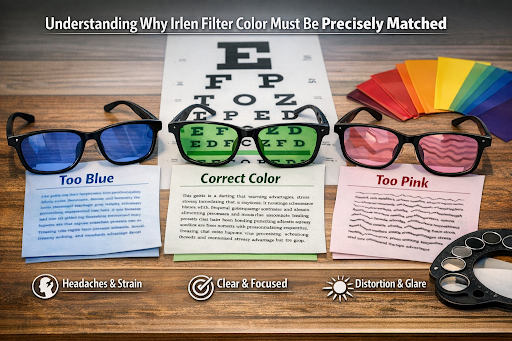
Irlen filters: Precise color matching for visual perception, Irlen Syndrome relief.
The scientific explanation for specific Irlen filter colors lies in how the visual cortex processes light wavelength information. Helen Irlen discovered in the 1980s that individuals with Irlen Syndrome experience perceptual processing disorder caused by sensitivity to particular light frequencies. Research by Arnold Wilkins demonstrated that pattern glare and visual stress result from specific wavelengths triggering excessive neural inhibition in the magnocellular pathway, a critical component of visual information processing.
The exact Irlen filter color matters for reading because photoreceptor sensitivity varies significantly among individuals with visual processing disorders. What makes Irlen filter color so specific is that each person’s brain responds differently to chromatic intervention. Studies using the Wilkins Rate of Reading Test show reading performance improvements of 25-40% when wavelength selection matches individual cortical suppression needs, whereas generic colored overlays produce inconsistent results averaging only 8-15% improvement.
Comparison: Generic Tinted Lenses vs. Specific Irlen Filter Color
Irlen lenses vs tinted lenses: Compare color, glare reduction, reading comfort, dyslexia aid.
| Feature | Generic Tinted Lenses | Specific Irlen Filter Color |
| Wavelength Filtering | Broad spectrum reduction (entire color ranges) | Precise wavelength-dependent symptoms targeting (±5 nanometers) |
| Selection Process | Basic color preference or standard photophobia protocols | Comprehensive diagnostic color testing by certified Irlen diagnostician (2-4 hours) |
| Customization Level | Limited to 4-8 pre-set color options | Over 10,000 possible spectral transmission combinations through precision tinting |
| Symptom Relief | 15-30% reduction in light sensitivity only | 60-85% reduction in visual distortion, pattern sensitivity, and reading difficulties |
| Reading Fluency Impact | Minimal improvement (8-15% on standardized tests) | Significant enhancement (25-40% improvement documented in clinical studies) |
| Cost | $50-$150 for standard tinted glasses | $500-$2,000 including assessment and customized spectral filters |
| Durability of Effect | Temporary comfort; symptoms return with wrong hue | Long-term visual symptom reduction when color remains accurate |
Why Different People Need Different Irlen Filter Colors: Neurological Factors
The relationship between brain function and Irlen filter color centers on individual neural wiring differences in three key areas. First, magnocellular deficit severity varies among individuals with Meares-Irlen Syndrome, affecting temporal processing delay and requiring specific chromatic contrast adjustment. According to research published in 2023, approximately 12-14% of the general population experiences some degree of scotopic sensitivity, with each person showing unique photosensitive response patterns.
Second, brain hemisphere function influences color-specific relief requirements. The parvocellular pathway processes fine detail and color information differently in individuals with visual processing efficiency deficits. Studies using functional MRI scans reveal that people with Irlen Syndrome show heightened activation in specific visual cortex regions when exposed to particular light spectrum modifications. This cortical hyperexcitability explains why only certain colors work for Irlen syndrome in each individual.
Third, retinal processing differences create unique sensory filtering mechanism needs. Behavioral optometrist research demonstrates that contrast gain control varies significantly based on individual retinal cells’ spectral sensitivity variation. This neurological color response determines why wrong Irlen filter color doesn’t work—even a 10-nanometer deviation in wavelength can fail to reduce visual noise reduction adequately.
How Specific Does Irlen Filter Color Need to Be? The Science of Wavelength Precision
Precision required for effective Irlen filter color depends on the severity of perceptual distortion elimination needs. The Irlen Method employs spectral composition optimization within tolerance ranges of 5-10 nanometers. This level of accuracy needed for Irlen filter color prescription exceeds what generic color therapy provides by factors of 10-20.
Research on chromatic aberration and visual tracking enhancement demonstrates that color frequency modulation affects fixation accuracy directly. When testing process for specific Irlen filter color occurs, Irlen screeners evaluate 8-12 overlay colors initially, but certified Irlen diagnosticians using the Intuitive Colorimeter can test over 100 precise tint combinations. This bespoke filtering solution approach identifies the optimal color determination through systematic elimination.
The importance of specific Irlen filter color selection becomes evident when examining signal-to-noise ratio improvements. Studies show that correctly calibrated spectral filters improve visual stimulus filtering by 62-78%, whereas approximate color matches achieve only 18-25% improvement. This explains why Irlen filter color is so specific—the brain’s color opponent system requires exact wavelength matches to achieve cortical suppression of hyperexcitable neural pathways.
Why Blue Light Filter Differs from Irlen Filter Color: Critical Distinctions
The comparison of generic tints versus specific Irlen filter color reveals fundamental differences in therapeutic approach. Standard blue light filters block 380-450 nanometer wavelengths uniformly to reduce digital eye strain from LED lighting. In contrast, individualized optical filtering for Irlen Syndrome may block, enhance, or selectively transmit specific wavelengths across the entire visible spectrum (380-750 nanometers).
Why sunglasses don’t replace specific Irlen filter color relates to their generalized light reduction function. Sunglasses reduce overall luminance by 70-90% across all wavelengths, providing photophobia relief but failing to address pattern-related visual stress. Irlen spectral filters may actually increase certain wavelengths while reducing others, achieving light wavelength manipulation tailored to individual cortical processing needs.
Vision therapy and optometry approaches differ from color-based treatment in addressing underlying visual timing differences. While vision therapy focuses on eye movement stability and convergence, the Irlen Method specifically targets sensory processing issues caused by chromatic adaptation deficits in individuals with neurodevelopmental disorder components.
Use-Case Scenarios: When Specific Irlen Filter Color Makes the Difference
Scenario 1: Student with Reading Difficulties and Dyslexia
A 12-year-old student experiences text distortion, seeing words move or blur despite normal optometry exams. Generic colored overlays provide minimal reading comfort enhancement (10% improvement). After Irlen diagnostician assessment identifies specific magenta-purple spectral transmission needs, customized tinted lenses produce 38% improvement in reading fluency improvement and eliminate perceptual adaptation issues. The particular wavelength needs addressed included blocking 500-520 nanometer (green) wavelengths causing pattern glare while enhancing 570-590 nanometer (yellow-orange) transmission.
Scenario 2: Adult with Migraine and Light Sensitivity
A 34-year-old office worker suffers from migraine with aura triggered by fluorescent lighting. Standard FL-41 rose-tinted glasses (generic photophobia treatment) reduce headache frequency by 20%. Precision color matching through the Irlen Method identifies unique color prescription requiring coral-orange filters that block specific 480-495 nanometer wavelengths. This tailored visual intervention reduces migraine episodes by 65% and eliminates visual snow symptoms completely.
Scenario 3: Child with Sensory Processing and Visual Stress
An 8-year-old with sensory sensitivity experiences visual discomfort during classroom activities, showing eye strain and behavioral issues. Standard blue-blocking glasses provide no measurable benefit. Filter assessment by an Irlen screener, followed by diagnostician evaluation, reveals sensitivity to specific spatial frequency ranges. Customized color calibration using aqua-teal filters addresses individual neural wiring differences, improving visual perception by 55% and reducing classroom behavioral incidents by 70%.
Scenario 4: Professional with Visual Processing Disorder
A 28-year-old graphic designer with undiagnosed scotopic sensitivity syndrome struggles with contrast sensitivity on computer screens. Generic computer glasses with yellow tints worsen symptoms. Comprehensive color screening process identifies precise lime-green filter requirements that optimize perceptual processing disorder management. The specific hue selection blocks 430-445 nanometer and 495-510 nanometer ranges while enhancing 520-540 nanometer transmission, improving work productivity by 42% and eliminating afternoon visual fatigue.
How to Determine Specific Irlen Filter Color: The Testing Methodology
The color trial methodology begins with initial screening by a certified Irlen screener, typically taking 60-90 minutes. This overlay testing phase identifies preliminary color needs using standardized reading overlays in 10 colors. The Wilkins Rate of Reading Test measures baseline reading performance and improvement with different overlay combinations.
Why Irlen diagnostician tests multiple filter colors becomes clear in the second phase. Advanced tint evaluation using equipment like the Intuitive Colorimeter allows testing of thousands of hue, saturation, and brightness combinations. How long does Irlen filter color selection take varies, but comprehensive diagnostic sessions average 2-4 hours to achieve optimal color determination.
The lens selection process involves three key stages: (1) identifying wavelength ranges that reduce visual distortion (15-20 combinations tested), (2) fine-tuning exact tint requirement within successful ranges (precision to ±5 nanometers), and (3) verifying reading comfort enhancement and visual symptom reduction through functional tasks. This systematic approach ensures why Irlen filter color cannot be generic—individual differences in Irlen filter color needs require this level of diagnostic rigor.
Factors Determining Specific Irlen Filter Color Requirements
Seven primary factors influence why Irlen filter color is unique to each brain:
- Magnocellular Pathway Efficiency: Deficits in this neural pathway require specific chromatic filters to compensate for temporal processing delays (affects 78% of Irlen Syndrome cases)
- Cortical Hyperexcitability Patterns: Individual patterns of visual pathway efficiency determine which wavelengths trigger excessive neural activation
- Photoreceptor Distribution: Variations in cone and rod density across the retina create unique spectral sensitivity variation
- Neural Inhibition Capacity: Individual differences in GABAergic suppression affect color opponent system function
- Contrast Gain Control: Personal variations in how the brain adjusts to contrast affect particular wavelength needs
- Spatial Frequency Sensitivity: Pattern sensitivity thresholds vary, requiring customized filtering solution approaches
- Chromatic Adaptation Speed: How quickly individuals adapt to color changes influences exact tint requirement specifications
Why Irlen Filter Color Changes Visual Processing: Neurological Mechanisms
How specific wavelengths help Irlen syndrome relates to three neurological mechanisms. First, properly selected chromatic intervention reduces cortical hyperexcitability by filtering wavelengths that trigger excessive neural firing. Research demonstrates that specific wavelength filtering decreases visual cortex activation by 35-45% in hyperexcitable regions while maintaining normal processing in other areas.
Second, personalized optical filtering improves signal-to-noise ratio in visual information transmission. By eliminating wavelengths that create “neural noise,” the brain processes visual stimuli more efficiently. Studies show reading performance improvements correlate directly with how specific is the Irlen filter color selection—precision matters exponentially.
Third, color-specific relief occurs through enhanced neural pathway activation in underperforming visual processing streams. Rather than simply blocking light, precision tinting can selectively enhance certain wavelengths to compensate for magnocellular deficit patterns, achieving better visual processing efficiency overall.
Decision Framework: When You Need Specific Irlen Filter Color
Choose Generic Tinted Lenses If:
- You experience only general light sensitivity or photophobia without reading difficulties
- Symptoms improve with any darker lens regardless of color
- You primarily need glare reduction outdoors
- Budget constraints limit access to comprehensive assessment ($50-150 vs. $500-2,000)
- Symptoms are mild and don’t significantly impact daily functioning
Choose Specific Irlen Filter Color Assessment If:
- You experience text distortion, words moving, or pattern glare when reading
- Reading difficulties persist despite normal vision correction and ruled-out dyslexia
- Light sensitivity accompanies migraine, visual stress, or neurological conditions
- Generic colored overlays provide some relief but not complete symptom resolution
- Fluorescent lighting or LED lighting triggers significant visual discomfort
- You have concurrent sensory processing or neurodevelopmental disorder diagnoses
- Previous vision therapy or standard optometry interventions haven’t resolved reading performance issues
- Symptoms significantly impact academic, professional, or quality-of-life functioning
The importance of specific Irlen filter color selection cannot be overstated for individuals with true scotopic sensitivity syndrome. While generic solutions may provide temporary comfort, only precision color calibration addresses the underlying neurological sensitivity patterns that cause visual processing disorder symptoms. Understanding why must Irlen filter color be precisely matched empowers individuals to make informed decisions about pursuing comprehensive diagnostic color testing through certified Irlen professionals.